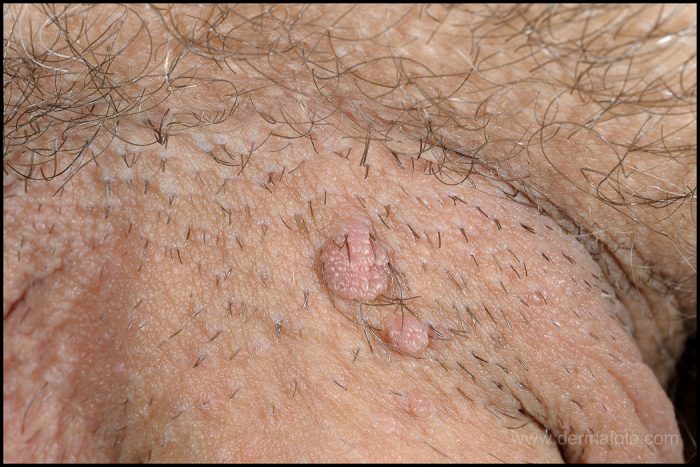
HPV infection
PART 2: DIAGNOSIS, TREATMENT, AND FREQUENTLY ASKED QUESTIONS
DIAGNOSIS OF GENITAL WARTS
Which doctor should I see if I think I have genital warts or seek treatment?
Sexually transmitted diseases are part of Dermatology, and the treatment of condylomas is prescribed by a dermatologist in the vast majority of cases. In the case of women, in addition to the visit with the dermatologist, a gynecological examination is mandatory to rule out an alteration in the cervix (through a cytology).
How are genital warts diagnosed?
The diagnosis of condylomas is, in the vast majority of cases, clinical. This means that, through visual examination, the dermatologist is able to diagnose them without the need to perform any test. In cases of doubt, a skin biopsy can be carried out, to observe the suspicious lesion under a microscope, although this is not a common procedure. It is also possible to use acetic acid. The application of this substance on the skin allows detecting if there are cells infected by HPV, since that area turns white. The positive predictive value of this test is very low, so it is currently in disuse. The diagnostic method used does not modify the treatment of warts.
How can I know what type of virus is causing warts?
First of all, it should be noted that it is not strictly necessaryto know which subtype of virus is the cause of the infection, as they do not support the diagnosis and the treatment is the same for all HPVs. It is not recommended as a routine study for diagnosis. Knowing the type of virus causing the infection will provide us with information about the potential oncogenic risk of the strain (low, medium or high oncogenic risk) and reinforces the need to be more cautious with gynaecological check-ups in the case of women. To find out the subtype of virus, a skin and lesion smear can be carried out, by scraping the skin with a cotton swab and sending the sample to the microbiology laboratory for a test called PCR (polymerase chain reaction). The result is available in a typical term of 7 – 10 days.
TREATMENT OF GENITAL WARTS
Which doctor treats genital warts?
Sexually transmitted diseases, including condylomas, are part of Dermatology and the professional in charge of treating them is the dermatologist. However, for lesions inside the vagina and to perform the cytological examination in women, it is strictly necessary to consult with Gynecology.
How is HPV infection treated?
It is considered that, theoretically, HPV infection is cured spontaneously within a period of 3-4 years thanks to the patient’s immune system, although there are many variables that influence this phenomenon and it is not uncommon for cure not to occur in this time. There are numerous therapeutic options for the removal of genital warts , such as the application of podophyllotoxin or physical destruction through cryotherapy, electroscalpel, CO2 laser and photodynamic therapy. Among these methods, the most frequently used due to its simplicity is cryotherapy, although the highest success rates are obtained with CO2 laser and photodynamic therapy.
The therapeutic methods discussed deal only with the ‘visible’ part of the disease and are aimed at eliminating warts. If the infection is not very active (few lesions, slow growing and with a stable course for months), most of the time it is a sufficient therapy. In case of signs of active infection, not only can the visible virus be physically eliminated, but the immune response to HPV can be favored through the application of imiquimod. This substance, applied topically by the patient himself, favors the enhancement of a natural immune response against the virus that manages, in most cases, to end the manifestations of the disease. In addition to imiquimod, a sinecatechin cream is currently available, which also has an immunological action.
FREQUENTLY ASKED QUESTIONS ABOUT HUMAN PAPILLOMAVIRUS INFECTION AND GENITAL WARTS
Is there prevention for the spread of HPV?
Practically 80% of the general population is infected with HPV and it is very difficult to avoid exposure if you have sexual intercourse. The virus is present not only in visible warts but also in healthy skin around the genitals, pubis, perineum and anus. The condom does not cover so much of the skin and it is very likely that despite using it you will come into contact with the virus. However, all medical guidelines recommend using it routinely. The present author recommends the use of condoms as a precaution to avoid the physical effect of HPV inoculation at the bottom of the vagina during penetration, to try to reduce the risk of involvement of the cervix, and the same for oral or anal sex. Currently, there is a vaccine against high-risk HPV serotypes, with the potential to cause cancer. These serotypes are 6, 11, 16 and 18. This vaccine is routinely applied in the vaccination schedule to the female population between 11 and 14 years of age. If it is applied before exposure to the virus, it produces immunity against these serotypes (not against the rest), which are potentially dangerous to health. In men and women already exposed to HPV and even with condylomas, it is unknown if there is a protective or accelerating effect on the resolution of the lesions, although there are some studies that have yielded positive results. In any case, it is not a routine practice and each patient will be personally evaluated to assess the convenience of vaccination.
Can condylomas appear even if you have a stable sexual partner without other risky relationships? And without having had recent sexual relations?
Yes. There are several factors that explain why condylomas can appear despite having a stable partner, without the need for risky relationships at the time the warts appear. The latency period between contact with the virus and the appearance of warts (if they appear at all) is highly variable and depends on the subtype of virus, the amount of inoculum and the immune system of each person, among other factors. It is impossible to know exactly when the risky contact that justifies the condylomas that appear today occurred.
How does the human papillomavirus affect my relationship?
The vast majority of adults have been in contact with the human papillomavirus, and only a minority will express genital warts , depending on their immune system, viral load and HPV serotype. The person who has genital warts should consult a dermatologist (and gynaecologist in the case of the woman), but in general it is not advisable for the couple to pass any medical examination if they are asymptomatic. The author of this article considers that women, despite being asymptomatic, should undergo a Pap smear to assess whether the uterine cervix is affected. It is now considered that it is not necessary to vary sexual practices with the stable partner after the diagnosis of genital warts, since they have probably already been exposed to HPV and the possibility of infection depends mainly on their immune system, and not on the use of condoms.
If most adults have been in contact with HPV, can I stop using the pre-preventive in relationships with new partners?
No. The condom does not completely protect against contact with HPV, although it does reduce the chances of its contagion and is very effective in the prevention of other transmitted diseases such as syphilis, chancroid, hepatitis and human immunodeficiency virus (HIV).
I have genital warts, will I get cancer for this reason?
The probability that this will happen is lower. HPV infection can be caused by many different serotypes, and only some have a potential risk of causing cancer. Most genital warts are caused by serotypes with low oncogenic risk . However, in the case of women, it is advisable to undergo periodic cytological examinations with their gynecologist to rule out cervical involvement; and in the case of receptive anal intercourse or HIV infection, it is also recommended to perform an anal and rectal examination (rectoscopy).
Having infection with a high-risk serotype does not mean that cancer will develop. The probability of this is not high. However, it is advisable to carry out regular check-ups with your dermatologist and gynaecologist to prevent it from occurring or being detected early.
KEY POINTS ABOUT THE HUMAN PAPILLOMAVIRUS
→ Up to 80% of the sexually active population has been in contact with HPV, which is the most common sexually transmitted disease. A small percentage of infected subjects suffer from visible genital warts .
→ HPV infection increases the risk of cervical cancer (women) and/or anorectal cancer (women and men). Most of the viruses that cause warts are of low oncogenic risk. If genital warts are detected, it is recommended to consult the dermatologist and gynecologist as soon as possible, who will indicate the procedure to follow.
→ Most genital warts will resolve spontaneously or through medical treatment , which obtains better results the earlier the consultation. Each treatment is individual and personalized for the patient.
→ Medical treatment is carried out by removing the warts in a first phase, and there is also the option of boosting the natural immune response against the virus in a second stage. Consult your dermatologist and gynecologist.
→ The use of condoms reduces the risk of infection against HPV, but not completely. It is recommended to use it in sporadic relationships and with new partners, not only for HPV but also for other sexually transmitted diseases.
→ The incubation time and manifestation of the infection is very variable and it is impossible to know which partner transmitted HPV. They can even appear with a stable partner without the latter being the transmitter, or after a more or less long period without having had sexual intercourse.
→ HPV should not have an excessive influence on sexual relations with the stable partner.
You can watch this video, where Dr. Dídac Barco explains more details about HPV:
→ Click here to learn how condylomas are diagnosed and treated.
→ Click here for information on laser condyloma removal.
REFERENCES
· Scheinfeld N, Lehman DS. An evidence-based review of medical and surgical treatments of genital warts. Dermatol Online J. 2006 Mar 30; 12(3):5.
· Tchernev G. Sexually transmitted papillomavirus infections: epidemiology pathogenesis, clinic, morphology, important differential diagnostic aspects, current diagnostic and treatment options. An Bras Dermatol. 2009 Aug; 84(4):377-89.
ACKNOWLEDGEMENTS
To Dr. Leo Barco for giving us his images. Consult the Dermatology atlas on-line Dermafoto.