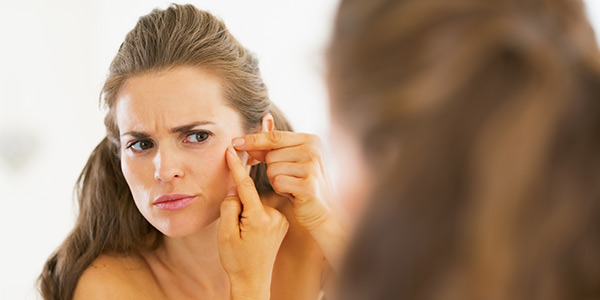
What is adult female acne?
It is defined as acne that appears or remains beyond 25 years of age. The prevalence of acne in the adult population is 41 – 54% in women and 34 – 40% in men.
Late-onset acne, defined as acne that appears after the age of 25, has a frequency of 18% in women and 8% in men. Although in most patients with acne it usually appears during adolescence, it is possible that it appears for the first time in adulthood without having previously suffered from it.
This difference in frequency between women and men increases as age increases, and in adults it is more common for women to have more severe acne than men.
Is it very common?
Yes. In addition to the prevalence data mentioned, two thirds of the acne visits made in Dermatology are by women, and one third by girls over 25 years of age.
What characterizes women’s acne?
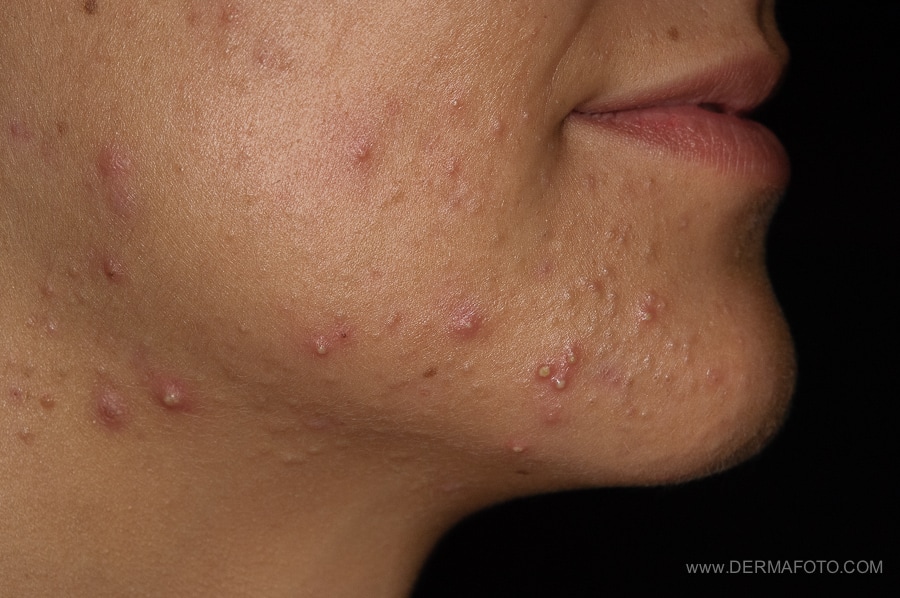
It is usually located in the lower third of the face with greater intensity, settling mainly on the jaw and chin. Although papules, pustules and nodules are usually observed, the predominant lesion is usually the comedo (pimple). Up to half of the patients have scars and hyperpigmentation secondary to the lesions, and in 97% of cases the inflammatory lesions are manipulated (scabs and excoriations). Almost 80% of women with acne report that it worsens a few days before menstruation. Some studies conclude that the psycho-social impact of acne in adult women has an impact similar to that of psoriasis.
Why does adult female acne appear?
The main cause of acne in women is hyperandrogenism. Androgens are male hormones, also present in the bloodstream of women. When the action of these hormones is excessive, we speak of hyperandrogenism. The signs of hyperandrogenism in women include all or some of the following manifestations: seborrhea (excess sebum), acne, hirsutism (excess hair in certain areas of the body) and androgenic alopecia (progressive hair loss of central involvement). The main cause of hyperandrogenism in young women, present in up to 80% of cases, is polycystic ovary syndrome.
A second reason for women to develop acne is the use of inappropriate cosmetics (cosmetic acne). In this case, comedones (pimples) are especially relevant and it is due to the occlusion of the sebaceous gland due to the application of fatty products (not oil-free or comedogenic).
When should hyperandrogenism be suspected in women with acne?
Acne associated with hyperandrogenism is usually distributed more noticeably in the lower third of the face, including the sides of the neck. Other skin signs are common in addition to acne (androgenic alopecia, severe seborrhea, hirsutism). Likewise, through the medical history, it is necessary to look at the presence and regularity of the menstrual cycle and other manifestations that may be associated with polycystic ovary syndrome (amenorrhea – lack of menstruation, oligomenorrhea – less than 8 periods/year, overweight, tendency to hyperglycemia, ovarian ultrasound with the presence of cysts, difficulty conceiving). Physical examination may show other signs of hyperandrogenism, such as a decrease in breast size, increased muscle mass, clitoromegaly or change in tone of voice.
A basic antecedent that points to the presence of hyperandrogenism is the rapid relapse of acne after finishing treatment with isotretinoin.
What studies should be carried out if acne is suspected due to hyperandrogenism in women?
Once acne of androgenic cause is suspected, it is essential to perform an androgenic hormonal profile in a blood test performed between the second and fifth day of menstruation. It is important that the patient is not taking oral contraceptives: if necessary, they will be suspended and after three menstrual cycles the analysis will be carried out. In it, your dermatologist will ask you for different male hormones that can guide the origin of the condition: testosterone, dihydrotestosterone, androstenedione, dihydroepiandrosterone sulfate (DHEAS), 17 hydroxyprogesterone, sex globulin-binding hormone (SHBG), prolactin, free androgen index, luteinizing hormone and folliculotropic hormone (LH, FSH). Certain alterations in androgen levels can lead to one condition or another (polycystic ovary syndrome, congenital adrenal hyperplasia, androgen-secreting tumor). Undoubtedly, the most frequent cause of hyperandrogenism is polycystic ovary syndrome. It is also advisable to perform an ovarian ultrasound if it has not been performed recently (although, curiously, it is not necessary to see ovarian cysts for the patient to suffer from polycystic ovary syndrome).

How is acne secondary to hyperandrogenism treated?
The treatment will depend on the underlying cause. In the case of polycystic ovary syndrome , there are different options. You can also choose to use only an antiandrogen such as spironolactone, which will also improve other hyperandrogenic signs such as seborrhea, hirsutism and androgenic alopecia. In the event of finding an underlying endocrinological cause (adrenal hyperplasia, e.g.), it is advisable to consult an endocrinology specialist. Treatment with oral isotretinoin is usually doomed to failure, with frequent relapse of acne after the end of therapy.
In conclusion, each patient should be evaluated personally based on the skin manifestations they present, the hormonal alterations in the blood test, the preference they have for one treatment or another and, if applicable, the gestational desire they may have in the coming months.
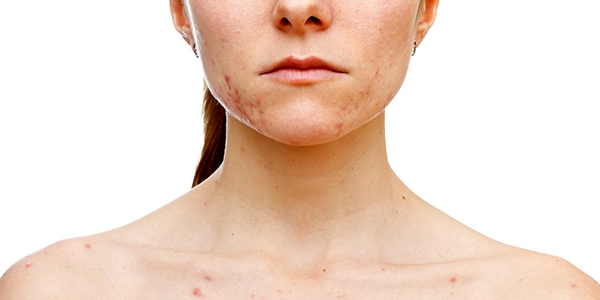
Click here to learn more about hormones and acne in young girls.

Click here to learn more about acne in women with polycystic ovary syndrome.
REFERENCES
Kamangar F, Shinkai K. Acne in the adult female patient: a practical approach. Int J Dermatol. 2012 Oct; 51(10):1162-74.