What is SAHA syndrome?
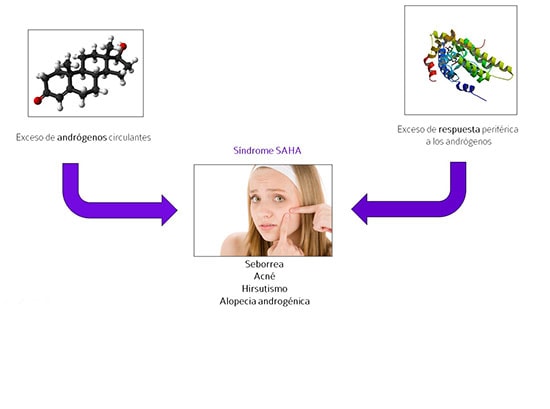
It is a disorder that includes the presence of Seborrhea, Acne, Hirsutism (excess hair in typically male areas) and androgenic alopecia . SAHA syndrome translates the response of the pilosebaceous apparatus to androgenic stimulation. It usually occurs in young or middle-aged women and involves an elevation of blood androgen levels (male hormones) or an exaggerated peripheral response to androgens with normal levels.
The coincidence of the four manifestations simultaneously (seborrhea, acne, hirsutism and androgenic alopecia) only occurs in 20% of patients. These are some of the manifestations, as it can be associated with polycystic ovary syndrome, cystic mastitis, obesity, menstrual irregularity and infertility.
What types of SAHA syndromes are there?
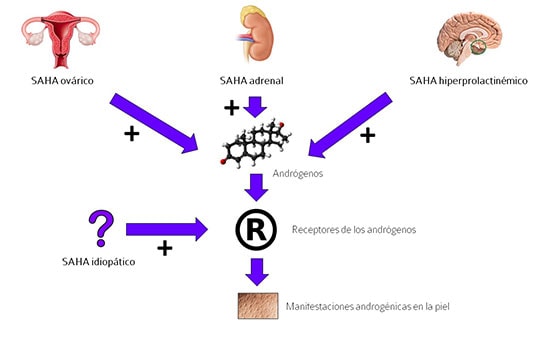
There are five variants:
1. Idiopathic or familial.
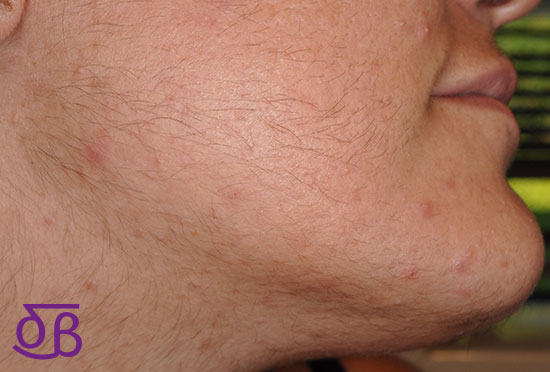
It is also called “ethnic hyperandrogenism”, and is a variant especially common in the Mediterranean area. It is of unknown cause, although it is believed that there is an excess sensitivity of the peripheral androgen receptors genetically determined or an increase in androgenic metabolism in the skin. There is usually no analytical hormonal alteration. Typically, affected women have hirsutism in the area of the sideburns and inflammatory acne.
2. Ovarian.
There is an increase in ovarian androgen metabolism. The ovaries do not have notable ultrasound alterations in most cases. Patients are usually young women who present with severe seborrhea , inflammatory scarring acne and lateral and central facial hirsutism on the body, and androgenic alopecia . It is not uncommon for overweight, obesity and/or menstrual irregularities (oligo/amenorrhea) to occur. There is usually a high LH/FSH ratio on blood tests and, not infrequently, an increase in androstenedione and free testosterone and a decrease in SHBG (sex hormone binding globulin).
3. Adrenal (adrenal).
Seborrhea is intense and acne is usually cystic-nodule on the face and back. Androgenic alopecia and mild or moderate central or lateral hirsutism are also observed. Characteristically, a greater extension of pubic hair is observed towards the abdomen and even to the chest. Patients are usually thin, prone to stress and with menstrual cycles longer than 30 days. It is not uncommon for a menstrual cycle to be skipped. Periods are usually long and painful. Biochemically, there is usually an increase in DHEAS (dihydroepi androsterone sulfate) and androstenedione. The levels of prolactin, SHBG and testosterone are normal. In severe cases, there may be an increase in plasma cortisol.
4. Hyperprolactinemic.
The manifestations are similar to adrenal SAHA syndrome. Nodule-cystic acne and hirsutism are the major signs, although galactorrhea may appear. Laboratory tests show an excess of prolactin.
5. HAIRAN syndrome.
It includes the presence of hyperandrogenism, insulin resistance and acanthosis nigricans. The patients are young, obese, with seborrhea, acne, hirsutism, androgenic alopecia, acanthosis nigricans and diabetes or a tendency to it. Insulin stimulates the ovary to manufacture androgens and reduces the formation of SHBG. In the laboratory tests there is an increase in different androgens, insulin, glucose, cortisol and progesterone.
What are the manifestations of SAHA syndrome?
The manifestations of SAHA are not usually expressed together, but usually only a few signs are present. Their intensity can vary greatly, from very faint to extremely overt. The manifestations of SAHA do not appear until puberty, along with androgenic development.
· Seborrhea and acne. Seborrhea or excess sebum (oil that covers the skin) occurs mainly in the areas with the greatest presence of sebaceous glands: the face, chest, back and scalp. Typically, patients with SAHA have a shine and unctuous touch of the skin, as well as on the scalp. Seborrhea is always present in a SAHA syndrome. Acne in the context of this syndrome usually manifests or persists beyond the age of 18 – 20, after adolescence.
· Hirsutism. It involves the appearance of excess hair in male distribution areas: moustache, beard, sideburns, armpits, mammary areolas, chest, abdomen (above and below the navel), thighs and back.
· Androgenic alopecia. Excess androgenic action causes a progressive miniaturization of the hair and its disappearance in certain areas of the scalp. In women, it characteristically affects the “crown” area and usually respects the frontal areas.
How is SAHA syndrome diagnosed?
These patients usually go to the dermatologist or gynaecologist for their skin and/or menstrual problems. Either of these two specialists who suspects SAHA syndrome or polycystic ovary syndrome will carry out the appropriate history and examination of the patient and may order the corresponding complementary tests (ovarian ultrasound and analytical analysis with androgenic profile).
What is the treatment for SAHA syndrome?
Those cases that are associated with overweight or obesity will benefit from a weight reduction. Weight loss alone improves the signs of hyperandrogenism (remember that peripheral fat is capable of synthesizing androgens).
Androgenic manifestations may or may not require treatment, depending on their intensity and the impact they have on the patient. Likewise, depending on the manifestations and origin of the SAHA syndrome, treatment will be carried out with the dermatologist, gynaecologist and/or endocrinologist. A multidisciplinary medical team is always beneficial for the patient.
In idiopathic SAHA syndrome , oral antiandrogens can be used at low doses. Antiandrogens do not necessarily have to be contraceptives. It should be borne in mind that, while taking an antiandrogen, pregnancy is contraindicated. It is important to note that, for an improvement in seborrhea and acne to be observed, a minimum of 2-3 months must pass. For hirsutism and/or androgenic alopecia to improve, the minimum period is 9-12 months.
For ovarian SAHA syndrome with elevated blood androgens, treatment with an oral anti-antigensal combination of antiandrogen plus estrogen (e.g., cyproterone acetate and ethinyl estradiol) is recommended, whether or not it is caused by polycystic ovary syndrome.
Adrenal SAHA has to be treated by suppression with corticosteroids along with antiandrogens.
Finally, hyperprolactinemic SAHA benefits from the combination of bromocriptine plus corticosteroids.
REFERENCES
Orfanos CE, Adler YD, Zouboulis CC. The SAHA syndrome. Horm Res. 2000; 54(5-6):251-8.