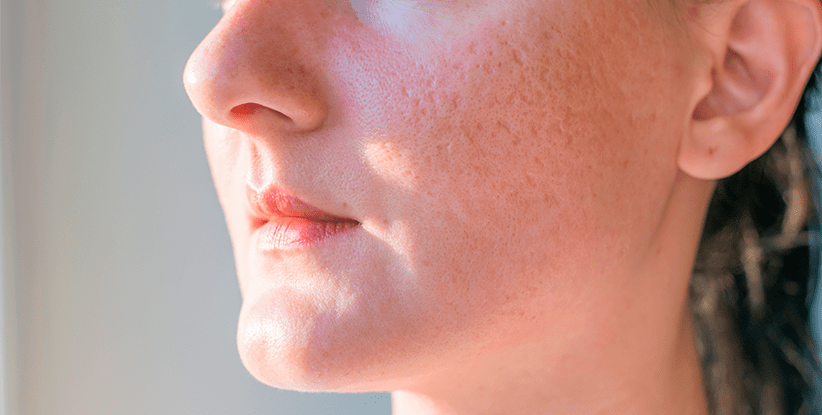
What is the best therapeutic approach to acne scars?
There is increasing evidence that the best therapeutic approach for acne scars is the combination of different techniques, in the same or different sessions, to affect all the treatable characteristics of the scars. To do this, it is essential to make a classification of the type of atrophic scars that the patient has, as you can read here: https://dbdermatologiabarcelona.com/cicatrices-marcas-de-acne.
Knowing the type of acne scars has therapeutic implications, since each type of acne has a specific treatment that offers better results. For example, in the case of rolling scars, it is highly recommended to do a subcision since they have fibrosis (hardened scar tissue) underlying that ties deeply to the surface of the skin as an anchor.
Using the best treatments, do acne scars disappear completely?
No. The vast majority of times there are significant improvements in them, but we do not manage to make them disappear completely. In general, depending on the type of scars, the techniques used in the treatment and the ability of each patient to synthesize collagen, the results vary between 30-70% improvements. This wide range of improvements is mainly determined by the ability of fibroblasts to produce collagen, the protein responsible for filling the gaps in the scars. This ability is highly variable between people.
What is the most suitable treatment for icepick and boxcar acne scars?
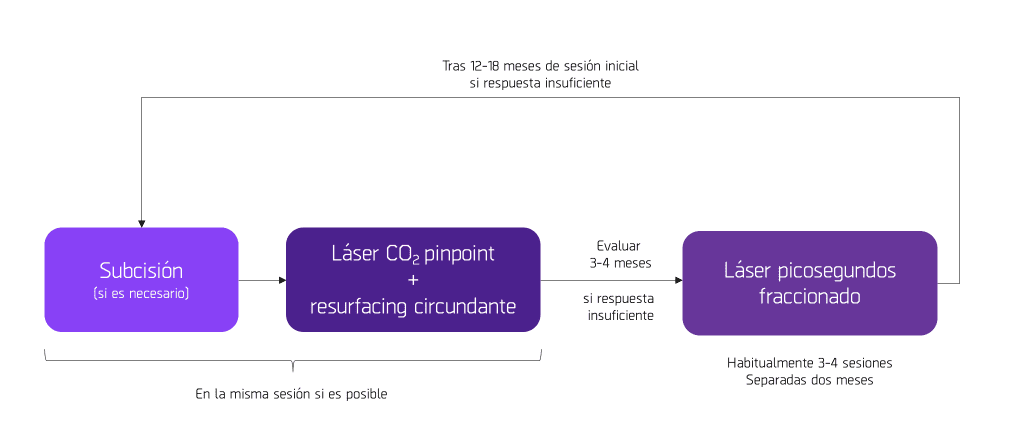
These types of scars have the basic characteristic of having very defined and steep edges by definition. It seems that the therapeutic system that can improve them the most is the use of the CO2 laser in pinpoint mode (press https://dbdermatologiabarcelona.com/laser-de-co2-para-tratar-las-marcas-de-acne for more information) and with fractional CO2 resurfacing around it. With this technique it seems that the maximum therapeutic effect is achieved while maintaining an adequate safety profile.
In the following video you have an example of boxcar and icepick scar treatment with pinpoint technique with surrounding resurfacing:
After performing a CO2 laser with the aforementioned technique, there is a progressive improvement over a period of 12-18 months according to some studies.
A clinical follow-up of the patient is usually carried out 3-4 months after the CO2 laser session and, if it is seen that the rate of collagen synthesis is excessively low, the treatment is complemented with fractional picosecond (https://dbdermatologiabarcelona.com/tratamiento-de-las-cicatrices-con-laser-de-picosegundos-fraccionado) laser sessions, which stimulates fibroblasts with a mechanism of action totally different from the heat of the CO2 laser. There are currently different studies that state that the effectiveness of the fractional picosecond laser is very similar to that of the fractional CO2 laser. However, these studies do not take into account the pinpoint technique with the CO2 laser, so we consider that CO2 continues to be an essential tool in the management of boxcar and icepick scars.
If the icepick and boxcar scars have underlying fibrosis (this is determined by the patient’s assessment at the first visit by physical examination), subcision can be performed on the same day of the CO2 laser session just prior to the laser passing.
What is the best therapeutic approach for rolling acne scars?
Rolling scars usually have underlying fibrosis, so it is advisable, if confirmed, to perform a subcision (https://dbdermatologiabarcelona.com/subcision-de-cicatrices-de-acne) prior to the fractional CO2 laser. The parameters of the CO2 laser in this type of scar must be intense to promote greater synthesis of new collagen.
This type of scar is usually relatively resistant to treatment, so it is common to perform 3-4 sessions of fractional picosecond laser when evaluating the response 3 months after subcision and CO2 laser. If the response is still insufficient, the filling with hyaluronic acid is carried out.
In these videos you can see the procedures mentioned:
Thus, the recommended algorithm in rolling acne scars would be the following:
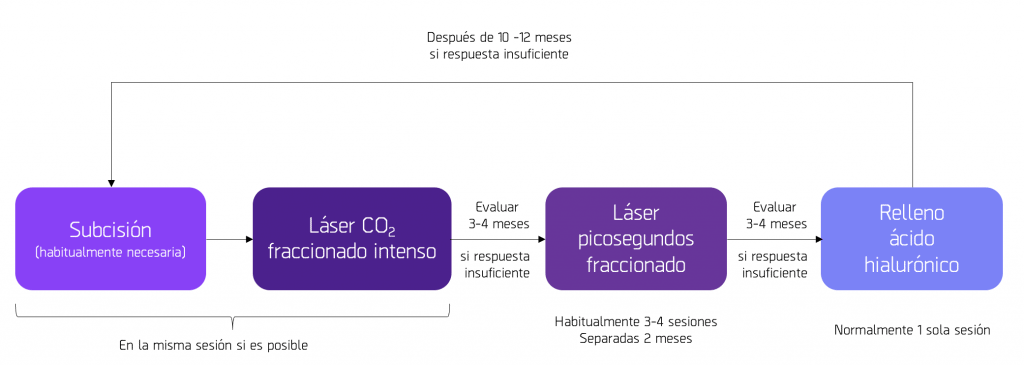
Current therapeutic algorithm in the management of rolling scars.
These algorithms are a first approximation of the management of these types of scars and, of course, each case must be examined in detail to consider individually which is the best therapeutic option. In the same way, there are other valid therapeutic options that are not mentioned in this post, since it is considered that the procedures with the best risk/cost/benefit ratio are currently presented.
REFERENCES
· Kim S. Clinical trial of a pinpoint irradiation technique with the CO2 laser for the treatment of atrophic acne scars. J Cosmet Laser Ther. 2008 Sep; 10(3):177-80.
· Ahmed R, Mohammed G, Ismail N, Elakhras A. Randomized clinical trial of CO₂ LASER pinpoint irradiation technique versus chemical reconstruction of skin scars (CROSS) in treating ice pick acne scars. J Cosmet Laser Ther. 2014 Jan; 16(1):8-13.
· Sirithanabadeekul P, Tantrapornpong P, Rattakul B, Sutthipisal N, Thanasarnaksorn W. Comparison of Fractional Picosecond 1064-nm Laser and Fractional Carbon Dioxide Laser for Treating Atrophic Acne Scars: A Randomized Split-Face Trial. Dermatol Surg. 2021 Feb 1; 47(2):E58-E65.
· Manuskiatti W, Punyaratabandhu P, Tantrapornpong P, Yan C, Cembrano KAG. Objective and Long-Term Evaluation of the Efficacy and Safety of a 1064-nm Picosecond Laser With Fractionated Microlens Array for the Treatment of Atrophic Acne Scar in Asians. Lasers Surg Med. 2021 Sep; 53(7):899-905.
· Nilforoushzadeh MA, Faghihi G, Jaffary F, Haftbaradaran E, Hoseini SM, Mazaheri N. Fractional Carbon Dioxide Laser and its Combination with Subcision in Improving Atrophic Acne Scars. Adv Biomed Res. 2017 Mar 1;6:20.