
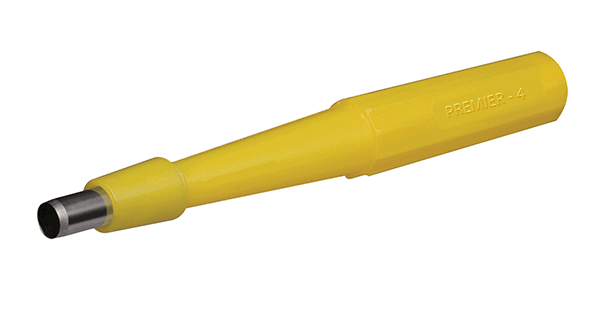
The punch is a scalpel whose blade has a circular morphology. It is used to perform skin biopsies, as it allows a perfect cylinder of skin to be removed through minimal trauma and with a simple procedure.
However, it may have other medical uses.
Punch can be used in three different ways to treat acne scars:
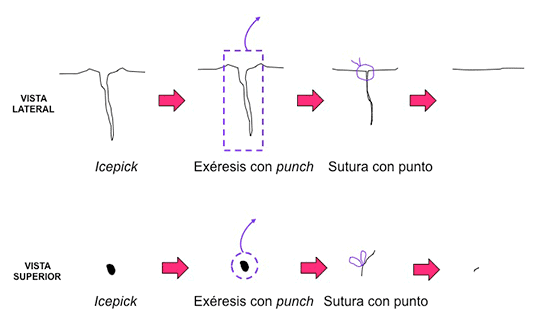
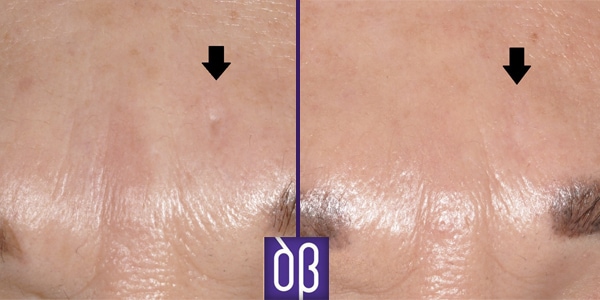
1. Removal of a scar. Acne scars on ice picks, which are deep and narrow, can be especially stubborn to treatment (with laser or trichloroacetic acid). In these cases, when the dermatologist considers it more appropriate than other techniques, it is possible to remove this entire scar on ice picks using the skin punch . Using local anesthesia, a cylinder of skin containing the scar is removed, discarded and then the resulting defect is sutured with a stitch.
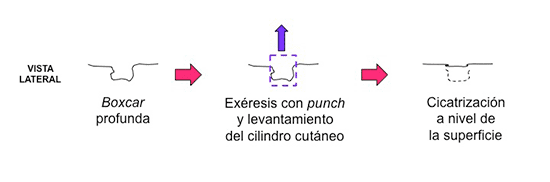
2. Punch lifting. In this technique, a circular cut is also made that surrounds the scar to break the fibrosis that ties it deeply. However, the skin cylinder is not discarded but simply left back in the resulting hole but in a higher position. Once it heals again, the surface is not so depressed but more regular with respect to the lateral margins.
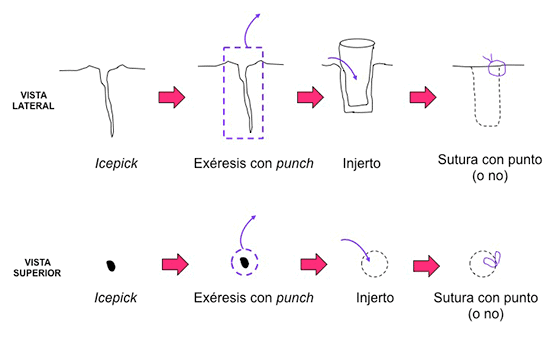
3. Punch skin grafting. It is considered the most appropriate technique using punch to treat scars with a very steep edge. It requires extreme dedication, as it is a laborious procedure: the scar is removed by punch and another punch is made in an area of donor skin – usually behind the ear. The graft usually heals at exactly the same surface level as the skin or slightly above.
All techniques that use skin punch are performed under local anaesthesia. It is also a procedure that requires a certain degree of specialisation and it is advisable to consult a dermatologist with field knowledge.
REFERENCES
Gozali MV, Zhou B. Effective treatments of atrophic acne scars. J Clin Aesthet Dermatol. 2015 May; 8(5):33-40.