What is 5-fluorouracil?
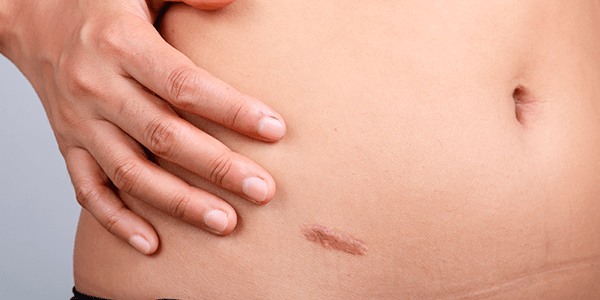
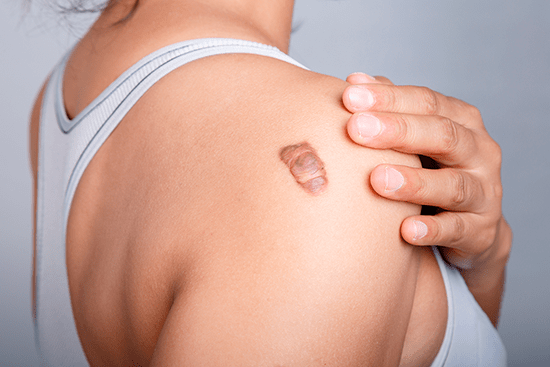
It is a drug that inhibits the formation of deoxyribonucleic acid (DNA) in cells, thus reducing the rate of cell replication (cytostatic drug). This property means that those cells that multiply rapidly (such as those of tumours, verruas or keloids) reduce the speed of their division. If fibroblasts – the cells that divide abnormally quickly in keloids – stop their proliferation, the volume of the scar improves. In dermatology, 5-fluorouracil (5FU) is used to treat proliferative skin lesions such as viral warts, actinic keratoses and/or hypertrophic and keloid scars. In the case of warts and actinic keratosis, 5FU is used topically (cream or elastic collodion); and in scars it is applied by injection into the lesion (intralesional injection).
How is 5FU used in the treatment of hypertrophic scars and keloids?
It is injected into the scar by puncture. It can be used as monotherapy (the only treatment) or in combination with other medications injected simultaneously (usually corticosteroids).
In monotherapy format, between 0.5 – 2 mL of 5FU in a solution of 50 mg/mL (50 – 150 mg of 5FU) are injected. It is usually used weekly for a period of up to three months, although other authors advocate monthly administration. Some studies reach a final amount of administration of 500 mg at the end of all infiltrations. There is also the possibility of surgically removing the keloid and infiltrating the scar area two weeks after extraction, repeating the injections every 2-4 weeks.
How effective is 5FU infiltration in keloids?
In general terms, the infiltration of 5FU 50 mg/mL in keloids achieves a good or excellent response between 45 and 78% of cases. According to the study by Gupta and Kalra, where 24 patients were treated with keloids with intralesional 5FU, there was a complete flattening of the scar in 33% of patients and 70% of patients reported a decrease in itching and pain. In Nanda and Reddy’s publication on keloids treated with intralesional 5FU in 28 patients, a ‘good response‘ was obtained in 71% of cases and an ‘excellent response‘ in 7% of them. A large number of subjects who had previously shown no improvement with corticosteroid injections(triamcinolone acetonide) participated in this study. Intralesional 5FU 50 mg/mL was administered undiluted, weekly, for a period of three months. The recurrence rate six months after the end of treatment was 0%. In the study by Kontochristopoulus et al., the relapse rate at 52 weeks was 47%; and in the study by Haurani et al., 19%.
Infiltration of 5FU plus triamcinolone acetonide simultaneously achieves good or excellent responses 96% of the time. According to Alsilian et al., the combination of 5FU plus triamcinolone acetonide or 5FU plus triamcinolone acetonide plus pulsed dye laser is more effective than triamcinolone acetonide alone. Daroughegh et al. also found greater efficacy in the combination of 5FU plus triamcinolone acetonide than in the use of acetonide alone in the treatment of hypertrophic scars.
In general, most authors recommend treating hypertrophic scars and keloids with triamcinolone acetonide plus 5FU simultaneously in the same session, since the result is better without increasing the complication rate. Ideally, more 5FU and less corticosteroids should be used. Increasing the dose of corticosteroids seems to only increase the rate of adverse effects. On the contrary, if a small amount of corticosteroids is used, it is possible to reduce the complications associated with the use of 5FU.

What are the most common adverse effects in the treatment of scars and keloids with 5FU?
The most common is pain or burning sensation (100% of cases) and temporary hyperpigmentation (up to 21% of patients): it is relatively common for the scar to become darker and browner for a few months when treated with 5FU. To reduce the pain or burning sensation caused by 5FU, this drug is usually mixed with triamcinolone acetonide in small amounts. Another possible adverse effect of 5FU is ulceration of the treated scar (formation of a wound). In systematic reviews, the profile of 5FU is very high and, if side effects occur, they are local and reversible or easily manageable according to the available literature.
To date, there are no publications of systemic side effects (blood dyscrasias) associated with intralesional infiltration of 5FU in the treatment of hypertrophic and/or keloid scars, and these types of reactions are observed only in intravenous administration of the drug.
The infiltration of isolated intralesional corticosteroids (triamcinolone acetonide) can also be associated with complications such as pain (100% of cases), appearance of telangiectasias (capillaries) (practically 100% of the time), skin atrophy, hyperpigmentation or permanent residual hypopigmentation. The use of corticosteroids can have a rebound effect, a phenomenon that is not observed with 5FU.
CONCLUSIONS
· Intralesional 5FU is an effective and safe drug for the treatment of hypertrophic scars and keloids. Sessions are recommended every 1 – 2 weeks, up to a maximum of 500 mg of 5FU as a total dose.
· Good or excellent responses are obtained in up to 78% of cases. The rate of recurrence after completion of treatment ranges from 4 – 47% after one year of follow-up.
· The combination with a small amount of corticosteroids (triamcinolone acetonide) enhances the therapeutic effects of both and reduces the rate of adverse effects that can occur with the isolated use of each of them.
· The side effects of 5FU infiltration are local (pain, hyperpigmentation, ulceration) and usually reversible.
· There have been no cases of systemic adverse effects on intralesional infiltration of 5FU into keloids or hypertrophic scars.
· 5FU can be combined with other therapeutic modalities such as cryotherapy or lasers.
REFERENCES
· Shah VV, Aldahan AS, Mlacker S, Alsaidan M, Samark andy S, Nouri K. 5-Fluorouracil in the Treatment of Keloids and Hypertrophic Scars: A Comprehensive Review of the Literature. Dermatol Ther (Heidelb). 2016 Jun; 6(2):169-83.