
What is Polycystic Ovary Syndrome (PCOS)?
It is an endocrine disorder typical of women of reproductive age. It consists of an alteration in the secretion of different hormones that leads to different metabolic, reproductive and cardiovascular manifestations, including hyperandrogenism (excess of male hormones) and insulin resistance (tendency to hyperglycemia and obesity). It is a very common disorder, which can affect up to 8 – 18% of women of reproductive age depending on the diagnostic criteria used.
What are the manifestations of polycystic ovary syndrome?
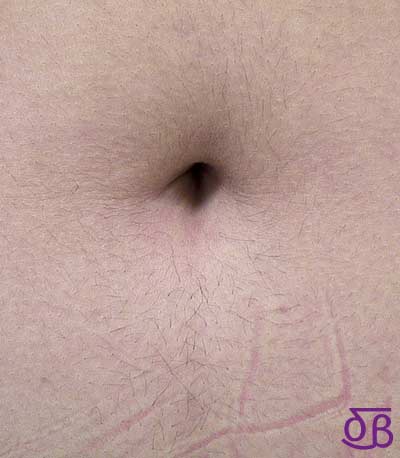
· Skin manifestations. Typical of hyperandrogenism: acne, seborrhea, hirsutism (excess hair in male-pattern areas), androgenic alopecia. The manifestations related to insulin resistance are acanthosis nigricans (hyperkeratotic brown papules and plaques that translate), stretch marks and acrochordons.
· Gynecological manifestations. Chronic anovulation, oligomenorrhea (<9 menses/year) or amenorrhea (lack of menstruation ≥3 months), difficulty conceiving, increased risk of endometrial cancer.
· Metabolic manifestations. Tendency to centrally predominant obesity (up to 75% of women with PCOS), to asteatotic hepatitis (accumulation of fat in the liver) and to metabolic syndrome (obesity, hypertriglyceridemia, hypercholesterolemia, hypertension, hyperglycemia) – up to 47% of cases.
· Cardiovascular manifestations. Coronary heart disease, dyslipidemia, hypertension.
· Other manifestations. Sleep apnea syndrome (snoring and breathing obstruction during sleep), psychiatric disorders (anxiety and depression).
It should be borne in mind that girls with PCOS may be completely asymptomatic or suffer only from some isolated symptom or sign, such as acne.
How is polycystic ovary syndrome diagnosed?
It is concluded that the patient has polycystic ovary syndrome when they meet TWO of the following 3 criteria (Rotterdam, 2.003):
a. Chronic anovulation or oligo-ovulation.
b. Clinical or laboratory signs of hyperandrogenism.
c. Ultrasound signs of polycystic ovaries and exclusion of other causes of hyperandrogenism and anovulation (congenital adrenal hyperplasia, Cushing’s syndrome or androgen-secreting tumors).
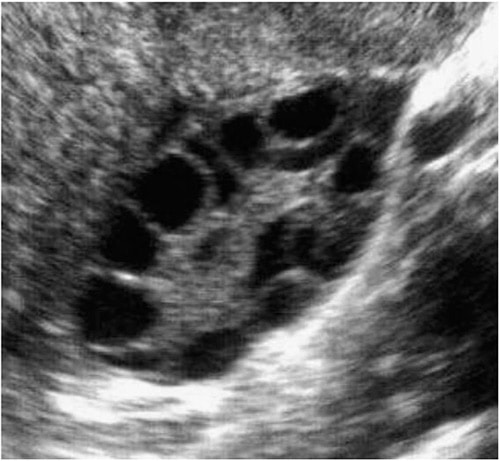
Note that, curiously, it is NOT necessary to have cysts in the ovaries to suffer from polycystic ovary syndrome (PCOS) and that, therefore, gynecological ultrasound can be rigorously normal. PCOS is a much broader concept that is not only limited to the presence of ovarian cysts but also to an endocrine disorder. It is also possible to diagnose it by medical history and physical examination (e.g., if the first two criteria are met) without the need for a hormonal analysis and an ovarian ultrasound, although it is always recommended to perform them. It should be noted that it is not strictly necessary to have disorders in the frequency of menstruation to suffer from PCOS (in fact, 30% of patients with PCOS have regular menstruation).
Regarding hormonal alterations in the blood test, the following characteristics are characteristic of polycystic ovary syndrome:
· Decrease in sex hormone binding globulin (SHBG).
· Increased free testosterone and free androgen index.
· Increased dihidepi androsterone sulfate (DHEAS).
Why does polycystic ovary syndrome appear?
The reason why it appears is unknown, although it is known that there is an excess secretion of luteinizing hormone (LH) by the cerebral pituitary gland, which will stimulate the ovary to produce androgens (androstenedione). In turn, these will cause the follicles to remain immature in the ovary (cyst formation) and will have their hormonal effect on peripheral tissues (hyperandrogenism).
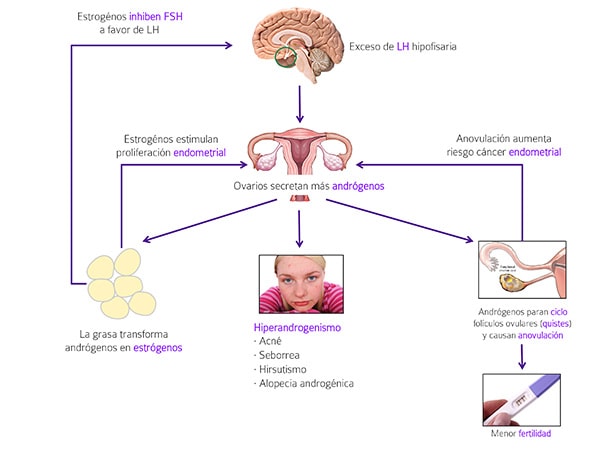

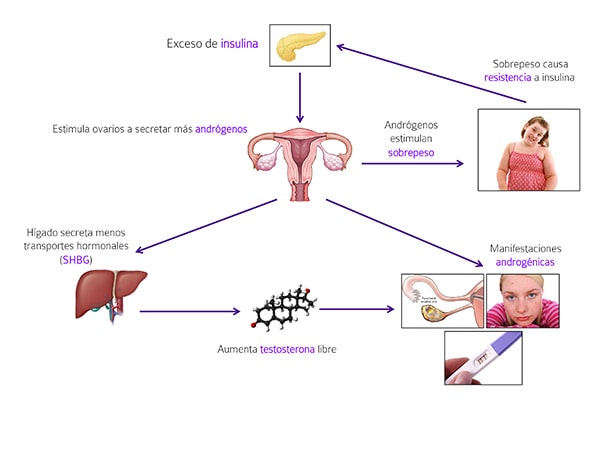
What are the most common manifestations of PCOS?
Up to 60% of patients with polycystic ovary syndrome have elevated total testosterone in their blood and 70% have hirsutism of variable degree, which is associated with an increased risk of metabolic and reproductive morbidity.
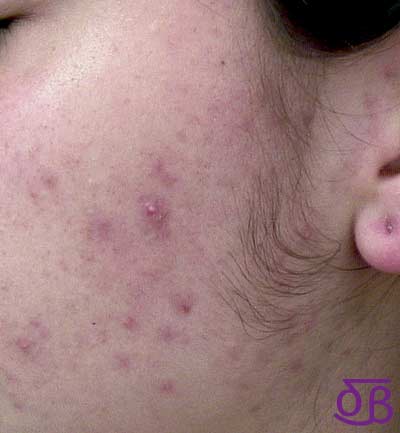

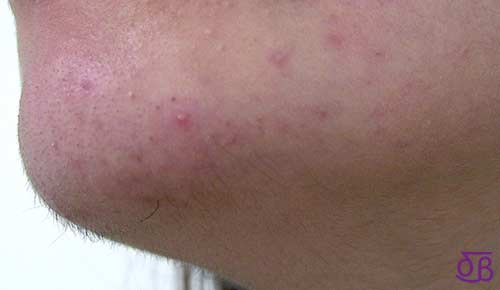

What are the peculiarities of acne in girls with polycystic ovary syndrome?
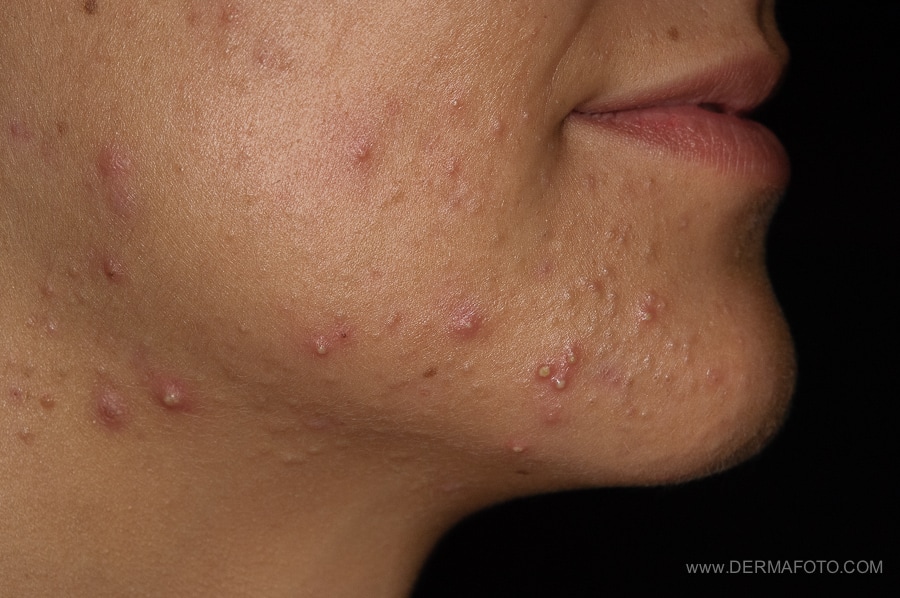
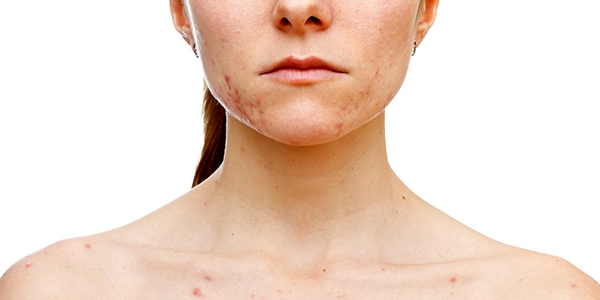
It predominantly has inflammatory lesions on the lower third of the face, neck, chest, and upper back.
Between 19 – 37% of women with moderate or severe acne meet diagnostic criteria for PCOS, so it is highly recommended to study all women with acne in detail by taking a medical history, a complete physical examination, a hormonal analysis and a gynecological ultrasound. This is especially true in those women in whom acne has developed or persists into adulthood, or in those in whom it is resistant to usual therapies or relapses after finishing treatment with isotretinoin.
It is estimated that up to 30% of women with polycystic ovary syndrome have acne.
What is the treatment for polycystic ovary syndrome?
Not all patients with PCOS require pharmacological treatment. Simple weight loss in patients associated with obesity is capable of improving all non-cutaneous manifestations of this disorder (fertility and metabolic syndrome).
· Oral contraceptives with progestogens derived from 19-nortestosterone. They include oral contraceptives (OCCs) that include ethinyl estradiol plus a specific progestogen (norgestrel, levonorgestrel, norethindrone, norgestimate, desogestrel or gestodene). They are effective for menstrual irregularity, reduce the risk of endometrial hyperplasia, hirsutism and – according to several but not all studies – acne.
This type of OAC has an indirect antiandrogenic profile for three reasons: they increase the synthesis of SHBG (reduce circulating free testosterone); they decrease the synthesis of ovarian androgens by reducing LH thanks to the progestogens they contain; and they decrease androgen receptors and 5 alpha reductase also thanks to progestogens.
However, they increase the risk of some thromboembolic cardiovascular phenomena (strokes, venous thrombosis, mycoardine infarction), breast cancer, insulin resistance and dyslipidemia.
The OACs derived from 19-nortestosterone currently available in Spain are:
Aylina® Gestinyl® Meliane® Minulet®
Bemasive® Gynovin® Melodene® Ovoplex®
Donabel® Harmonet® Melteva® Suavuret®
Danielle® Levobel® Microdiol® Tevalet®
Edelsin® Linelle® Microgynon® Tri-minulet®
Gracial® Loette® Minesse® Trigynovin®
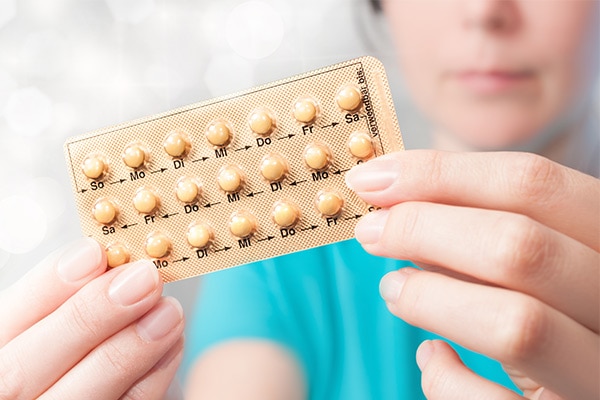
· Oral contraceptives with antiandrogenic progestogens.
They are combinations of ethinyl estradiol with cyproterone acetate or drospirenone with a direct antiandrogenic action. Cyproterone acetate reduces blood testosterone and androstenedione, as well as the activity of 5-alpha reductase. Drospirenone inhibits the manufacture of ovarian and adrenal androgens, as well as the activity of peripheral androgen receptors.
This group of OACs also increases the risk of some thromboembolic phenomena.
Currently, in Spain, the following are available:
Antin® Dretinelle® Yasmin®
Antinelle® Drosiane® Yasminelle®
Aranka® Drosianelle® Yaz®
Arankelle® Drospil® Yira®
Daylette® Drosure®
Diane 35® Drosurelle®
Drelle® Gyneplen®
Dretine® Lyophora®
· Non-contraceptive antiandrogens.
This group includes spironolactone and finasteride. None of these drugs have a contraceptive action, so they do not prevent pregnancy. However, pregnancy is totally contraindicated during their use due to the fetal malformations associated with their antiandrogen action.
In conclusion, the concept of polycystic ovary has been progressively transformed from a purely ovarian disorder to a more complex syndrome involving different organs and systems that can mark the prognosis of patients (hyperglycemia, hyperinsulinemia, coronary heart disease, obesity, hypercholesterolemia…). For this reason, in the treatment of PCOS, the therapeutic spectrum is being expanded beyond the use of contraceptives (with metformin or other combinations) to regularize the underlying metabolic alterations and the cutaneous manifestations of the same, and not only influence the menstrual cycle.
Click here to learn more about hormones and acne in young girls.

Click here to learn more about acne in young women.
REFERENCES
· Housman E, Reynolds RV. Polycystic ovary syndrome: A review for dermatologists: Part I. Diagnosis and manifestations. J Am Acad Dermatol. 2014 Nov; 71(5):847.e1-847.e10.
· Buzney E, Sheu J, Buzney C, Reynolds RV. Polycystic ovary syndrome: A review for dermatologists: Part II. Treatment. J Am Acad Dermatol. 2014 Nov; 71(5):859.e1-859.e15.
· Ibáñez L, Díaz M, Sebastiani G, Marcos MV, López-Bermejo A, de Zegher F. Oral contraception vs insulin sensitization for 18 months in nonobese adolescents with androgen excess: posttreatment differences in C-reactive protein, intima-media thickness, visceral adiposity, insulin sensitivity, and menstrual regularity. J Clin Endocrinol Metab. 2013 May; 98(5):E902-7.
· Sirmans SM, Pate KA. Epidemiology, diagnosis, and management of polycystic ovary syndrome. Clin Epidemiol. 2013 Dec 18;6:1-13.