
Why is thyroidectomy at risk of forming a hypertrophic scar or keloid?
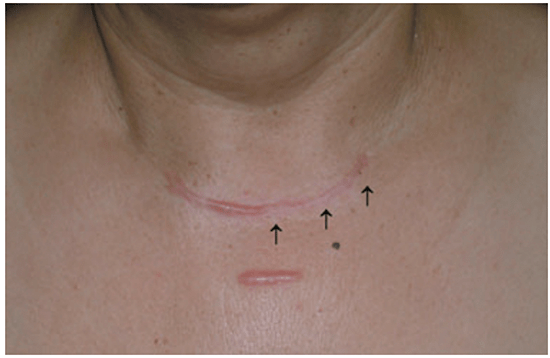
Total or partial thyroidectomy involves a transverse incision in the front of the neck, above the jugulum and below the walnut. It is an area with minimal density of hair follicles (which help the epithelialization of wounds and the healing process) and subjected to considerable tension due to the mobility of the head. These factors contribute to the fact that on many occasions a hypertrophic scar or keloid finally occurs in a particularly visible area.
Why can KTP’s laser be useful?
In the initial phases of healing, a large blood supply is established due to the proliferation of the capillaries in the area, giving the area a reddish colour. This hypervascularisation increases the metabolic rate of the area and, therefore, the risk of a hypertrophic scar appearing. For this reason, and because these vascular structures are formed at the beginning of the scarring process, it may be advisable to treat the scar preventively with vascular lasers, which remove the capillaries in the area. Among the vascular lasers , KTP (532 nm), pulsed dye (585 – 595 nm) and Nd:YAG (1,064 nm) stand out. Reducing the blood supply in the early stages of scar formation reduces the risk of scar growth becoming hypertrophic or keloid.
You can learn more about KTP’s laser scar treatment here and Nd:YAG’s here.
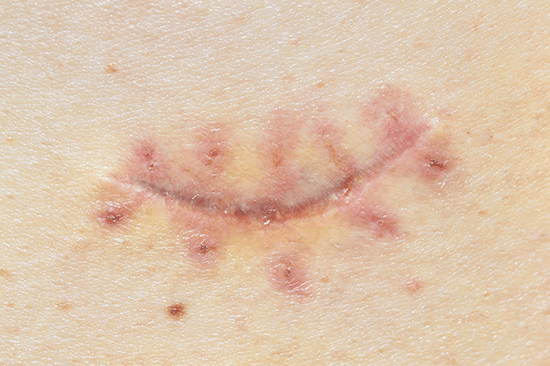
How effective is the KTP laser applied preventively on a thyroidectomy scar?
The study by Yun et al . compared a control group of 8 patients who underwent thyroidectomy and did not receive any lasers with a study group of 20 people who had their thyroid scar treated with KTP laser. Patients were followed for 6 months, at which time the aesthetic results were compared. In both groups of patients, a silicone occlusive patch was applied for 3 months after surgery. Patients treated with KTP laser underwent a treatment session every two weeks starting in the second or third week after surgery.
After two sessions of KTP laser, the appearance of the scars in the study group began to be progressively better than that of the control group according to a scoring scale (Vancouver Scar Scale , VVS). The VVS assesses the following parameters of a scar: vascularization, pigmentation, texture and height. The maximum score (worst possible appearance) is 13 points. The mean SVV score at the end of the study was 2.2 in the treated group and 5.7 in the control group. The average degree of satisfaction with the final result was 3.1 in the treated group and 1.6 in the control group (1=poor, poor=2, good=3, excellent=4). In the improvement score issued by the dermatologists evaluating the results, the endpoint was 3.07 in the treated group and 1.83 in the control group (1=poor, scarce=2, good=3, excellent=4).
In conclusion, all parameters and scales improved significantly in patients with early KTP laser-treated thyroidectomy scar compared to patients who did not receive laser.
According to an interesting study by Vaccaro et al., in which half of a scar was treated by KTP laser thyroidectomy and the other half was left untreated, an improvement of the first of approximately 70% was observed with only two treatment sessions:
What adverse effects does KTP laser have on the treatment of thyroid scar?
Following the data from the study by Yun et al., none of the patients in the study group treated with the KTP laser had adverse effects, except for one in which blisters appeared after the first laser session. In this patient, both redness and blisters disappeared within 48 hours, so in the following sessions it was not necessary to reduce the laser power. There were no cases of depigmentation, intense pain, scarring or ulceration.
In the patient treated by Vaccaro et al., fine scabs appeared on the treated area, which disappeared within 48 hours.
REFERENCES
· Yun JS, Choi YJ, Kim WS, Lee GY. Prevention of thyroidectomy scars in Asian adults using a 532-nm potassium titanyl phosphate laser. Dermatol Surg. 2011 Dec; 37(12):1747-53.
· Vaccaro M, Borgia F, Guarneri B.Treatment of hypertrophic thyroidectomy scar using 532-nm potassium-titanyl-phosphate (KTP) laser. Int J Dermatol. 2009 Oct; 48(10):1139-41.