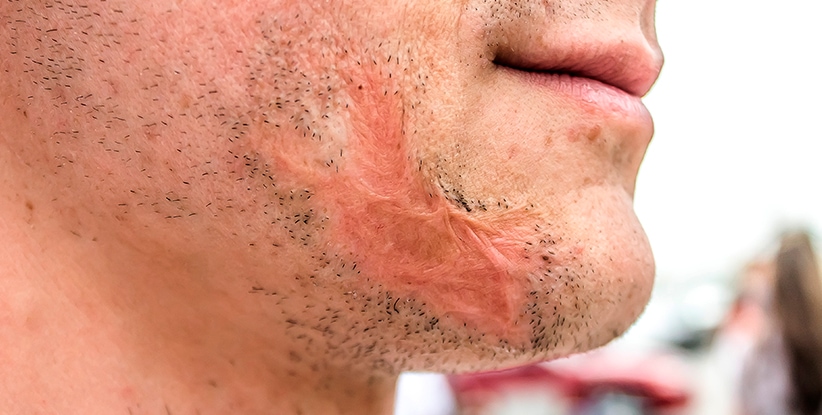
What are the characteristics of burn scars?
In general, burn scars are hypertrophic – excess scar tissue that does not exceed the edges of the wound – and, occasionally, keloid – in this case the scar edges are superimposed. As such, they present an excess and disorganization of the collagen of the dermis.
It is also not unusual for them to have pigmentation disorders, an excess (hyperpigmentation) or a defect (hypopigmentation). Secondary to treatment with infiltrated corticosteroids or due to the tension generated by the scar itself, it is not uncommon to find an excess of blood vessels (telangiectasias). It is common for burn scars to cause pain, itching and/or restriction of mobility in the affected area.
What aspects can be improved with fractional ablative laser in the treatment of burn scars?
The main ablative fractional laser is the CO2 laser. You can find more information about it here.
There are different characteristics of burn scars that can be improved with treatment:
- Volume and texture. The excess volume and alteration of the texture presented by the scars are mainly due to a disorganization of the collagen and a loss of the skin adnexa (glands and hair follicles), respectively. Collagen can be reorganized by using fractional lasers, either ablative – the most efficient – or non-ablative.
- Pain, itching, and restricted mobility. The use of ablative fractional lasers increases the flexibility and compliance of hypertrophic scars, thereby increasing the mobility of the treated skin tissue. This is especially relevant in areas of high movement, such as joints. In addition, fractional CO2 laser can improve scar discomfort.
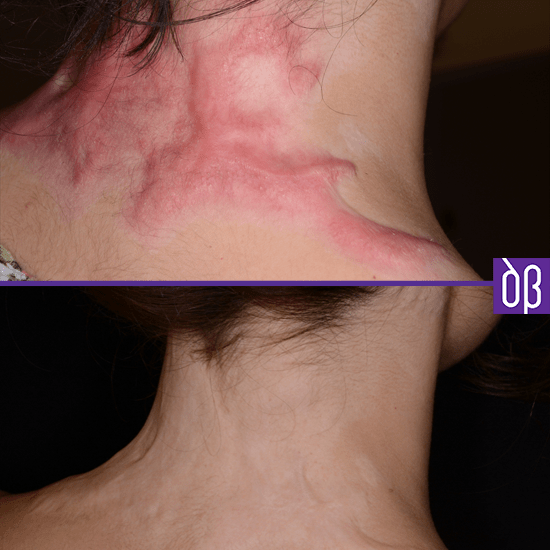
What aspects of burn scarring does fractional CO2 laser not improve?
The CO2 laser acts mainly on collagen. For this reason, it does not usually improve the reddish colour or telangiectasias that burn scars may have. To act on these characteristics, it will be necessary to use vascular lasers such as KTP (more information here), pulsed light or pulsed dye. Likewise, pigmentation disorders are not the target of the CO2 laser. In these cases, we can use Q-switched lasers, pulsed light or short-pulse Nd:YAG. Since burn scars usually have different alterations simultaneously (volume, red or brown), a combination of different lasers is usually used to treat them more completely and efficiently.
What are fractional CO2 laser sessions like in the treatment of burn scars?
They are usually performed with topical anaesthesia (cream), which is left to act for about 30 minutes on the area of skin to be treated. It is then removed and the laser is passed over the scars. It usually causes minimal discomfort or may even be imperceptible in some areas. After the session, the duration of which depends on the extent of the burns treated, the skin is reddish and oedematous (swollen) for a few hours. Subsequently, “pixelated” scabs form – small brown dots – that come off in a few days (between 5 and 21 days, approximately depending on the area treated). These scabs usually do not require special care, except to avoid swimming in the pool and to be strict with sunscreen. Rarely, nuestr@ dermatólog@ can indicate any type of antibiotic or antiviral prevention, whether topical and/or oral.
How many fractional CO2 laser sessions are needed in the treatment of burn scars?
It depends on the severity of the scars and their extension, mainly. The CO2 laser is the therapeutic method that offers the greatest effectiveness and efficiency, so in general there are usually few sessions and 1-6 months apart from each other.
From the time a fractional CO2 laser session is performed until a period of one year or a year and a half, collagen remodeling remains active – it continues to improve the appearance of the scars during all this time. For this reason, it is not usually advisable to put the therapeutic sessions together and a minimum of 4 weeks between one and the other is recommended (although the usual period between sessions is usually 3 months).
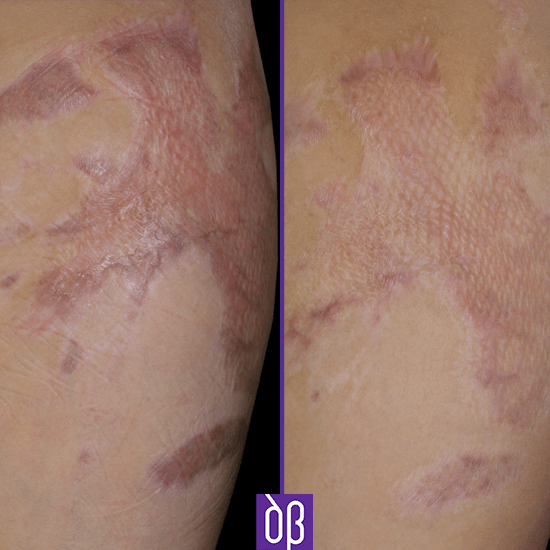
Is the fractional CO2 laser compatible with other techniques to improve burn scars?
No doubt. We have mentioned above that it can and usually is combined with other lasers that treat specific aspects of scars: redness (vascular lasers) or hyperpigmentation (pulsed light, Q-switched or picosecond lasers). However, we can also combine fractionated CO2 laser with intralesional drug infiltrations (more information here), cryotherapy with liquid nitrogen, topical application of drugs or platelet-rich plasma, among others. It should be borne in mind that the different mechanisms of action of these procedures enhance each other and allow the results obtained with fractional CO2 laser to be improved. Depending on the characteristics of the scar, your dermatólog@ can recommend a specific therapeutic plan.
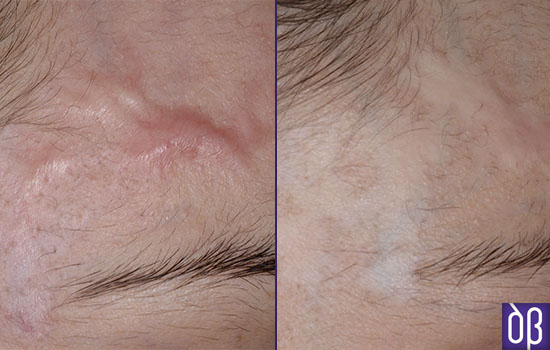
When can burn scar treatment with ablative fractional laser be started?
Ideally, the sooner the better. Already in the first days after the accident, once the wound has been epithelialized, lasers can begin to be used to drive the scarring process on a faster path and with less risk of ending up in keloid. Recent scars (first 6-12 months) benefit from using vascular lasers to reduce their redness and to facilitate the correct settlement of collagen. In these early stages, vascular lasers can be combined with fractional lasers, whether ablative or non-ablative.
If the scar is old (more than 6-12 months) and has already lost redness, vascular lasers no longer have much role and only fractional lasers can be used, usually achieving lower therapeutic responses.
Therefore, the earlier the laser burn scar treatment, the better the response and the fewer sessions are needed.
REFERENCES
Douglas H et al. Carbon dioxide laser treatment in burn-related scarring: A prospective randomised controlled trial. J Plast Reconstr Aesthet Surg. 2019 Jun; 72(6):863-870. doi: 10.1016/j.bjps.2019.01.027. Epub 2019 Feb 10.