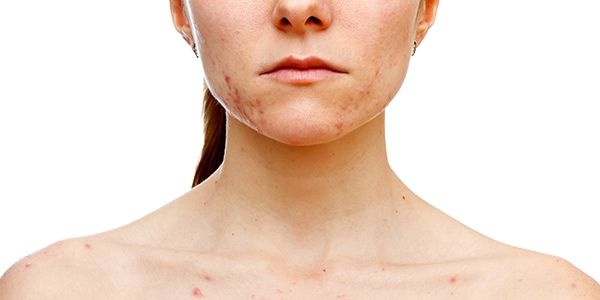
Can acne be related to hormones?
Yes. Acne , which is a disorder of the follicle-sebaceous units of the skin, can appear as a response to an alteration in the levels or functionality of androgens ( sex hormones with masculinizing action) since they are the ones that can stimulate the production of the sebaceous glands.
How do hormones act at the origin of acne? Androgens stimulate the production of sebum in the skin when they interact with their receptors in the sebaceous glands.
There are different types of androgens, and the most powerful in terms of this action are dihydrotestosterone and testosterone (the former is 5-10 times more powerful). On the same skin, less potent androgens such as dihydroepiandrosterone, dihydroepandrosterone sulfate or androstenedione are transformed into testosterone and dihydrotestosterone thanks to proteins such as 5 alpha reductase (also involved in androgenic alopecia). In this way, the overproduction of sebum clogs the follicular orifice generating comedones (pimples), the first clinical step for the appearance of acne.
Can I get acne as an adult if I haven’t had it in adolescence?
Yes, and it is common in the case of acne caused by a hormonal disorder. It is common for some girls to start with acne in their thirties without having suffered from it during their adolescence. This is especially true if the patient has been on contraceptive treatment for a long time and stops contraception.
Is acne in girls always related to hormonal alterations? Do you always have to ask for a hormonal analysis?
Most often, it is not the result of a hormonal alteration, so a hormonal analysis is not usually a routine study in adolescent acne. However, it is advisable to perform it on young women with persistent or late-onset acne, or who have relapsed at the end of isotretinoin or when stopping a contraceptive treatment.
How does hormonal acne manifest itself?
This variant is common in young girls and has some clinical characteristics that are specific to them, such as the location of the lesions in the jaw, chin and neck; the appearance in adulthood; the coexistence with other signs of hyperandrogenism (seborrhea, hirsutism, alopecia) or its pre-menstrual exacerbation.
When should acne associated with a hormonal disorder be suspected?
In women who have never had acne and it appears suddenly in adulthood; when conventional acne treatment fails; when in addition to acne there are other signs of hyperandrogenism (hirsutism, irregular menstruation, androgenic alopecia, changes in the voice, increased libido) or endocrinological disorders (hyperglycemia, obesity, cushingoid phenotype…).
What hormonal syndromes are related to acne?
There are different hormonal disorders that can cause acne:
· Adrenal hyperplasia.
· Hyperandrogenism and insulin resistance (HAIR syndrome). It is a disease of women consisting of the disorders mentioned plus acanthosis nigricans and, occasionally, other autoimmune diseases (Hashimoto’s thyroiditis, Graves’ disease and vitiligo).
· Polycystic ovary syndrome. It can affect up to 6% of the general population. It is associated with hyperandrogenic manifestations (seborrhea, acne, hyrustism, alopecia), irregular menstruation and/or ovarian cysts. It is very frequently associated with obesity and insulin resistance. You have more information here.
· SAHA syndrome. It is an acronym for seborrhea, acne, hirsutism and androgenic alopecia. It occurs in middle-aged women with high androgen levels in the blood or with normal androgens but with excessive response to them at the peripheral level (skin). It is frequently associated with acanthosis nigricans.
Why can polycystic ovary syndrome cause skin disorders?
PCOS is the most common hormonal disorder in young women. The diagnostic criteria (Rotterdam) are as follows:
– Clinical or analytical androgen excess
– Oligomenorrhea or amenorrhea (ovarian dysfunction)
– Ultrasound criteria for poly-micro-cystic ovary
Because there is an excess of ovarian production of androgens, it can be accompanied by skin signs and symptoms typical of hormonal action on the skin: seborrhea, acne, hirsutism (excess hair) and androgenetic alopecia (decrease in scalp hair density following a specific pattern).
In addition, other signs can be found: obesity, insulin resistance, hypertension, diabetes, metabolic syndrome, acanthosis nigricans, infertility, signs of virilization, sleep apnea syndrome…
What tests can my dermatologist order if he or she suspects polycystic ovary syndrome?
To meet the diagnostic criteria for this suspicion, it is common for you to be asked for a hormonal analysis during days 1 and 3 of your menstrual cycle (study of sex hormones, thyroid and prolactin) and an ovarian ultrasound . An interconsultation with Gynecology or Endocrinology may be carried out if there is an abnormal result.
Is this type of acne cured with isotretinoin?
No. If the underlying cause of this pathology remains untreated, it is most likely that some time after discontinuation of isotretinoin, the lesions will recur.
Is it possible that you have done one or more cycles of isotretinoin and still have acne?
Yes. Even if you have common acne, not associated with any underlying disorder, it is believed that up to 25% of patients may relapse in the year after finishing isotretinoin. This likelihood decreases if the total cumulative dose of drug is closer to 150 mg per kilogram of body weight than 120 mg. If acne is caused by an underlying hormonal disorder, a relapse is normal within weeks or months of finishing the isotretinoin cycle.
What is the treatment for hormonal acne?
It will depend on the underlying hormonal alteration. There are different options, such as pure non-contraceptive antiandrogenic drugs (spironolactone) or contraceptives, either antiandrogenic alone (drospirenone) or combined (antiandrogens + estrogenics: cyproterone acetate + ethinyl estradiol). Polycystic ovary syndrome may benefit from insulin-sensitizing agents, such as metformin. However, clinical improvement with this drug is usually not high.
Each case must be assessed personally and your dermatologist will recommend the best therapeutic option in your case.
Click here to learn more about acne in women with polycystic ovary syndrome.
REFERENCES
· Lakshmi C. Hormone therapy in acne. Indian J Dermatol Venereol Leprol. 2013 May-Jun; 79(3):322-37.