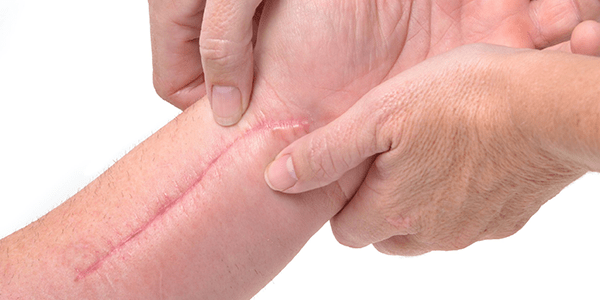
Why is the Nd:YAG laser used for the treatment of keloids and hypertrophic scars?
In this type of scar, as we mentioned in another post, there is usually an increase in blood vessels, which partly explains the accelerated metabolic rate that both keloids and hypertrophic scars have, and their reddish coloration. Lasers that are used to remove excess vessels can be useful to treat hypertrophic scars and keloids: the 595 nm pulsed dye laser, the 532 nm KTP laser and the 1,064 nm Nd:YAG laser.
What are the properties of the Nd:YAG laser that justify its use to treat scars?
The 1,064 nm neodymium laser has a relatively long wavelength, which allows it to reach deeper vascular structures (reticular dermis, 1 – 2 mm) than those that can be treated with the pulsed dye or KTP laser. In fact, the Nd:YAG laser is also used to treat spider veins and varicules of the legs, which are usually deep. The occlusion of keloid capillaries and hypertrophic scars reduces the blood supply necessary for the abnormal synthesis of collagen and the nerve fibers they contain. It seems that, in vitro, the Nd:YAG laser also has the ability to reduce collagen synthesis in scars directly.
There are three types of 1,064 nm Nd:YAG lasers: ultra-short pulse (Q-switched) lasers and longer pulse lasers, which can be contact lasers or applied at a distance. Q-switched lasers are not normally used to treat scars, as such short pulses do not allow deep vascular structures to be removed. Longer pulse and contact lasers penetrate twice as much as long-pulse lasers applied at a distance. According to Koike et al., long-handed lasers improve very thick scars little due to their low penetration and the contact head is preferred.
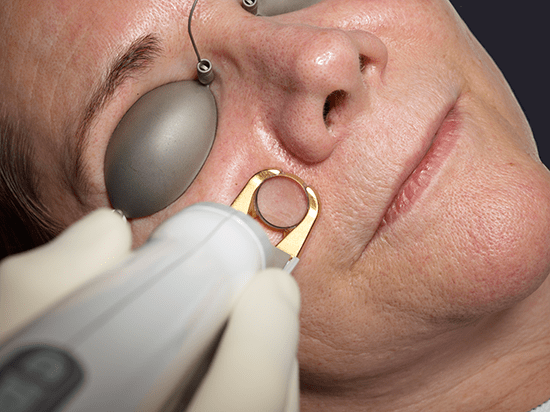
How effective is the neodymium laser in the treatment of keloids and hypertrophic scars?
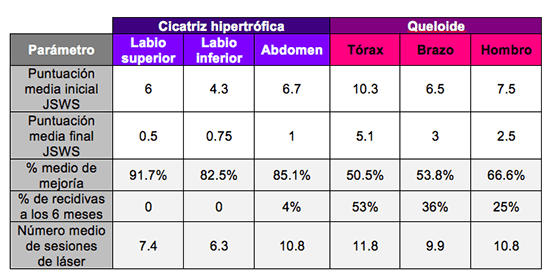
According to the study by Koike and colleagues, in which 102 patients participated, hypertrophic scars and keloids were evaluated using a scale that evaluated the induration, elevation, redness of the scar and its surroundings, spontaneous pain on pressure and pruritus (Japan Scar Workshop Scale, JSWS). The treatment was carried out with sessions spaced 3-4 weeks apart. The data provided by the study are the following:

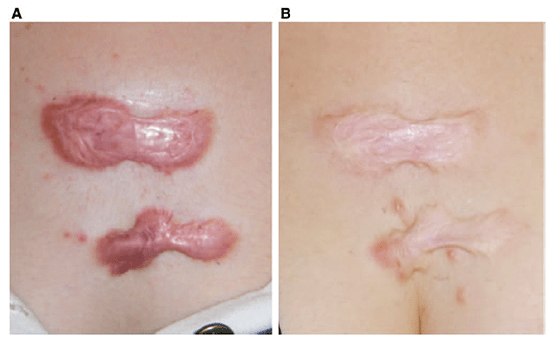
Which laser is more effective for treating keloids and hypertrophic cictrices, pulsed dye or neodymium?
There is a comparative study, by Al-Mohamady et al., where 28 patients with hypertrophic and keloid scars were treated with the two lasers: one half of the scar with the pulsed dye laser and the other half with the 1,064 nm neodymium laser, with a total of six sessions per patient.
Response was assessed one month after the end of treatment using the Vancouver scar scale (which assesses vascularity, pigmentation, elasticity, height, pain, and itching of scars). The degree of improvement with the pulsed dye laser on the Vancouver scale was 55.1%, and with the Nd:YAG laser it was 65.4%, although the differences were not statistically significant.
It seems that a slight superiority of the Nd:YAG laser was observed for hypertrophic scars, and of the pulsed dye in keloids, again without statistical significance. Both lasers improved the parameters of redness, height and elasticity of the scars, but did not produce changes in their pigmentation.
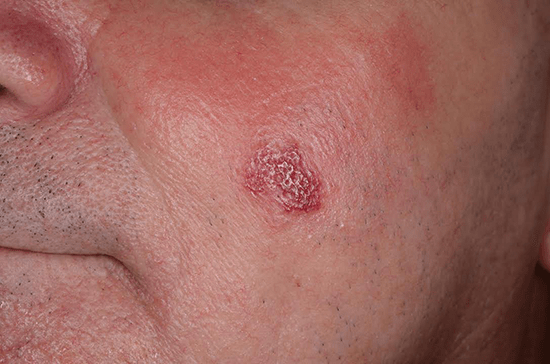
In terms of adverse effects, all patients experienced some discomfort during treatment. 35% of the subjects suffered from residual purpura (hematoma) and 10% hyperpigmentation in the area treated with pulsed dye. Blisters formed in 10% of the areas treated with Nd:YAG.
REFERENCES
· Koike S, Akaishi S, Nagashima Y, Dohi T, Hyakusoku H, Ogawa R. Nd:YAG Laser Treatment for Keloids and Hypertrophic Scars: An Analysis of 102 Cases. Plast Reconstr Surg Glob Open. 2015 Jan 8; 2(12):E272.
· Al-Mohamady Ael-S, Ibrahim SM, Muhammad MM. Pulsed dye laser versus long-pulsed Nd:YAG laser in the treatment of hypertrophic scars and keloid: A comparative randomized split-scar trial. J Cosmet Laser Ther. 2016 Aug; 18(4):208-12.