
Scar treatment. What is 5-fluorouracil?
It is a drug for the treatment of hypertrophic scars and keloids that reduces the production of genetic material needed by highly proliferative cells for reproduction. It is an analogue of pyrimidine (nucleic base) that acts as a metabolic inhibitor of thymidylate synthetase, causing less RNA (ribonucleic acid) to be produced. Through this action, cells that divide excessively, such as those in tumours or those in scars and keloids, reduce their metabolic rate and proliferation. Consequently, the degradation of hypertrophic scars and keloids is stimulated.
How is 5-fluorouracil used in the treatment of hypertrophic scars and keloids?
It is a drug available in liquid solution that is injected into the scars by puncture. It does not have any difference in terms of the procedure with respect to intralesional corticosteroids, but it does have some advantages that we will discuss later. In general, 5FU is administered in several sessions, separated from each other for a variable period ranging from one week to 4 weeks.
More rarely, 5FU can be applied topically after performing a fractional CO2 laser. This laser opens channels within the scar and allows a drug applied to the scar to penetrate more effectively.
What can we expect from the use of intralesional fluorouracil 5 in keloids?
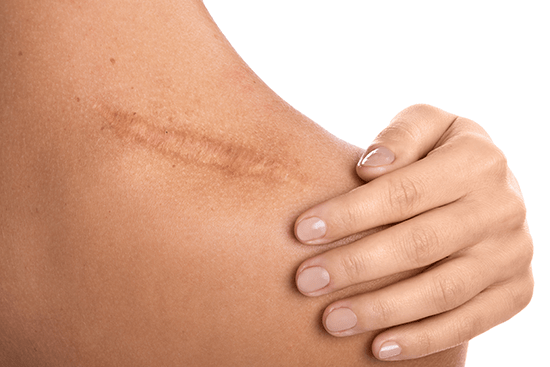
A review of published studies regarding their efficacy shows a clear decrease in keloid symptoms (itching, pain, tenderness) and a noticeable decrease in keloid height. Up to a third of keloids experience a flattening of more than 75% with complete treatment. Up to almost 80% of patients have a response between good (approx. 70%) and excellent (approx. 7%).
How long does the effect of 5-fluorouracil last?
In the articles published to date, with a follow-up of 6 months after the end of treatment, there has been no recurrence of keloids.
Do everyone respond the same to 5-fluorouracil for the treatment of keloids?
No. First, those keloids of less than 5 years of evolution tend to respond better than those that appeared more quickly. This is likely due to the fact that “young” keloids have a higher rate of proliferation and, therefore, blocking proliferation by 5FU is more effective.
Secondly, interpersonal variabilities in the response to 5FU have been described due to a change in the expression of different genes within keloids (YAP1 and CCL-2) that facilitate the treatment to be more or less effective.
What are the adverse effects of 5-fluorouracil injected on keloids or hypertrophic scars?
According to the publications, the adverse effects are local: pain at the time of puncture in all cases and the appearance of transient hyperpigmentation of the injection site on some occasions. Exceptionally, ulceration may be observed in the injection site.
Contrary to its intravenous use, intralesional injection of 5FU in scars is not associated with systemic adverse effects (anemia, thrombocytopenia, or leukopenia) in any of the scientific publications to date.
How much fluorouracil 5 is commonly used in the treatment of scars and keloids?
In Spain it is marketed at a concentration of 50mg/5mL. At this concentration, the publications recommend the injection of an amount of 2.5 – 10mL per session, every week, for up to 3 months.
What are the advantages and disadvantages of using 5-fluorouracil in the treatment of keloids?
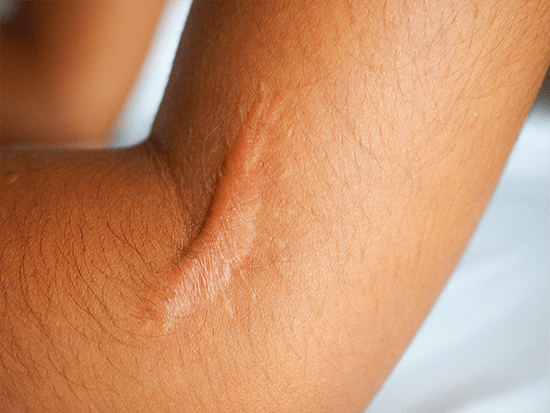
As advantages, 5FU can be combined with (or can replace) intralesional corticosteroid injection. Corticosteroids are an extraordinarily safe and effective drug, but in the treatment of keloids it is not uncommon that, if we are generous in its application, we can observe atrophy around the treated scar and the appearance of telangiectasias (blood capillaries) in the scar itself and/or its perimeter. 5FU is not angiogenic nor does it atrophy the surrounding tissue. However, in my experience, its action is later and less rapid than that of corticosteroids. It should also be said that the intralesional injection of 5FU is more painful than that of corticosteroids. This stinging lasts seconds or a few minutes, but usually does not occur with corticosteroids.
REFERENCES
· Ibrahim A et al. 5-FU for problematic scarring: review of the literature. Annals of burns and fire disasters; 31:2, 2018.