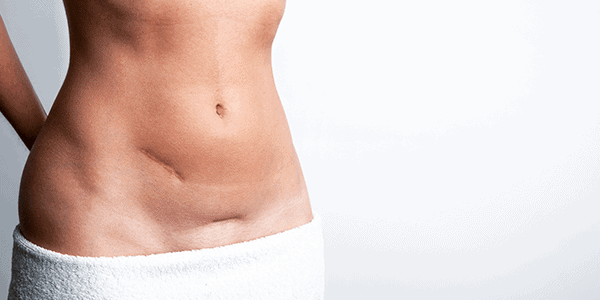
Cesarean section scar: why can it evolve into a keloid or a hypertrophic scar?
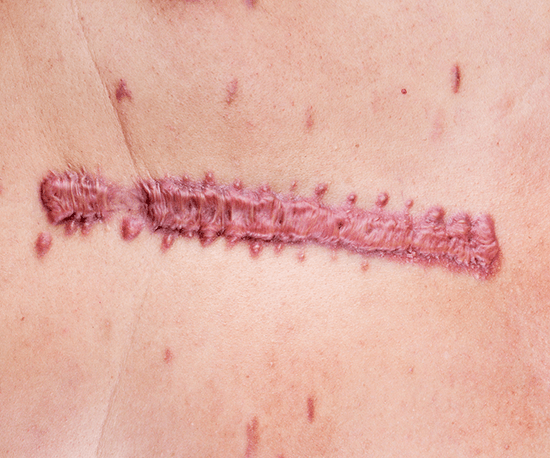
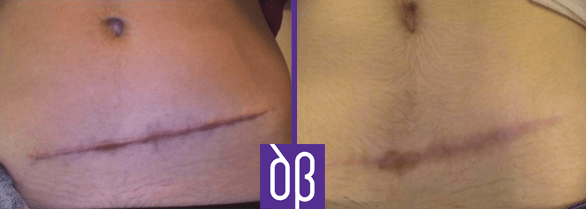
The incision of a cesarean section can often transform into a hypertrophic scar or a keloid. The hypertrophic scar has an excessive volume compared to that needed to repair the tissue, but it does not exceed the limits of the wound. The keloid, on the other hand, exceeds the limits of the wound and usually causes discomfort (pain, itching). The formation of this type of scar depends on several factors: the type of wound (surgical and clean, or traumatic and dirty); the area where the wound settles (more risk in the chest or upper back); the patient’s intrinsic ability to heal; the patient’s race (more risk in African Americans); and the topical care of the scar, among others. The area where the caesarean section incision is made, above the pubic section, is an area with a relatively low density of hair follicles. The follicles are precisely the reservoir from which the cells that will form the new scar are recruited. If these reservoirs are less abundant, the probability of an abnormal scar appearing is higher. It should also be noted that the pubic area is an area of insertion of a large number of muscles and abdominal fibrous tracts. As there is a high number of tension forces in the area, healing can be compromised. If we also remember that the abdominal skin has been subjected to a great deal of distension due to pregnancy, we will understand that the skin conditions are not optimal for an ideal healing process.
What treatment is recommended for cesarean scar?
If excessive scar tissue growth is observed in the first few weeks, it is advisable to use silicone patches so that the pressure exerted tries to contain the growth of the scar. The next step is usually the application of cryotherapy (liquid nitrogen) with or without local infiltration of corticosteroids. In hypertrophic scars and keloids, there is no physiological ‘stop’ signal in healing when the wound reaches the surface level of the skin: inflammation persists and the healing process continues indefinitely. Corticosteroids are anti-inflammatory and act by facilitating the stop signal in the scarring process, so they are usually effective in treating this type of scar. If these measures are insufficient, it is recommended to use lasers.
Here you can find out more about a therapeutic algorithm for hypertrophic scars and keloids.
What lasers are used to treat a cesarean scar?
There are two types of lighting systems that are of interest in treating the scar of a caesarean section. In the first phase, when the scar is still red and highly vascularised (capillaries), lasers can be used to act on the blood vessels: pulsed dye, KTP, neodymium or pulsed light. These devices eliminate excessive blood vessels and encourage the supply of aberrant pro-inflammatory substances to reach the scar. They have efficacy on the volume of the scar and on its colour. Once the inflammatory phase of the scar has passed, vascular lasers have little action.
You can find more information about KTP’s laser to treat scars here; and about neodymium, here.
In a second phase, in which the scar already has excessive volume, the aim of the treatment is to reorganise the aberrant collagen and manufacture a new one of higher quality. The lasers that reorganise collagen most effectively are the ablative fractional (click here) and non-ablative (here) lasers. These two devices impact the dermis (the intermediate part of the skin, where the collagen sits) and favour the manufacture of a new, more resistant collagen, which occupies less volume, and also rearrange the old collagen fibres to reduce the thickness and stiffness of the scar.
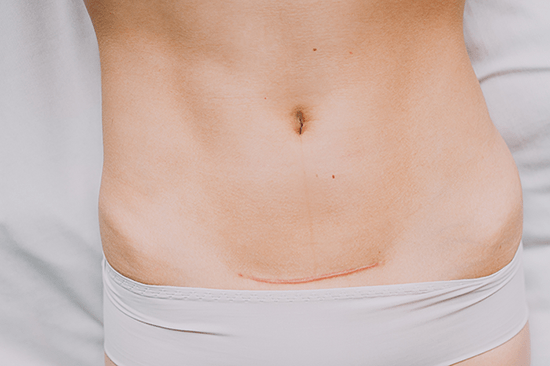
What is the difference between ablative and non-ablative fractional laser to treat a caesarean section scar?
The fractional ablative laser creates small columns of evaporated tissue, which are a very powerful stimulus for neocollagenogenesis. Its effectiveness and efficiency are greater than those of the non-ablative laser (it requires fewer sessions), although it causes the formation of micro-scabs that will fall off in the next 7 – 14 days. The fractional non-ablative laser does not form scabs but simply heats the scar tissue. After the session, redness and swelling of the area is observed that lasts a few hours or a few days. Despite this advantage, the efficiency of the non-ablative laser is significantly lower in general terms. In some comparative studies it has been observed that the non-ablative is more effective in reducing the redness of the scar and the ablative is more effective in reducing the thickness and hardness of the scar.
How many laser sessions are required to treat a cesarean section scar?
The number of sessions will depend on the patient’s ability to form new collagen; the lasers used and the initial volume of the scar. In general, if only the non-ablative fractional laser is used, it is necessary to perform 8 – 12 treatment sessions. If the ablative and non-ablative lasers are combined , about 6 – 10 in very thick scars is usually enough.
What improvement can be expected with laser treatment?
Taking into account the factors discussed above, the appearance and texture of the caesarean section scar can improve between 30 and 70%. These results are always subject to the variability of the individual ability to form new collagen.
REFERENCES
· Eilers RE Jr, Ross EV, Cohen JL, Ortiz AE. A Combination Approach to Surgical Scars. Dermatol Surg. 2016 May; 42 Suppl 2:S150-6.
· Koike S, Akaishi S, Nagashima Y, Dohi T, Hyakusoku H, Ogawa R. Nd:YAG Laser Treatment for Keloids and Hypertrophic Scars: An Analysis of 102 Cases. Plast Reconstr Surg Glob Open. 2015 Jan 8; 2(12):E272.
· Cassuto DA, Scrimali L, Siragò P. Treatment of hypertrophic scars and keloids with an LBO laser (532 nm) and silicone gel sheeting. J Cosmet Laser Ther. 2010 Feb; 12(1):32-7.