The most frequent aesthetic sequelae of acne is the formation of scars. Depending on the appearance they have with respect to the skin surface, they are divided into atrophic (when they are depressed) and hypertrophic or keloid (when they protrude from the skin surface and overflow the scarring area, respectively). Within the atrophic ones we can include the so-called “ice pick”, which has the appearance of punctiform perforations.
In this section we will talk about atrophic and ice-pick scars, to learn more about the therapy of hypertrophic and keloid scars you can go here.
Atrophic or depressed scars appear due to a defect in collagen and elastin in the dermis, the middle layer of the skin. Therefore, all therapies will be aimed at the formation and rearrangement of collagen dermal fibers.
Until now, previous treatments that obtained the best results have indeed managed to increase collagen synthesis, but with one major drawback: the epidermis (the outermost layer of the skin) had to be removed in order to treat the dermis. The systems that act in this way are deep peels and ablative lasers (e.g. CO2 or erbium). This type of therapy involves the formation of scabs and painful wounds, requires a period of skin re-epithelialization and preventive oral treatment for herpes simplex superinfection. Together, these factors mean that the rate of adverse effects or discomfort caused by the treatment is high and stops the patient’s usual pace of life.
Currently, non-ablative fractional laser systems have been produced, which allow a direct impact on the dermis while respecting the surface of the skin. Therefore, they promote the new formation of collagen without having to remove the epidermis and form wounds or scabs. The ablative fractional laser is applied with a refrigerated head on the skin to safeguard the epidermis and emits micro-columns of heat to the dermis to stimulate collagen synthesis. The formation of this new collagen progressively fills in the defects of the scars and homogenizes the surface of the skin, improving its external appearance and eliminating or significantly attenuating the depressions it presented. The process of collagen neoformation is not immediate and the effects of the therapy are perceptible after 3-4 weeks after the first session.
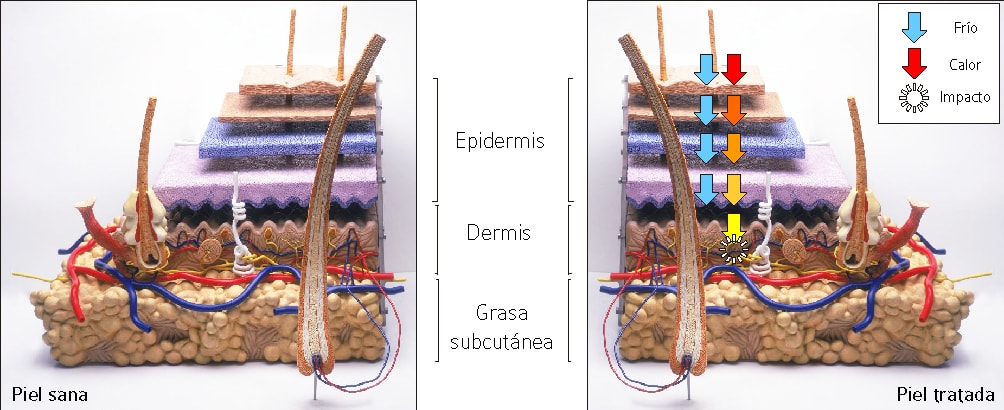
The treatment with non-ablative fractional laser is performed in sessions of minutes duration, separated by 4-6 weeks. The sessions are comfortable for the patient, not very bothersome, and only cause a transient erythema (redness) in the treated area, so they do not force the normal rhythm of life to be interrupted. After the treatment, it is not necessary to make any special treatment on the area, except for using sun protection.
An additional advantage of this treatment is that the new formation of collagen is a dynamic process that lasts several weeks, so once the therapy is finished it is possible to continue improving for a period. The number of sessions to be practiced varies depending on the type of scars, their depth and the possible combination with other therapies, although they usually range between 3 and 6 sessions.
Published studies regarding the application of non-ablative fractional laser for the treatment of acne scars show results of improvement of up to 75% in the irregularity of the skin surface, with a high degree of satisfaction on the part of the patient.
Finally, the treatment of acne scars with non-ablative fractional laser allows a perfect combination with additional therapies such as hyaluronic acid filler, superficial peels and rollers.
Treatment of acne scars with non-ablative fractional laser
→ Non-ablative fractional laser is an effective, safe , and comfortable treatment for all types of acne scars, especially atrophic scars.
→ It is a device approved since 2006 by the Food and Drug Administration (EUA) for its safety and efficacy profile for this indication.
→ Compared to other therapies, it is more comfortable and harmless for the patient, producing a transient erythema without the formation of scabs or wounds that force the normal rhythm of life to be interrupted.
→ The treatment is carried out with sessions of minutes and separated between 4 and 6 weeks.
→ Non-ablative fractional laser can be combined with other therapeutic options such as superficial peels, rollers or hyaluronic acid filler.
Clinical cases after 2-3 sessions


Explainer video
FREQUENTLY ASKED QUESTIONS
What is the best treatment for acne scars?
It depends on the type of scars. However, the non-ablative fractional laser is the one that allows all types to be treated, whether protruding or depressed, extensive or not, in a comfortable, safe and effective way. It is a treatment with an optimal risk/benefit ratio, and with very high rates of effectiveness and patient satisfaction. In addition, the cost/benefit ratio is more favourable than in other therapies.
Is non-ablative fractional laser effective for acne scars?
It is currently the treatment with the best risk/benefit ratio, above ablative lasers and deep peels. The reduction of skin irregularity can reach up to 75%.
What type of acne scars does non-ablative fractional laser improve?
It is effective in all hypertrophic, keloid and atrophic diseases, although it is in the latter where it is most useful.
Is it a very aggressive treatment that disrupts the normal rhythm of life?
No. It is not necessary to take sick leave, treat wounds or force you to take tablets to prevent bacterial infection. This system causes a transient redness of hours.
Does the treatment require hospitalization, stay-at-home or general anesthesia?
No. It is an outpatient treatment, lasting a few minutes, and not very painful. In addition, it is possible to use an anaesthetic cream applied before the session for greater comfort whenever necessary.
Is treating acne scars with non-ablative fractional laser very expensive?
It is currently the treatment with the best cost/benefit ratio, as it is effective, comfortable and does not have a higher cost than other treatments.
What are the sessions like? How often is it done? How many are needed?
They are outpatient. The refrigerated laser head is applied to the areas to be treated and pressed on them. They are not painful, and if it causes any discomfort, it is possible to use an anaesthetic cream beforehand. The sessions last a few minutes, depending on the extent of the scars, and are separated by 4-6 weeks. The number of sessions varies according to the depth and extension, and usually between 4 and 10 are needed.
What does the skin look like after having a fractional non-ablative laser session?
It usually only causes transient redness for hours. Very occasionally it can cause a slight edema (swelling) that lasts a few hours. The treatment does not force you to take sick leave nor does it involve a significant aesthetic alteration.
What care should I take after a non-ablative fractional laser session?
You should only apply sunscreen. As it does not cause scabs or wounds, it is not necessary to take or apply antibiotics or re-epithelializing creams.
REFERENCES
• Cho SB, Lee SJ, Cho S, Oh SH, Chung WS, Kang JM, Kim YK, Kim DH. Non-ablative 1550-nm erbium-glass and ablative 10 600-nm carbon dioxide fractional lasers for acne scars: a randomized split-face study with blinded response evaluation. J Eur Acad Dermatol Venereol. 2010 Aug; 24(8):921-5.
• Lene Hedelund, Karen Estell R. Moreau, Ditte M. Beyer, Peter Nymann, Merete Hædersdal. Fractional nonablative 1,540-nm laser resurfacing of atrophic acne scars. A randomized controlled trial with blinded response evaluation. Lasers Med Sci. 2010; 25:749–754.
Click here to learn more about the treatment of acne scars in ice pick.

Click here to find out what types of acne scars are there.

Click here to learn more about chemical peels on acne.
Click here to learn more about acne scar treatment with ablative laser.