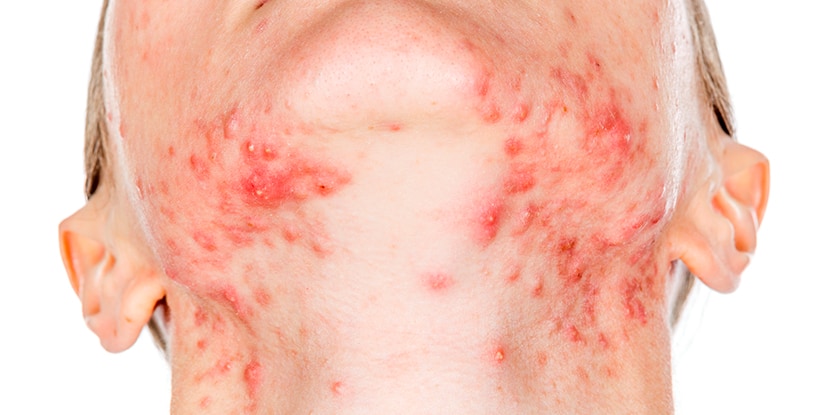
What is cystic acne?
It is a form of acne in which subcutaneous nodules filled with keratin (cysts) appear, which can become inflamed and/or infected (cystic-nodule acne). A not uncommon variant is characterized by the presence of a large number of cysts of a size less than 0.5 cm located on the face (“microcystic” acne).
What are the particularities of microcystic facial acne?
The treatment of cystic acne is usually a therapeutic challenge and usually requires the oral administration of isotretinoin. It is also not uncommon for treatment with isotretinoin to fail or have less success in facial microcystic forms than in other variants of the disease. It is also common that, due to manipulation or spontaneously, acne cysts can leave irreversible scars.
Why CO2 laser can be useful in the treatment of facial microcystic acne?
The CO2 laser can be used to open a communication between the inside of the cyst and the outside, in a delicate way and with minimal risk of scarring. In this way, it is possible to empty the contents of the cyst and expose the cyst capsule so that it can be removed permanently. Also, just at the end of the laser session, it is possible to apply a topical retinoid – derived from vitamin A – to reduce the risk of cyst recurrence. This type of treatment is called laser-assisted drug delivery.
What are the advantages of using CO2 laser for the treatment of cystic acne compared to other options?
Cysts are usually removed by surgery. The main problem with surgery is the resulting scar, especially if numerous cysts have to be removed and in a visible area such as the face. The CO2 laser has been shown to be effective in removing cysts in certain cases, without the need for surgery (more information here), so the wound does not need to be sutured and the risk of scarring is much lower.
How is CO2 laser used in the treatment of microcystic acne?
Depending on the number of cysts, it is used manually (shooting in each of the cysts) or in fractions (if there are many cysts, a sweep is made over the affected areas). The procedure is usually performed with topical anaesthesia applied in cream form for the previous 30-40 minutes. Once the CO2 laser has been passed, if desired, a 0.1% tretinoin cream can be applied to reduce the risk of relapse. This same preparation can be used every 12 hours for 3-4 days, taking advantage of the fact that the channels opened by the laser are still open.
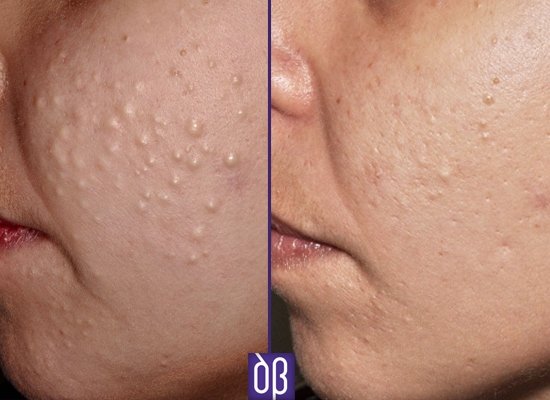
Can Tretinoin Only Clear Acne Cysts?
Although it is true that retinoids (such as tretinoin) are the cornerstone of acne treatment and improve all types of lesions, cysts do have a capsule that prevents drugs from penetrating them unless they are exposed to the outside by a puncture, incision or CO2 laser perforation. Therefore, tretinoin is usually the support and prevention part of microcystic acne, but it probably improves it little once the cysts are already established.
What care should be taken after treating microcystic acne with CO2 laser?
The CO2 laser creates a scab on top of each of the treated cysts, which corresponds to the opening that communicates the cyst with the outside. If the cysts are very numerous, the presence of scabs is noticeable and they last for a period of approximately 4 – 8 days. In addition to the tretinoin cream, an SPF 50 sunscreen should be applied to reduce the risk of residual hyperpigmentation.
Can CO2 laser leave scars on treated cysts?
Yes. The risk is minimal, but it is possible that punctate scars may remain. At the beginning of the process, during the first weeks, it is possible to observe the channels opened by the laser in the form of small depressions: this is normal and, most of the time, temporary. In any case, the cicatracices that could be left with the laser are significantly lower than those secondary to surgery. It should also be taken into account that when the cysts disappear and the volume they occupied, there is a certain tendency to atrophy in the area where they settled.
Can the combination of CO2 laser with subsequent topical drug application be used for other skin disorders?
Yes. Laser-assisted drug delivery is a field in full development in Dermatology, and is useful in other skin ailments such as milium cysts, in the treatment of hypertrophic scars and keloids, condylomas caused by the human papillomavirus… This type of technique will be a future therapeutic milestone.