
Why can short-pulse neodymium laser be useful for the treatment of keloids?
Keloids usually have a reddish color caused by an overgrowth of blood capillaries secondary to chronic inflammation. Therefore, lasers that impact and remove blood vessels, such as pulsed dye, KTP dye, long-pulse neodymium , or short-pulse neodymium, will be useful in reducing hypertrophic scars and reddish keloids.
What is Short Pulse Neodymium Laser?
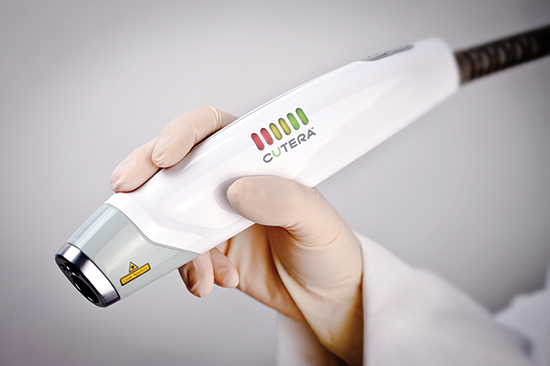
It is a laser device with a wavelength of 1,064 nm, capable of removing deep blood capillaries with a very short firing duration (0.3 ms). The very low firing duration makes the treatment very comfortable for the patient (it is not painful) and the safety of the treatment is very high (long pulses of energy can damage tissues).
How is short pulse neodymium laser treatment performed?
It is a device that does not contact the skin. It acts at a distance of about two centimeters. The dermatologist moves the handpiece as if it were a brush, ‘painting’ on top of the skin to be treated. The patient only experiences a sensation of heat, but no pain, since the laser has a temperature meter on the surface of the skin: at all times, the operator knows the skin temperature and keeps it below 42ºC.
The complete treatment is carried out through several sessions, separated by 3-4 weeks, in which between 500 and 1,000 pulses are emitted on the keloid. The number of sessions depends on the extent and thickness of the scar, as well as the combination with other therapeutic weapons (here you have more information), although the average number of sessions is approximately 10.
What are the results of treating keloids with short-pulse neodymium lasers?
In Akaishi’s study, in which a total of 22 patients participated, different parameters of keloids were evaluated: redness, height, hardness, itching and pain. A scale was applied from 0 to 3, where 0 is ‘absent’ and 3 is ‘severe’ (therefore the score of the most severe keloid is 15). The initial mean score was 10 and at the end the study was 6.
90% of keloids experienced a clear reduction in size. Mean redness decreased from 2.3 to 1.5; average height and hardness went from 2 to 1.2; and itching and pain decreased from 1.75 to 0.75.
Interestingly, the authors observed these improvements regardless of the following factors: age of the patient, origin and number of keloids, location of keloids, or tension in the scar area.
REFERENCES
· Akaishi S, Koike S, Dohi T, Kobe K, Hyakusoku H, Ogawa R. Nd:YAG Laser Treatment of Keloids and Hypertrophic Scars. Eplasty. 2012; 12:e1.
· Rossi A, Lu R, Frey MK, Kubota T, Smith LA, Perez M. The use of the 300 microsecond 1064 nm Nd:YAG laser in the treatment of keloids. J Drugs Dermatol. 2013 Nov; 12(11):1256-62.