Best Laser for Treating Acne Scars
What types of lasers are commonly used to treat atrophic acne scars?
In general terms, the most commonly used devices are those that promote the formation of collagen in the dermis, whose function will be to fill in the atrophy of the scars and facilitate the tightening (skin tightening) of the skin surface. Among these are erbium lasers (classic ablative, fractional ablative or non-ablative) and CO2 lasers (classic ablative or fractional ablative). To learn more about what the ‘fractionation’ of a laser means, you can consult here; and if you want to know more about non-ablative lasers, click here.
Conceptually, splitting a laser beam is dividing the same energy that circulates through a single beam into different beams (as a shower head does); and a non-ablative laser manages to treat the middle layer of the skin without damaging the superficial layer (epidermis), so it does not cause crusts during the procedure – but it is less efficient. By ‘resurfacing‘ we mean creating a new layer of skin from a laser treatment applied to a wide area, usually the entire face. Resurfacings can be with fractional or non-fractional ablative lasers (classic).
What are the differences between these lasers and their effects?
Ablative lasers penetrate to the dermis, removing the upper layers of the skin by heat: they form wounds that, when re-epithelialized, help to fill existing defects with new collagen. They are more aggressive (they form scabs), more efficient (higher results per session) and more effective (the degree of final improvement is higher). Among them are the CO2 laser and the 2940 nm erbium laser. When forming wounds, they also have more associated risks (infection, pigmentation disorders, scar formation) even though they are very safe devices. Non-ablative lasers (mainly the 1540 nm erbium laser) do not remove the epidermis when they work, so they do not cause scabs and the associated risks are practically zero, although they are less efficient and effective (they require many more treatment sessions and the final response is lower than that of ablatives).
How was the only comparative study of lasers for the treatment of acne scars carried out?
To date, the study by You HJ et al. is the only one of its kind. This is a retrospective study in which the therapeutic responses and the rate of adverse effects that have occurred in patients treated for acne scars with four different types of lasers have been analyzed: classic CO2 (unfractionated), classic ablative erbium:YAG (unfractionated), non-ablative fractionated erbium and fractionated CO2. The response was evaluated by digital photography by 3 plastic surgeons and 3 nurses with a scale ranging from 0 (no improvement) to 10 (excellent improvement). Patients were asked about the adverse effects presented (bleeding, exudate, scaling, crusting, redness and post-procedure recovery time). A total of 58 patients were analyzed.
What were the results?
· 60% of men and 40% of women participated.
· The patients were phototype IV.
· The mean age of the patients was 27.2 ± 6.3 years.
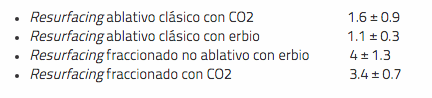
· The average number of treatments was as follows:
· The response was positive in all patients from weeks 3 – 8 after the procedure.
· The average degree of improvement (out of 10) was as follows:
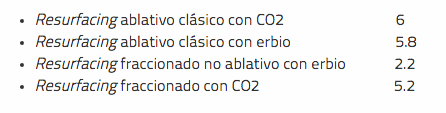
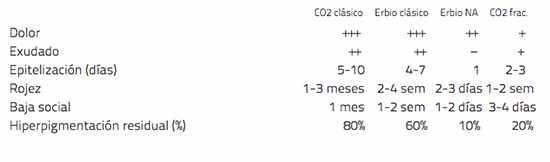
· Fractional CO2 laser resurfacing offers a clinical result very similar to classic erbium or CO2 resurfacing. Non-ablative laser resurfacing showed a clearly inferior result to the other options, as were the adverse effects in patients undergoing this treatment.
· As for the adverse effects, their statistics were as follows:
How should these results be interpreted?
This is a study carried out in a single centre, in a relatively small sample of patients, and is retrospective. The quality of this type of data, although they can give us a good overview of the subject, is relative. However, they are in line with the vast majority of (non-comparative) studies of acne scars treated with lasers: the more aggressive the mode of treatment, the greater the improvement obtained but with a greater probability of adverse effects.
A point to take into account in this study is the geographical location in which it was carried out (Korea). This justifies that the participants are phototype IV and, therefore, that there is a much higher risk of adverse effects related to skin pigmentation than if it is practiced in patients with lower phototypes.
A very interesting aspect to note is the small difference obtained between the results of a classic (non-fractional) resurfacing and an ablative fractional resurfacing with CO2. The result obtained is similar, but in the second case the rate of potential complications is clearly lower.
So, what is the best laser to treat acne scars and marks?
In view of the results of this comparative study and many other isolated ones, we can conclude the following:
· The highest degree of improvement is obtained with ablative devices, which require fewer work sessions but can be related to a higher rate of adverse effects compared to non-ablative lasers.
· Probably, the slightly higher benefit obtained with a classic (non-fractional) resurfacing session compared to two or more of ablative fractionation does not justify the use of the former, since it has a clearly higher probability of adverse effects.
· The efficiency and effectiveness of an ablative device is higher than that of a non-ablative device, which needs a much higher number of sessions to achieve a lower result (depending on the type of scars). However, non-ablative lasers have a very high safety . The greater number of sessions required can cause the cost of non-ablative laser treatment to be higher than that of the ablative laser (to be assessed according to each case).
· The combination of ablative laser (classic or fractional) in a limited way in the most stubborn atrophic scars together with fieldwork with non-ablative fractional laser in the same session probably provides a balance between the efficacy of the treatment, the cost and the risk of associated adverse effects. The same can happen with techniques other than light devices (e.g., fillings, subcision).
REFERENCES
· You HJ, Kim DW, Yoon ES, Park SH. Comparison of four different lasers for acne scars: Resurfacing and fractional lasers. J Plast Reconstr Aesthet Surg. 2016 Apr; 69(4):E87-95.