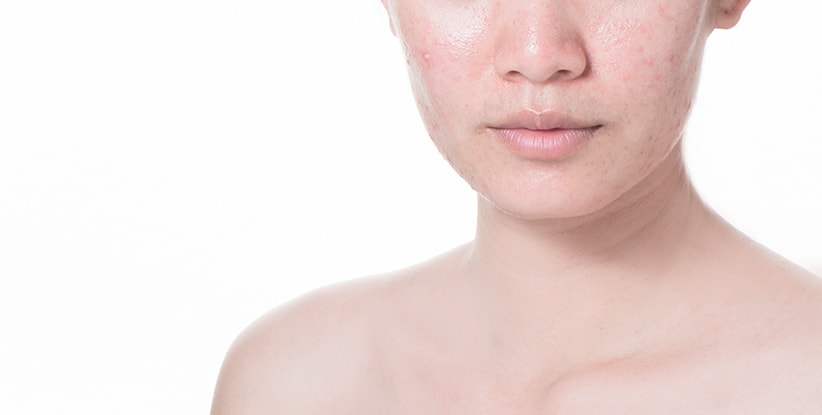
Why are hormones important in women’s acne?
Hormones are involved in the origin of acne in both women and men. However, in the case of women there are some hormonal disorders that may be the underlying cause of the appearance of acne, especially over the age of twenty.
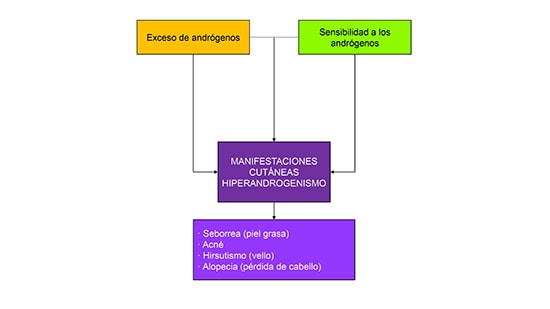
The stimulation of the hair follicle by androgens is one of the keys to the appearance and/or maintenance of acne. Androgens are hormones that, among other functions, promote the secretion of sebum in the pilosebaceous gland, the increase of body hair and hair loss. They are typical of men, but they are also present in women.
In fact, the external manifestations of an excess of androgen action in women (“hyperandrogenism“) may have two basic origins.
Firstly, it is possible to have an excess amount of androgens and therefore ultimately perform too much action on their physiological targets (this can be seen, e.g., in congenital adrenal hyperplasia).
Secondly, androgen levels may be normal but the targets where they function (androgen receptors) can be very sensitive to them: therefore, they overwork even if the total amount of hormone is normal. This occurs, for example, in SAHA syndrome (click here for more information).
And, finally, there may be a combination of both factors: having an excess of androgens and that the receptors are very sensitive to them, as may be the case with polycystic ovary syndrome (click here for more information).
Why can hormonal treatment be important in women’s acne?
In cases where there is an excess of androgens, sensitivity to them or a combination of both, hormonal regulation can improve or eliminate acne. In these cases, isotretinoin therapy usually fails to control the disease since it does not act on the origin of acne due to hyperandrogenism.
Are all hormonal acne treatments birth control?
No. There are drugs with contraceptive action and others that are antiandrogenic but not contraceptive.
Do all birth control improve or cure acne?
No. There are some contraceptives with androgenic action that can even worsen acne. For example, those that only contain gestagens (one of the two possible components of an oral contraceptive).
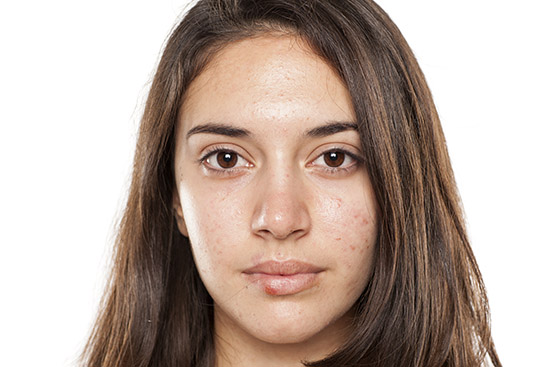
What types of hormonal treatments are there for women’s acne?
· ORAL CONTRACEPTIVES. It is a pharmacological combination of an estrogen (usually ethinyl estradiol) and a gestagen (highly variable). The gestagens approved by the FDA for the treatment of acne from the age of 14 are norgestimate, norethindrone and drospirenone. However, there are other gestagens that, although not approved by the FDA, have enough scientific evidence to confirm that they improve acne: levonorgestrel, dienogest and chlormanidone.
Oral contraceptives reduce the production of androgens by the ovary and adrenal gland; they reduce the production of the hormone LH (which stimulates the synthesis of ovarian androgens); they increase the production of the SHBG hormone (which captures free testosterone in the blood so that it can exert less action) and some also inhibit 5 alpha reductase (which converts testosterone into dihydrotestosterone, the most potent androgen). In conclusion, oral contraceptives are antiandrogenic. Their action takes a minimum of three months to become apparent.
If you want to have more information about oral contraceptives and acne, click here.
· SPIRONOLACTONE. Spironolactone is a diuretic used mainly in the treatment of hypertension and heart failure. However, it has a double antiandrogenic action: it blocks androgen receptors and inhibits 5 alpha reductase. It is an oral medication that can be taken for this indication at a dose of 50 – 200 mg/day. The improvement of the acne symptoms with spironolactone begins in the first three months of taking it. The adverse effects of spironolactone are usually dose-dependent and exceptional at low doses: headache, increased urine output, menstrual irregularity and mastalgia (breast pain). It should be avoided during pregnancy due to the risk of feminization of the fetus.
· CYPROTERONE ACETATE. It is an antagonist of androgen receptors, especially dihydrotestosterone. It also inhibits the conversion of dihydroepiandrostendedione to androstenedione. It is usually associated with ethinyl estradiol to have contraceptive action, although its use is not necessarily linked to this combination. Studies have shown improvements in acne of 75 to 90% in less than three months of use. It may have a risk of hepatotoxicity at high doses. For this reason, it is used in low quantities, usually only during the first 10 days of the menstrual cycle, usually combined with a state-of-the-art contraceptive.
REFERENCES
· Hassoun LA, Chahal DS, Sivamani RK, Larsen LN. The use of hormonal agents in the treatment of acne. Semin Cutan Med Surg. 2016 Jun; 35(2):68-73.