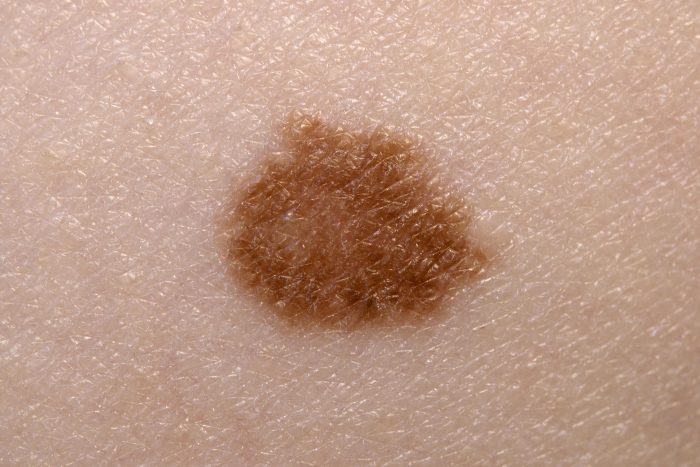
MYTHS AND FALSE BELIEFS ABOUT MOLES AND THE SUN
1. “Moles on palms or soles are malignant and have to be removed”
This is not true. Previously, without dermoscopy or epiluminescence, studying the pigmented pattern of palmoplantar lesions was practically impossible, but nowadays this tool can determine signs of benignity and malignancy of moles and freckles, including those of the palms and soles. It should also be said that the vast majority of the time the pigmented lesions in these areas are not malignant. In the event of the appearance of a pigmented lesion on the palms or soles, it is necessary to consult a dermatologist to confirm whether it is a benign lesion and determine whether or not its excision is necessary.
2. “Moles have to protect themselves more from the sun than skin that does not have moles”
False. Moles are accumulations of melanocytes, the cells that are responsible for protecting the skin from ultraviolet radiation. For this reason, as they have more cells, they are more protected than normal skin. Melanoma (more aggressive skin cancer) is more common on normal skin than on moles. The skin, with or without moles, has to be protected in the same way, with SPF 30-50 sunscreen and avoiding direct sun for 12 to 16 hours.
3. “Traditional moles can’t be bad”
Incorrect. Although skin cancer is more common on healthy skin and not on moles, even a mole present from birth or childhood (congenital melanocytic nevus) has a certain risk of degeneration to cancer. Thus, it is strictly necessary to have a periodic check-up with your dermatologist by means of dermoscopy, to observe your pigmented lesions.
4. “Moles with hairs are bad”
It is not true. Although there are melanomas (aggressive skin cancer) that have hair follicles, the presence of a hair in a pigmented lesion is a sign of benignity most of the time, especially if it has perifollicular hypopigmentation around it, observed by dermoscopy.
5. “You can’t wax or remove hairs from moles because they become bad.”
False. The hair of a melanocytic nevus (mole) can be removed by any physical method to improve aesthetics, without the risk of malignancy.
6. “If a mole changes, I have to consult a dermatologist.”
True, and recommended. The changes in the size, color, shape or symptoms provided by moles are reason to consult with an expert in Dermoscopy to confirm if it is a benign mole or if it presents signs that suggest its removal and histological analysis to rule out skin cancer.
7. “If I don’t get sunburned and I’m very dark, I can’t have a freckle bad.”
False. Although skin cancers are more common in people with light skin, eyes and hair, people with darker phototypes may also have melanoma and other skin tumors. In fact, it is not uncommon for these to be the people who are least protected from the sun, so their risk increases.
8. “If I put on sunscreen I can spend all day in the sun because I am protected.”
Incorrect. Sunscreen is effective for a maximum of two hours. It should be applied half an hour before exposure to the Sun and renewed every two hours at most, or when you get out of the water (even if they are ‘waterproof’).
9. “Any sunscreen is good, they’re all the same.”
It is not true. Those with SPF less than 30 have a minimum efficacy, so those that bring a factor higher than the aforementioned are recommended.
10. “If I put on sunscreen I don’t get a tan.”
False. Sunscreen attenuates some of the UVA and UVB rays, but not all. Using sunscreen allows the aesthetic benefit of the sun (getting a tan) and reduces the risk of skin cancer. It is true that tanning takes a little longer to appear if sunscreen is used, but the risk/benefit ratio is clearly in favor of the use of sunscreens.