What is squamous cell carcinoma of the skin?
Squamous cell carcinoma is a malignancy derived from keratinocytes, the cells that make up the upper layers of the skin. Although the prognosis is usually good, it has the potential to spread to surrounding tissues and can also spread to other organs at a distance (metastasis).
Is squamous cell carcinoma of the skin serious?
Most squamous cell carcinomas of the skin are low-risk and manageable with treatment, with a favorable prognosis when diagnosis and therapy are early. However, if not diagnosed early, it can spread to distant organs and in advanced cases cause death.
What does the prognosis of squamous cell carcinoma of the skin depend on?
Various factors such as size, time of evolution, location, histological type (microscopic), the patient’s immunological capacity, the causative factor… The combination of these factors varies the behaviour of the tumour.
Is squamous cell carcinoma common?
It is the second most common type of malignant skin tumor, after basal cell carcinoma. It is usually more common in sunny population areas and in fair-skinned people chronically exposed to the elements.
Why does squamous cell carcinoma of the skin appear?
The main risk factor is chronic exposure to ultraviolet radiation (Sun, UVA), although it can arise as a result of other factors such as radiotherapy, burns, wounds or chronic unhealed infections.
In which area does it usually appear?
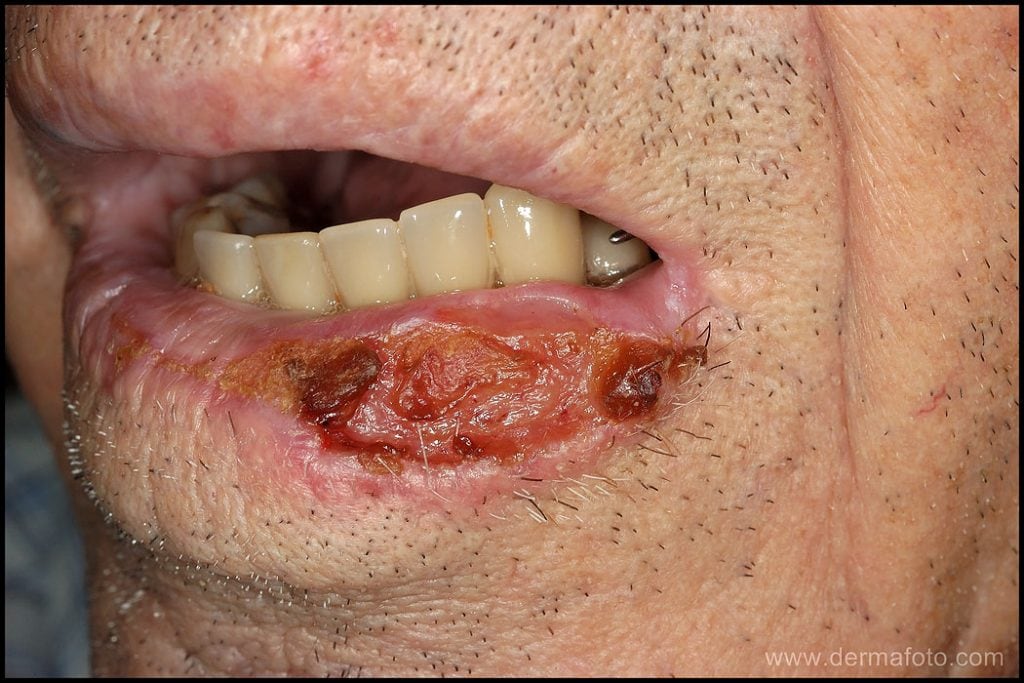
It is typical of areas chronically exposed to the sun, such as the scalp in people with little hair, the face, ears, or the lower lip.
Although squamous cell carcinoma usually appears in the skin, it can be seen within the oral mucosa or in the genital mucosa. In the case of the oral mucosa, accompanying risk factors, such as smoking and alcohol consumption, frequently appear.
What does squamous cell carcinoma of the skin look like?
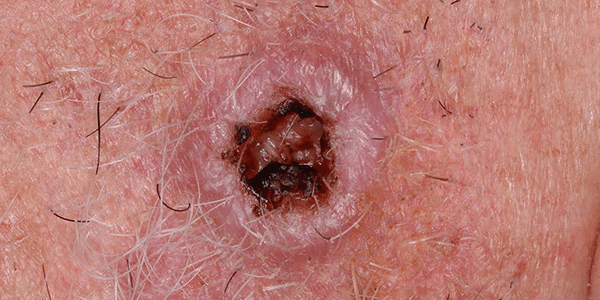
It usually manifests as a protruding lesion, of variable size (papule, plaque or nodule), pink in color, with a crust on its surface, and progressive growth. On palpation it usually appears indurated. More rarely it does not have a superficial crust or has the appearance of an ulcer.
How is squamous cell carcinoma of the skin diagnosed?
The fetal diagnosis is made by a skin biopsy observed under a microscope. However, the experienced dermatologist is usually able to guide the diagnosis by natural observation or with dermoscopy. When in doubt, a confirmatory biopsy should always be performed.
What is the treatment for squamous cell carcinoma of the skin?
Treatment is aimed at the complete elimination of the tumour, which is usually achieved by surgical removal with safety margins and histological verification (observation under a microscope). It should always be checked by microscopy if the lesion has been completely removed.
In general, simple excision is usually sufficient for the elimination of the tumor, although in complex areas or in high-risk tumors, better results have been observed by Mohs micrographic surgery. This allows the complete resection of the lesion to be verified in the same surgical act. However, there are no large studies that have compared the results of conventional surgery with Mohs surgery, so this is not routinely performed except in high-risk tumors or when they recur after a first removal.
Especially in high-risk lesions, before surgery, it is advisable to carry out an imaging study (e.g. ultrasound, CT or MRI) to observe the boundaries of the lesion and the lymph nodes in the drainage area.
Is there only surgery to treat squamous cell carcinoma of the skin?
No. Excellent results have been published with curettage (and electrocoagulation of the wound bed), and with cryotherapy (destruction by liquid nitrogen). However, these therapies depend on the expertise of the surgeon and do not allow histological confirmation (biopsy) of their complete removal.
Radiotherapy is also a therapeutic option in patients with conditions that contraindicate surgery or in certain tumour sites with a high degree of surgical difficulty (floor of the mouth, lip, nasal vestibule or ear). Studies show results comparable to surgery.
REFERENCES
· Motley R, Kersey P, Lawrence C; British Association of Dermatologists; British Association of Plastic Surgeons. Multiprofessional guidelines for the management of the patient with primary cutaneous squamous cell carcinoma. Br J Plast Surg. 2003 Mar; 56(2):85-91.
ACKNOWLEDGEMENTS
To Dr. Leo Barco, for the clinical images that you will find in Dermafoto, the online Dermatology atlas.