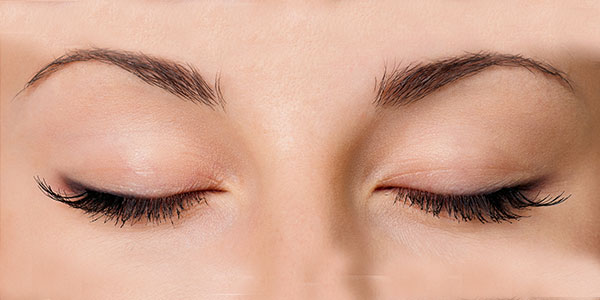
What are Xanthelasma?
They are well-defined yellowish papules or plaques, which are generally located in the inner canthus of the eyelids. They consist of cholesterol deposits in the dermis, and in up to 50% of cases can be associated with hypercholesterolemia in the blood. They do not pose any health problem, but they do pose a very common aesthetic discomfort. For more information about xanthelasma, click here.
Can Xanthelasmas Be Removed?
Yes. There are mainly four therapeutic options: surgery (scalpel excision and stitch suture); electrosurgery (electrocoagulant removal); 30% trichloroacetic acid (TCA) peeling and CO2 laser vaporization.
What are the options for removing xanthelasmas?
Of the four options discussed, we will not discuss the surgical ones since, although effective, they are more traumatic than other alternatives and the probability of scarring or resulting retraction is higher than with either of the other two. Therefore, we will talk in more detail about the TCA peeling and the CO2 laser.
Trichloroacetic acid is a liquid that, when applied to the skin, destroys its superficial layers until it reaches the dermis, where the xanthelasma cholesterol deposit is located. It is applied to them with a cotton swab in different weekly sessions until the xanthelasma disappears completely. With each session, the skin where the TCA is applied is reddish and forms a crust that will fall off over a few days. It is an effective method, although it has two basic drawbacks that lie in the nature of the TCA. As it is a liquid, it can run if the drop applied is thick, and therefore it can damage noble structures (eyelid, eye) if you do not proceed with strict caution. Precisely to avoid this, you usually work with minute amounts of liquid. However, the fact of working with so little liquid will force the number of sessions to remove xanthelasmas to be high.
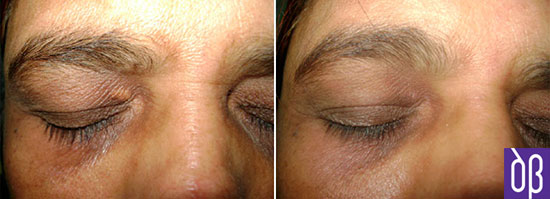
The CO2 laser forms a beam of light that specifically impacts the water, vaporizing the skin that contains it. The laser only acts on the structures where it impacts and fully respects the surrounding tissues. We can also program its parameters to control the depth to which the treatment reaches. Consequently, the CO2 laser is a very precise device. The treatment forms a superficial wound where the laser acts, which will later epithelialize through a scab that will come off in a few days. As the adjustable parameters allow you to program in detail the part of skin that we want to remove, the number of sessions needed to treat xanthelasmas is less than those of TCA. However, the TCA is an economical method (since the liquid is not expensive) and very simple to perform. On the other hand, the CO2 laser device has a very high cost, and the duration and work provided by each session are noticeably longer. Therefore, a CO2 laser session usually costs more than a TCA session.
Which system is better for removing xanthelasma, CO2 laser, or trichloroacetic acid?
In comparative studies, the complete clearance rate of xanthelasmas with the CO2 laser is 100%; the TCA is 56%. The higher the xanthelasma, the greater the effectiveness of CO2 over the TCA. In most cases, it takes between one and three sessions (1.56 sessions on average) with the CO2 laser to completely remove the xanthelasmas. With the TCA, it takes between nine and twelve sessions to achieve a complete response (9.74 sessions on average). As for xanthelasma recurrences , they are less frequent and later in patients treated with laser (from 6 months) than in those treated with ED (from the third month).
What are the adverse effects of trichloroacetic acid and CO2 laser for treating xanthelasmas?
Both systems can cause pigmentary changes (dark or light spot) in the treated area. These pigmentary changes are slightly more frequent in patients treated with laser than with TCA. Pigmentation alterations are temporary and do not last beyond 6 months. TCA most often causes ulceration of the skin in the applied area; while CO2 laser causes more prolonged erythema (redness lasting weeks). Both unwanted effects are temporary.
Neither xanthelasmas treated with TCA nor CO2 laser are usually associated with scarring, retraction or ectropion, as can occur in surgical options. The risk of these adverse effects is minimal with either of the two options mentioned above and much lower than with surgical alternatives.
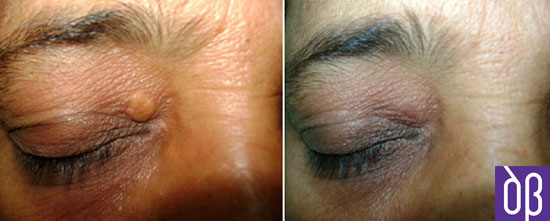
How likely are xanthelasmas to come back?
Studies indicate that, using surgical techniques, the probability of relapse is 40 – 60%; with TCA between 25 – 40%; and with CO2 laser between 9 – 16%. Relapse times after treatment are shorter with surgery, then with TCA and finally with CO2 laser. In conclusion, the CO2 laser is the system that offers the least probability of relapse and favors that if it occurs it is as late as possible. This is especially true the larger and deeper the xanthelasma.
If xanthelasma is caused by hyperlipoproteinemia in the blood and this does not resolve, the recurrence of xanthelasma is practically constant. Therefore, it is strictly necessary that blood lipid levels are kept as low as possible at all times.

Click here for more information on Xanthelasmas and CO2 Lasers.
REFERENCES
· Khushbu Goel, Kabir Sardana, Vijay Kumar Garg. A prospective study comparing ultrapulse CO2 laser and trichloroacetic acid in treatment of Xanthelasma palpebrarum. Journal of Cosmetic Dermatology, 14, 130-139.