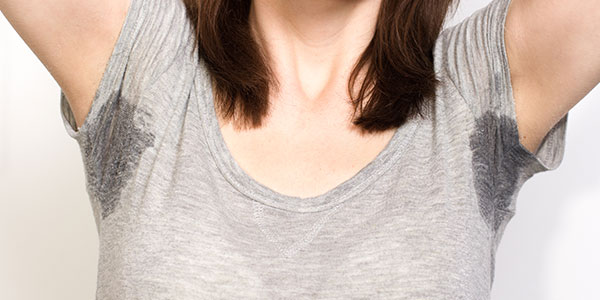
Axillary hyperhidrosis with botulinum toxin
What is axillary hyperhidrosis?
In axillary hyperhidrosis there is an excess of function of the eccrine sweat glands that leads to continuous sweating in the armpits, without being justified by circumstances (physical activity, stress, heat). It is a chronic disorder that is exacerbated in times of emotional stimuli (stress, embarrassment). It is considered that it can affect up to 2.5% of the population and has a critical impact on the patient’s quality of life , and can restrict their routine activities and social relationships.
Why does hyperhidrosis appear?
Although it is a disorder of unknown cause, in hyperhidrosis there is an excess of sympathetic activity (dysregulation) in our autonomic nervous system: it sends unnecessary stimuli to the sweat glands to increase their production. Therefore, it seems that the fundamental cause is neurological, rather than cutaneous.
How is axillary hyperhidrosis treated?
There are three types of therapeutic options:
· Locally applicable. Included in this category are topical products with aluminum salts, iontophoresis (electric currents applied through baths), botulinum toxin, and microwave systems that destroy sweat glands.
· Oral administration. Some drugs such as glycopyrrolate or clonidine are used to regulate the autonomic nervous system and improve the hyperstimulation it produces.
· Surgical. It contemplates options that remove glandular tissue (liposuction, lipolaser, surgical excision) or those that ‘disconnect’ the autonomic nervous system from the sweat glands (transthoracic sympathectomy).
What is the best treatment for axillary hyperhidrosis?
The application of botulinum toxin is considered the best therapeutic option, as it has an optimal efficacy/safety/profitability ratio. To this day it is still considered the gold standard, the basic treatment with which the rest are compared.
Botulinum toxin infiltration is an outpatient procedure, lasting a few minutes , painless if performed with anaesthetic cream, without remarkable adverse effects and with a prolonged duration of effect (months). The rest of the options discussed are less effective (treatments for local application), with more risks (surgical) or economically limiting (sympathectomy, microwave).
How does botulinum toxin work in the treatment of axillary hyperhidrosis?
Botulinum toxin temporarily blocks the release of acetylcholine from sympathetic nerve fibers, which is the biochemical signal that stimulates the sweat glands in the armpit. In this way, a temporary and reversible ‘denervation’ of the sweat glands is obtained.
How is axillary hyperhidrosis treated with botulinum toxin?
The botulinum toxin is infiltrated with different intradermal punctures (about twenty per side, approximately) in the axillary area, after leaving an anesthetic cream on for thirty minutes. These punctures are separated by 1.5 – 2 square centimeters, following a grid that is drawn on top of the skin to be treated, as shown in the video. In general, the process is painless or occasionally you can perceive minimal discomfort with one of the punctures, only at the time of injection. The procedure lasts between 5 and 10 minutes. Subsequently, the patient can go about their usual rhythm of life. The effect of botulinum toxin is perceived after 3-5 days
How long does the effect of botulinum toxin last in the treatment of axillary hyperhidrosis?
The action of botulinum toxin is limited in time. There is variation in the duration of its effect among patients, although it is considered to last, most of the time, between 4 and 12 months (7 on average). Recent studies have confirmed that the repetitive use of botulinum toxin increases the duration of the effect. In some series, 90% of patients who use botulinum toxin for axillary hyperhidrosis score this procedure with a 9 out of 10 in terms of satisfaction.
What are the adverse effects of using botulinum toxin for the treatment of axillary hyperhidrosis?
The application of botulinum toxin, either for hyperhidrosis or to improve expression wrinkles, is the safest aesthetic procedure that exists, above lasers, fillers, peelings and any surgical treatment. During the application procedure, minimal pain can be felt with some of the infiltrations that are practiced. In 9% of cases, a small hematoma can form if one of the punctures contacts a blood capillary; and compensatory hypersweating in the trunk occurs in less than 6% of the cases (a lower rate than other therapeutic options).

Which is more cost-effective in the treatment of axillary hyperhidrosis, performing endoscopic thoracic sympathectomy or repeated application of botulinum toxin?
Given the natural persistence of hyperhidrosis and the limited duration of the effect of botulinum toxin, some authors have conducted cost/effectiveness studies comparing repetitive use of botulinum toxin versus endoscopic transthoracic sympathectomy.
According to Gibbons et al., in order to cover the costs of endoscopic thoracic sympathectomy without postoperative complications, the same patient could apply botulinum toxin for a total of 13.3 years. The authors of the same study suggest that, given the extreme safety of botulinum toxin application for this indication, this technique should be considered the gold standard.
REFERENCES
· D’Epiro S, Macaluso L, Salvi M, Luci C, Mattozzi C, Marzocca F, Salvo V, Scarnò M, Calvieri S, Richetta AG. Safety and prolonged efficacy of Botulin Toxin A in primary hyperhidrosis. Clin Ter. 2014; 165(6):e395-400.
· Brehmer F, Lockmann A, Grönemeyer LL, Kretschmer L, Schön MP, Thoms KM. Repetitive injections of botulinum toxin A continuously increase the duration of efficacy in primary axillary hyperhidrosis: a retrospective analysis in 101 patients. J Dtsch Dermatol Ges. 2015 Aug; 13(8):799-805.
· Gibbons JP, Nugent E, O’Donohoe N, Maher B, Egan B, Feeley M, Tierney S. Experience with botulinum toxin therapy for axillary hyperhidrosis and comparison to modelled data for endoscopic thoracic sympathectomy – A quality of life and cost effectiveness analysis. Surgeon. 2015 Jun 10.
· Scamoni S, Valdatta L, Frigo C, Maggiulli F, Cherubino M. Treatment of primary axillary hyperhidrosis with botulinum toxin type a: our experience in 50 patients from 2007 to 2010. Dermatol ISRN. 2012;2012:702714.