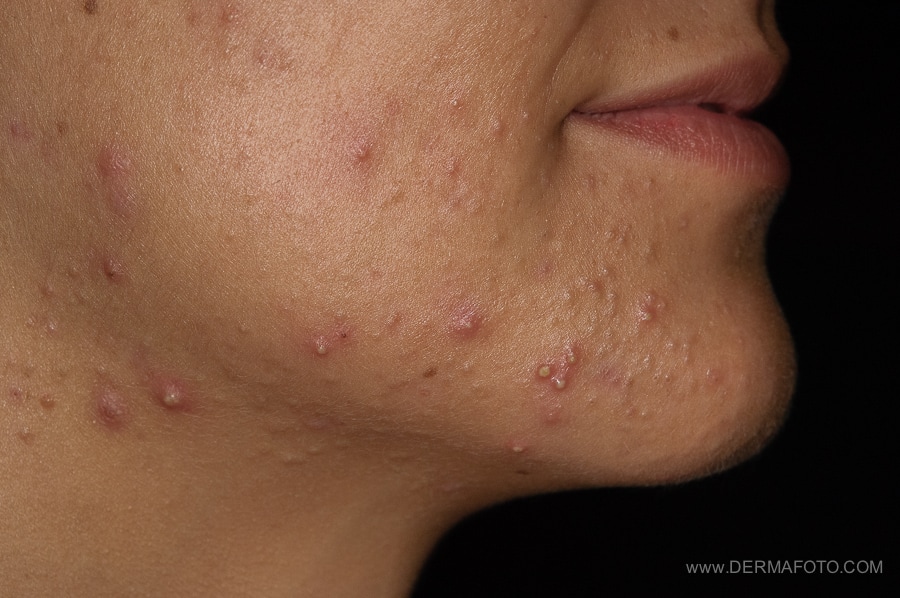
Acne is a skin disease with a high impact on the quality of life of the person who suffers from it, either due to the injuries themselves or the scars it can cause. It is an independent risk factor for anxiety, depression and increases the risk of suicide among adolescents.
Fortunately, isotretinoin (a drug approved for this indication since 1982) has a high success rate in curing this disease, close to 90% of treated patients.
So why is severe acne and the scars caused by it still so common? Among other reasons, because of the respect that taking a drug as peculiar as this one imposes on patients and because of the popularity of this drug.
What is isotretinin and how does it work?
It is a retinoid, a molecule derived from vitamin A, administered orally. The action of this drug on the skin is as follows: it reduces the clogging of pores (keratolytic effect), excess sebum production, is anti-inflammatory and reduces the population of bacteria (Propionibacterium acnes) that act in this skin disease. To summarize, it specifically impacts on all the factors that cause this disease – as long as it is not the result of an underlying hormonal disorder.
Is it very effective?
Yes. It has been a before and after in the treatment of this skin pathology, as it achieves complete cures between 70 and 90% of the cases treated. Practically 100% of the patients who have undergone the treatment are satisfied with the result and would repeat the therapy if necessary.
What are the advantages of treating this pathology with isotreinoin?
· First of all, its effectiveness. Not only does it manage to eliminate it but it is also usually a definitive cure. It is estimated that, if the complete treatment is carried out, the relapse rates are around 15-20%, and always of less intensity than previous acne. This medication produces a rapid improvement of these lesions (4-6 weeks after the start of treatment) and a drastic reduction in the risk of irreversible scarring .
· While treatment with this drug is being carried out, the vast majority of cases it is not necessary to use any other therapy to improve this skin pathology, thus avoiding the possible adverse effects of topical and/or oral options, in addition to their economic cost.
· It improves the basal appearance of the skin, not only by minimizing acne but also by making it smoother, brighter and with a rejuvenated appearance (retinoids have an anti-aging action on the skin).
· Removes excess sebum from the skin and scalp: reduces the need to wash hair and face frequently in seborrheic people, and removes uncomfortable shine from areas with sebum.
What are the disadvantages of taking it?
· Like any other drug, it can have adverse effects. Fortunately, they are rare, perfectly defined and most are detectable by a simple blood test. It is one of the most regulated drugs and there is extensive knowledge of its adverse effects, making it a safe therapy. Other drugs considered “harmless” such as paracetamol or ibuprofen, when taken en masse by the population, have a higher frequency of adverse effects and their idiosyncrasies (they depend on each person, are unpredictable and cannot be monitored by any parameter).
· In most cases, when there is a spectacular improvement in this skin disease, the patient becomes “impatient” when he sees that he no longer has lesions and has to continue taking the medication. This only translates into an excellent response and effectiveness, but we must know that if treatment is stopped early, there is a risk of relapse: we must be patient and finish the therapy to ensure that it does not reappear.
· Another drawback is that before treatment, after 2-4 weeks and every 3 months, it is advisable to do a blood test to monitor the patient.
What are its adverse effects?
The most frequent and important adverse effects are the following. It should be noted that they are perfectly known and detectable through, at most, a blood test.
· Xerosis (dry skin and mucous membranes). Because isotretinoin reduces the amount of sebum in the skin, it has a greater tendency to be dry. This effect is especially noticeable on the lips, nasal mucosa and on the back of the hands; it is related to the daily dose of medication and is proportional to it. Therefore, it is a reversible effect when the treatment ends. This drug was popularly related to the concept of “that medication that peels your skin like a lizard and makes your lips open”. This approach is outdated: low daily doses are now used and tolerance is usually excellent, so flaking and lip suffering are rare.
· Fetal malformations (teratogenesis). A patient who takes isotretinoin during childbearing age should not become pregnant during treatment, as there is a high risk that the fetus will suffer malformations (up to 45% of cases). Once the therapy is finished, the teratogenic potential disappears and after 1-3 months of stopping treatment there is no such risk. For this reason, while taking this medication, blood cannot be donated. This is the main reason why patients have to sign an informed consent form committing to keep it in mind during treatment.
· Photosensitivity. Retinoids promote erythema (redness) and burns when exposed to the sun. While the treatment lasts, caution should be exercised with sun exposure and use sunscreens. For this reason, it is usually recommended to reduce the dose during the summer season or even temporarily suspend the treatment. For practical purposes, using low doses it is possible to lead a normal life as long as the patient is responsible for not exposing themselves excessively to the sun and using sunscreens.
· Hepatotoxicity. Like the vast majority of drugs, it is metabolised in the liver. For this reason, alcohol consumption should be avoided at the same time as treatment and blood tests should be carried out during therapy. Transaminases can increase in up to 15% of cases, and this is a reversible phenomenon.
· Others. The rest of the side effects are rare: increased cholesterol and/or triglyceride levels (reversible), decreased hair density (temporary and reversible), dry eyes, muscle or back pain and fatigue. Finally, the drug’s label lists other even less common adverse effects and other anecdotal ones.
FREQUENTLY ASKED QUESTIONS ABOUT ISOTRETINOIN
Is it really worth taking this drug with the side effects it has?
Two points must be borne in mind on this issue.
First of all, the type of acne of the patient and the impact it has on their day-to-day life: each person experiences it in a particular way and no one knows better than him/her the problems it causes. It is the task of the patient and the dermatologist to find the best option for that person and inform each other of the situation.
And secondly, it must be understood that side effects are never constant and do not have to occur (in fact, they are rare). The only one that occurs in 100% of cases is xerosis (dry skin and mucous membranes) because it is a consequence of the action that the drug has on the skin. The vast majority of cases the patient does not report or detect any other adverse effects.
A recommended exercise to put concepts into perspective is to read in its leaflet the adverse effects that other drugs that are consumed very frequently without thinking about it, such as paracetamol, ibuprofen or antibiotics, may have.
How long do I have to do the treatment?
It depends on each patient. The total dose of drug that must be reached to reduce the risk of relapse of this pathology is 120 mg of isotretinoin per kilo of the patient’s weight . It should be known that the more daily dose is taken, the shorter the treatment, but the greater the frequency and intensity of side effects occur.
In the past, the drug tended to be used for 4-6 months at a very high dose, so its tolerance was very poor. Nowadays the approach is different and there is a tendency to favor the comfort of the patient by taking a low daily dose for a longer period. Interestingly, studies show a lower rate of acne relapses the longer the drug is taken, regardless of the total dose administered.
What care should I take if I take this drug?
The most important aspect in girls is contraception: while the treatment is being carried out, there must be a commitment not to get pregnant to avoid fetal malformations.
Apart from this point, most of the time you just have to keep in mind not to consume alcohol, moisturize your skin if you need it and protect yourself from the intense sun .
It should be borne in mind that, while the treatment lasts, it is not recommended to do laser hair removal or photoepilation, or cosmetic procedures such as peelings or skin cleansings, as there is a risk of burns or skin irritation.
I’ve been told that at the beginning of the treatment it gets much worse and that I’ll have a very bad time. Is that true?
When therapy is started with a high dose, as was done in the past, the skin worsens in up to 15% of cases. For this reason, treatment is currently started with a low dose and progressively increased when necessary, thus minimizing the probability of this happening.
While taking this medication, can I laser hair removal or photoepilation?
It is not recommended, since having the skin more sensitive to light could cause burns.
I’m having a party and I’m taking isotretinoin. If I don’t drink it that day and drink alcohol, is something wrong?
The drug circulates in the blood and tissues for days/weeks. Until 1-3 months have passed, it is not advisable to consume alcohol in high doses or to sunbathe actively.
Is it better to do the treatment for a short time or a lot?
It depends on the patient’s preference. The less daily dose is taken, the better the adverse effects are tolerated but the longer the therapy is prolonged, and vice versa. It should be known that the more months the sebaceous glands are inhibited by this drug, the less likely it is that the skin disease it treats will return at the end of the treatment. This aspect has to be addressed in your consultation with the dermatologist and discuss the preferences you have.
How long does the treatment take?
In general, treatments usually last between 6 and 12 months depending on the points discussed in the previous question: patient’s weight, daily dose started and personal preferences.
Can isotretinoin affect the mood or character of the person taking it?
Most studies carried out with this drug show a reduction in anxiety, the tendency to depression and suicide thanks to the improvement they produce on the skin and therefore on the person’s social relationships and self-esteem. Sometimes an increase in depressive symptoms has been seen when the patient had unrealistic expectations of its effectiveness.
Have I heard that if I take isotretinoin my hair will fall out and I will go bald. Is that true?
No. One of its adverse effects (very rare) is telogen effluvium. In this, there is a reduction in hair density (hair shedding) that is later recovered.
Since I take isotretinoin I am more tired, is it normal?
One of the (rare) adverse effects it has is fatigue, and even muscle or back pain. Most of the time they are transitory and appear at the beginning of therapy, but it is advisable to consult with your dermatologist and discuss it so that they can consider whether it is necessary to suspend the treatment or request a complementary test.
Can it cause intestinal diseases?
No comparative or review studies have been able to find data pointing to isotretinoin as a risk factor for Crohn’s disease or ulcerative colitis.
Why are there people who are so afraid of this drug?
Because it is a drug with peculiar adverse effects: contraception must be used so as not to get pregnant (and an informed consent must be signed with the doctor), it can cause intense dry skin if a high dose is taken… Fortunately, the side effects of this drug are perfectly known, most of them are reversible and can also be monitored by a simple blood test.
Many drugs that we take regularly do not have visible adverse effects nor do they require the signing of an informed consent, so they do not cause as much fear to the patient.
If I have taken isotretinoin in the past, can I have problems if I become pregnant?
After 1-3 months of completing treatment, no increased risk of fetal malformations or fertility has been demonstrated.
So, is it wonderful and risk-free?
No. It is a drug with an excellent response, but with adverse effects that must be taken into account. You have to consult with your dermatologist, discuss the pros and cons of the treatment in your particular case and make a joint decision.
ABSTRACT
→ It is the most effective treatment for acne and produces a high degree of satisfaction in practically all patients.
→ It is a safe drug and its adverse effects are known. Most of them, in addition, are reversible and controllable by means of a blood test.
→ During treatment you cannot get pregnant or donate blood, it is easier to get sunburned, and alcohol abuse is not recommended.
→ If the dose is moderate, it does not have to cause significant dryness of the skin and lips, or cause any noticeable discomfort.
→ Treatment should be done with a dermatologist who has experience in its management and personalize the therapy according to the preferences of each person.
Dr. Didac Barco has no conflict of interest in the writing of this article.

REFERENCES
· Wolverton SE, Harper JC. Important controversies associated with isotretinoin therapy for acne. Am J Clin Dermatol (2013) 14:71-76.
· Rademaker M. Isotretinoin: dose, duration and relapse. What does 30 years of usage tell us? Australasian Journal of Dermatology (2012): epub ahead of print.


