
What is photoaging?
It consists of the set of skin signs visible as a result of accumulated passive and active sun exposure: brown spots (lentigines), red spots (telangiectasias), fine wrinkles, atrophy and sagging. The appearance of hyper/hypopigmentation, telangiectasias and atrophy is called “pochyloderma” and is typical -although not exclusive- of the décolleté. More information here.
How can lasers help improve the signs of skin aging?
Lasers are medical devices that allow the impact of certain skin structures while preserving intact the rest of the elements that do not contain the specific target for the laser. Thus, there are lasers that are capable of reducing or eliminating lentigines, telangiectasias and spider veins, wrinkles, scars… Unfortunately, there is no single device that is capable of reducing all signs of skin ageing and that is particularly conservative (the CO2 laser does improve all of them but requires a period of leave after the procedure – more information here). Therefore, in general, a combined treatment is required if we want to eliminate different elements of the complex picture that photoageing entails.
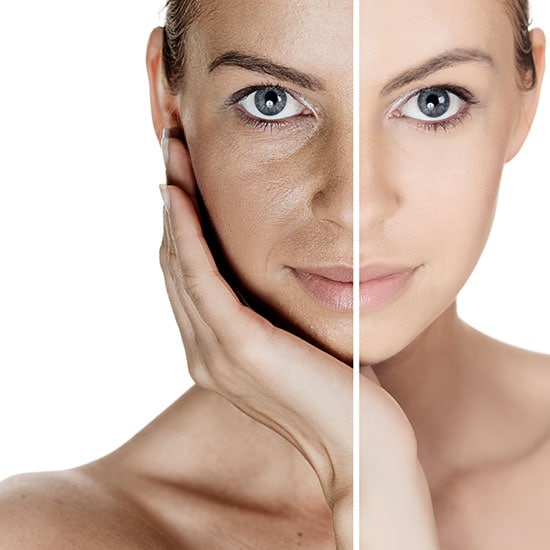
Can photoaging be treated with a single laser?
Yes, partially, or by using the CO2 laser (resurfacing). For example, a Q switched alexandrite laser can be used to remove lentigines (but not telangiectasias or atrophy), or a pulsed dye laser to treat telangiectasias (but not lentigines). With a single device, in general, only one of the signs of skin ageing is treated. Pulsed light (which is not a laser from a strictly theoretical point of view) is capable of treating telangiectasis and lentigines in the same act, although it works poorly on collagen.
What is the best combination of lasers to treat complex skin photoaging?
In comparative studies, it seems that the sum of pulsed light plus non-ablative fractional laser in the same session is the optimal combination to treat each and every one of the signs of photoaging: brown spots, red spots, fine wrinkles and mild atrophy. What makes this combination optimal? Not only does it treat all the alterations but it also does not increase the adverse effects of each of them in isolation (temporary darkening of the lentigines and skin erythema) but also reduces the need for sessions of both devices.
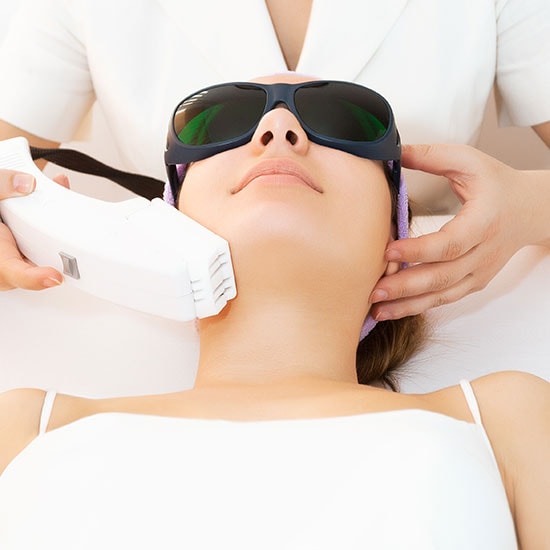
How does the combination of pulsed light plus non-ablative fractional laser work?
The filtered pulsed light impacts the haemoglobin contained in the blood vessels of the telangiectasias and the concentrated melanin within the lentigines: it mainly treats the alterations in the colour of aged skin. The non-ablative fractional laser targets the water contained in the dermis: its heating produces a remodelling of collagen, which will result in a decrease in the intensity of the finest wrinkles. Some studies support that the non-ablative fractional laser is capable of opening microscopic channels through the epidermis, through which the melanin fragmented by the pulsed light will be extruded. In a comparative trial between pulsed light, non-ablative fractional laser and their simultaneous combination, the latter proved to be more effective than either of the two devices alone or their combination separated by 4 weeks (greater reduction of pigmentation and homogenization of skin texture). The rate of adverse effects (temporary darkening of the lentigines and redness lasting for hours) was exactly the same as using one or the other device alone or 4 weeks apart.
What are the advantages of the combination of pulsed light and non-ablative fractional laser for the treatment of skin aging?
There are several advantages to consider:
· It produces a greater improvement than using a single laser device.
· It acts synergistically: it produces more improvement than using the two devices separately.
· It does not increase the risk of adverse effects by using the ‘combo’ properly.
· It reduces the number of sessions needed to treat photoaging and therefore the overall cost of treatment.
REFERENCES
Kearney C, Brew D. Single-session combination treatment with intense pulsed light and nonablative fractional photothermolysis: a split-face study. Dermatol Surg. 2012 Jul; 38(7 Pt 1):1002-9.

