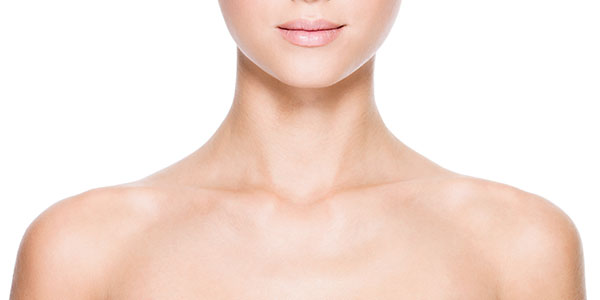
What signs appear in an aged décolleté?
The décolleté is an area passively and actively exposed to ultraviolet radiation. This leads to greater ageing compared to other areas of the body, with premature appearance of brown spots (lentigines), white spots (hypomelanosis guttata), red spots (telangiectasias, ruby spots), wrinkles and flaccidity.
The joint presence of skin atrophy, hyper/hypopigmentation and telangiectasias is called Civatte’s poikiloderma. Although poikiloderma is typical of older ages, it is not uncommon in young women with an intense sun habit (active or passive). It is not exclusive to the décolleté, it can be found on the face, back, scalp…
How do you remove blemishes and wrinkles from the décolleté?
The signs of poikiloderma must be kept in mind, and treated together to produce improvement in all its aspects:
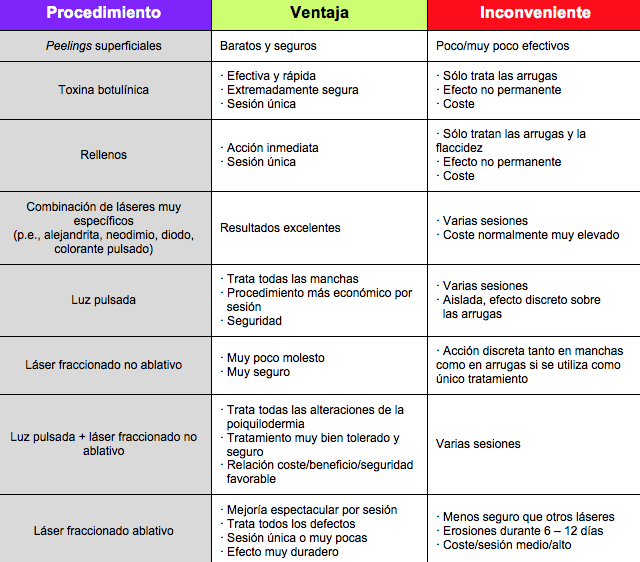
· Lentigines (brown sunspots). They are attenuated or removed with different types of lasers (e.g. alexandrite) or pulsed light. Superficial peels are of little use, and botulinum toxin or fillers have no action on them.
· Telangiectasias (capillaries). They can be removed by different lasers (pulsed dye, e.g.) or pulsed light. Like lentigines, peels and other alternatives are useless.
· Atrophy. Atrophy is the result of a decrease in the thickness of the middle layer of the skin, the dermis, whose turgor depends mainly on the amount of collagen. The procedures with the greatest potential for collagen production are lasers (fractional ablative or non-ablative). Peels and fillers also slightly increase collagen synthesis. Botulinum toxin has a minor action in this field.
· Wrinkles. They also depend on the lack of collagen and the muscle tension in the area. Lasers that increase collagen synthesis (ablative or non-ablative fractionation), fillers and botulinum toxin are useful to reduce them. Superficial peels have a discreet action on them.
As can be seen, laser and/or pulsed light systems are the most complete therapeutic method, as they manage to impact all the signs of potachyloderma.
What lasers are used for the treatment of aged décolleté?
Lasers are light systems that specifically impact a target: the melanin of the spots (e.g., alexandrite or ruby laser); the hemoglobin of the capillaries (e.g., pulsed dye or neodymium laser) or the water in the dermis to manufacture collagen (e.g., erbium non-ablative laser or CO2 ablative laser).
The more specific the laser, the more effective it is for its indication and, therefore, the fewer treatment sessions it requires for that specific alteration (brown or red spots). However, more specific types of lasers will have to be used to treat the different alterations of poikiloderma: one for brown spots, one for capillaries, another to increase collagen… This can make the treatment more expensive and, as some of these lasers cannot be combined in the same act, the final number of sessions may not be so low.
To avoid the use of many devices and the extra cost involved, in poikiloderma there is a tendency to use pulsed light: a light system capable of impacting melanin (brown spots), hemoglobin (capillaries) and heating the dermis to discreetly increase collagen synthesis. With pulsed light it is possible to treat all the “color” alterations of poikiloderma. Its effect on flaccidity and wrinkles is discreet and it is recommended to combine it in the same session with the erbium non-ablative fractional laser, which treats “volume” alterations. The combination of these two lighting systems allows all alterations of the décolleté to be treated with a broad safety profile and in a few sessions (3 – 5) at a more favourable cost than the combination of specific lasers. The session causes only redness and slight swelling lasting for hours in the vast majority of cases.
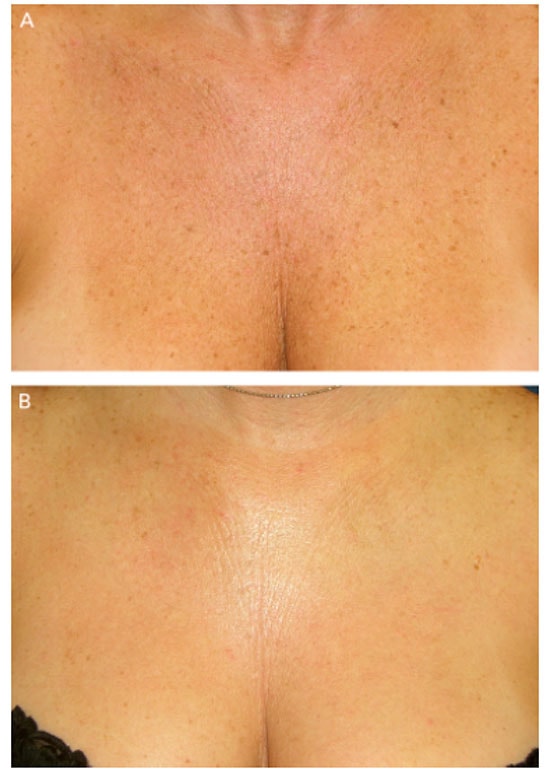
Another option is the fractional CO2 ablative laser. This allows a deep action on collagen (improves wrinkles and atrophy) and also a superficial peeling (attenuates blemishes) simultaneously, as well as creating a tightening effect. This is the so-called resurfacing. By number of sessions, it is undoubtedly the most effective laser system of all and usually has a spectacular effect (improvements of 50 – 65% per session). However, it has the disadvantage of forming punctiform crusts (less than 1 mm) and erosions throughout the treated area. This means that, for a period of 6 – 12 days, specific care must be followed.
What fillers can be useful to reduce wrinkles in the décolleté?
Fillers (regardless of their nature) add volume to the dermis, so their action will partially reverse wrinkles, atrophy and sagging exclusively, without improving any other signs of poikiloderma.
The fillers can be made of polylactic or hyaluronic acid, mainly. Their action is immediate and the improvement is noticeable within a few days of the procedure. However, as they are degradable biological materials, in a few months (6 – 18 months) their effect disappears. Usually between one and three sessions are required, separated by about 4 – 8 weeks. They can be combined with other treatments such as laser, pulsed light or botulinum toxin.
How do you reduce wrinkles on the décolleté with botulinum toxin?
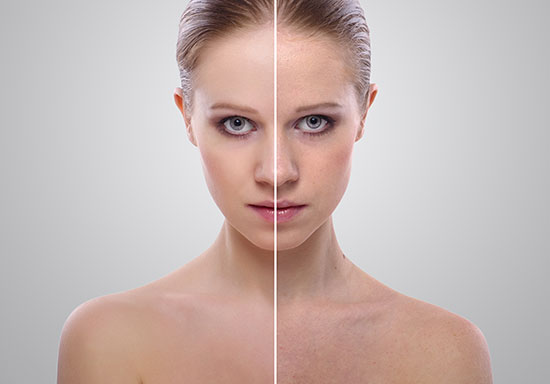
Botulinum toxin causes a relaxation of the muscles where it is applied. All wrinkles caused by excessive muscle contraction on atrophic skin will be attenuated. This action occurs wherever it is injected. In the anterior area of the neck and décolleté, the muscle tension exerted by the platysma muscle can cause an accentuation of wrinkles and sagging.
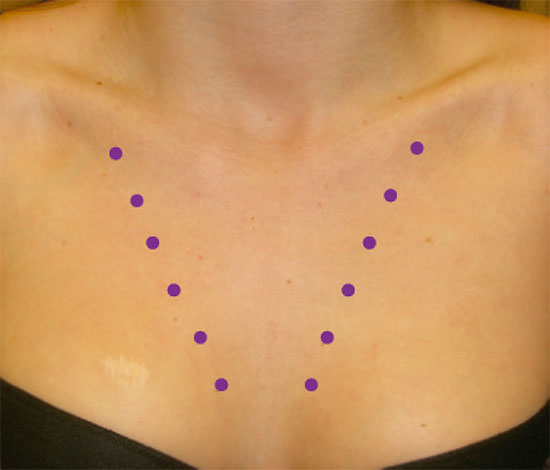
A minimum amount of botulinum toxin (15 units), distributed in different punctures 2 cm apart, is usually required to obtain a satisfactory response one week after treatment. The injection is performed in a single session with the needle perpendicularly penetrating about 4 mm and in a field in the form of an isosceles triangle of inferior vertex.
Its effect is very fast, it is the safest aesthetic procedure that exists and it can be combined with other therapies, but it must be remembered that it does not treat blemishes and that its effect is not permanent (4 – 6 months).
Which peels are useful for treating low-tongue low-end pain?
The safest (superficial) peels, such as glycolic, pyruvic and/or salicylic acid peels, are only useful for minor signs of photoaging, and their action is discreet. The medium, more effective peels have a moderate safety profile and, today, with existing alternatives they should be used with caution.
In the author’s opinion, peels (e.g. with a combination of tretinoin, glycolic acid and salicylic acid) are optimal as a maintenance treatment once the desired response has been achieved with other methods.
How useful is mesotherapy to treat décolleté?
No rigorous study has been able to demonstrate favorable changes (clinical or histological) caused by mesotherapy, also called “vitamin infiltration”.
What is the best treatment for Civatte poikiloderma of the décolleté?
It will depend on the predominant sign on the décolleté and the patient’s preferences .
In general terms, the recommendations are as follows:
· If you only want to treat wrinkles: botulinum toxin or filler.
· Décolleté with significant signs of ageing: CO2 ablative fractional laser.
· Décolleté with intermediate ageing, high safety and predisposition to perform 3 – 5 sessions: combination of pulsed light with non-ablative fractional laser.
· Very important need for improvement in a single session: CO2 ablative fractional laser.
In short, if you have some patience and want to follow a safe and comfortable path, the combination of pulsed light with non-ablative fractional laser is recommended. If you want a dramatic change quickly and are willing to take a minimum risk and be strict with the care of the wounds it causes, you would opt for the ablative fractional laser.
What are the advantages and disadvantages of each of the décolleté treatments?
REFERENCES
· Peterson JD, Goldman MP. Rejuvenation of the aging chest: a review and our experience. Dermatol Surg. 2011 May; 37(5):555-71.
· El-Domyati M, El-Ammawi TS, Moawad O, El-Fakahany H, Medhat W, Mahoney MG, Uitto J. Efficacy of mesotherapy in facial rejuvenation: a histological and immunohistochemical evaluation. Int J Dermatol. 2012 Aug; 51(8):913-9.