
AESTHETIC PROCEDURES: WHAT DO WE KNOW ABOUT THEIR EFFECTIVENESS? EVIDENCE-BASED MEDICINE IN AESTHETICS
What is evidence-based medicine?
It is defined as “the rational, explicit, judicious and up-to-date use of the best objective data applied to the treatment of each patient”. This doctrine allows, through clinical practice and transparent and objective scientific studies, to improve the quality of Medicine, both in its diagnostic and therapeutic aspects. Its main objective is to ensure or facilitate that current medical practice is based on objective efficacy data and not on beliefs or assumptions without a proven factual basis.
Why is it necessary for evidence-based medicine studies to exist within aesthetics?
Evidence-Based Medicine (EBM), through rigorous scientific studies, makes it possible to verify the effectiveness of medical, technological or surgical treatments in an objective way, allowing us to offer those with better rates of efficacy, efficiency and lower rates of adverse effects. With the advent of an endless number of aesthetic procedures derived from a great demand by patients, practices have been carried out and are carried out for cosmetic and aesthetic purposes without a scientific basis that strengthens their effectiveness in objective data, so that therapies are currently offered that in no case have demonstrated a greater effect than the natural evolution of a process and that, in addition, can be associated with the generation of unwanted adverse effects. EBM allows us to know which aesthetic procedures have reflected a statistically significant effectiveness, compare them with each other and choose those that have a more positive effectiveness/risk ratio for the patient’s health.
Through the use of EBM, it is possible to rule out the use of aesthetic procedures that have not shown efficacy and that, in addition, may not be harmless for the patient. In this way, the rate of adverse effects is reduced, the quality of the patient’s health is improved, better aesthetic results are obtained through procedures of proven effectiveness, and the futile economic expenditure made by a patient expecting an aesthetic result that is more hypothetical than confirmed is reduced.

Is there a great knowledge of evidence-based medicine in the field of aesthetic medicine?
Unfortunately, no. There are few rigorous studies available on the vast majority of procedures, techniques or technologies applied in aesthetic medicine. This is due, in part, to a regulatory and legislative defect in this area, where a technique or procedure is not required to provide objective efficacy data in order to be offered to the public; and also to the enormous exponential growth in demand for aesthetic treatments and novelties by patients, which often exceed the level of rigorous scientific knowledge that exists in this field.
What is evidence-based medicine based on?
In scientific rigour, in the enhancement of objectivity through data obtained in designed studies and in the continuous systematic updating of knowledge. All this with the aim of improving the health of patients. Depending on the design of the studies and the quality of the methodology used in them, the data obtained in them can be classified by their degree of reliability and quality into “levels of evidence“. From these levels, “degrees of recommendation” can be issued supported by objective data on the effectiveness of the treatments.

What are the degrees and levels of evidence on scientific recommendations in aesthetic medicine?
For the reader who wants a more in-depth knowledge on the subject, you can go here. But at the summary level, scientific studies are classified according to the credibility of the data obtained according to their objectivity and risk of bias using a level of evidence scale ranging from 1++ (high quality of scientific studies that support this technique) to 4 (opinion of an expert in the field). Depending on the studies that deal with the treatment of a disorder, EBM can make therapeutic recommendations for it using another scale, ranging from A (based on studies of high scientific quality) to D (knowledge deduced from less rigorous studies).
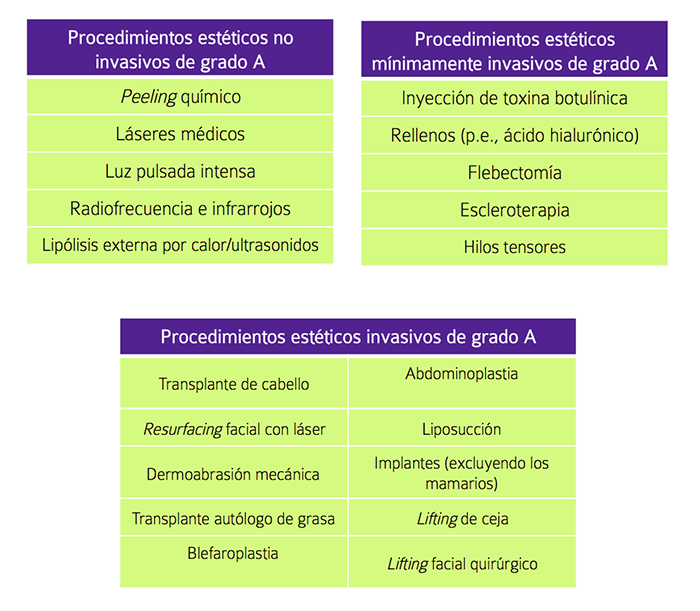
What are the Recommendation Grade A cosmetic procedures?
This group includes those techniques and procedures that are supported by data with a high to moderate degree of scientific evidence. Therefore, they are the ones that have reflected the greatest objective effectiveness in all the studies that have studied their validity.
Below we see what they are:
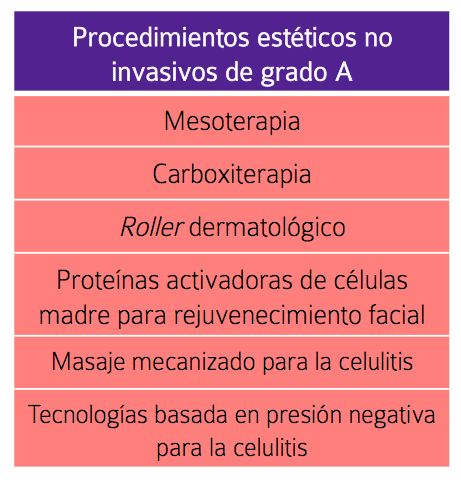
What are the current cosmetic procedures with recommendation grade B?
These include those for which there is a low/very low level of evidence of effectiveness and/or their efficacy has not been established or is unacceptable:
Why are aesthetic procedures performed that have not proven effective?
According to Goh’s review in the Journal of Cutaneous Aesthetic Surgery , there are three main reasons why aesthetic procedures are performed without their effectiveness having been proven:
- The rest of the treatments that have demonstrated efficacy have already been offered to the patient and the desired results have not been obtained.
- The procedure in question has not been shown to involve any significant risk or adverse effects.
- The patient knows that the procedure is not very effective but since other options are not possible or effective in his case, he accepts this practice by consent.
The author adds that, because the patient is offered a procedure of very little or no effectiveness, the cost of this therapy should not be economically burdened .
CONCLUSION
Despite the fact that millions of aesthetic procedures are currently performed around the world, only some of them have scientific and objective support for their effectiveness obtained through rigorously designed studies (recommendation grade A). These include the injection of botulinum toxin, hyaluronic acid fillers and the use of laser devices.
However, there are countless aesthetic procedures that are regularly practiced that have not demonstrated any efficacy or in a very low degree of reliability (recommendation grade B), such as mesotherapy, platelet-rich plasma injection or carboxytherapy. In these cases, the patient must be informed of this and confirm that there are no better therapeutic options so that they can certify whether they accept these conditions before starting treatment.
REFERENCES
· Goh, C. The need for evidence-based aesthetic dermatology practice. J Cutan Aesthet Surg. 2009 Jul; 2(2):65-71.