Excessive scars are made up of an accumulation of collagen fibers irregularly arranged in the middle part of the skin, the dermis. This accumulation of redundant tissue causes the scar to be disproportionate compared to the causative wound (hypertrophic scar), and may even protrude from the edges of the wound (keloid).
To date, there are numerous therapeutic alternatives available to treat atrophic, hypertrophic and keloid scars, including ablative fractional laser, peelings, surgery, local infiltration of corticosteroids or hyaluronic acid, and the use of pulsed dye laser. All these options show variable results and duration, and a discreet tolerance on the part of the patient, either due to the pain caused by the medical procedure, or due to recovery after it (crusting and erosion formation).
From 2004, the concept of dermal remodeling by fractional photothermolysis was introduced, which is what defines the action of the non-ablative fractional laser. Through this therapy, small micro-columns of heat are emitted from a refrigerated head that selectively impact the middle part of the skin (dermis) without damaging the surface of the skin, which remains unscathed thanks to the continuous cold transmitted by the aforementioned head:
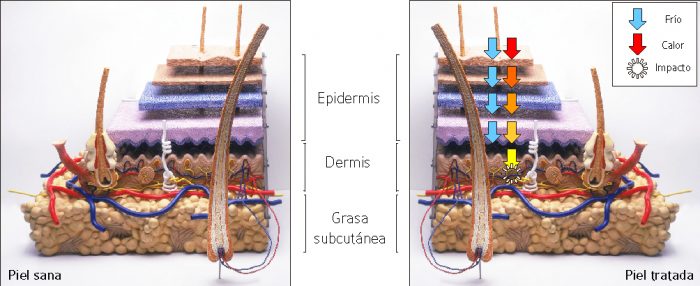
The impacts of heat on the dermis cause a new formation of collagen and elastin, with a reorganization of its fibers, without any effect on the external part of the skin. The progressive rearrangement of the collagen and elastin fibers favors the restructuring of the damaged dermis , which results in a gradual improvement of atrophic, hypertrophic and keloid scars.
The treatment of scars with non-ablative fractional laser is carried out through comfortable sessions of a few minutes , separated by a period of 4 – 6 weeks. The number of sessions to be performed depends on several factors: the time of evolution of the scar, the type and size of the scar, its location and previous therapies. The non-ablative fractional laser allows scars to be treated in combination with other therapies, such as silicone dressings, corticosteroids or fillers with hyaluronic acid.
Due to the cooling of the epidermis, immediately after the non-ablative fractional laser session, only redness is observed in the treated area, without scabs or wounds appearing as is the case with ablative devices (intermediate or deep peels). This means that the treatment sessions do not force the patient’s usual rhythm of life to be interrupted.
The effect of the non-ablative fractional laser begins to become noticeable when a minimum of 4 weeks have passed since the start of the treatment, as it is the consequence of a progressive process of neosynthesis and rearrangement of the collagen itself.
Published studies on the treatment of acne scars using fractional non-ablative laser show improvements of between 40 and 75% in the decrease in scar perceptibility, with high patient satisfaction. Other studies on the treatment of burn scars also show satisfactory results in skin texture, with excellent patient tolerance.
• In conclusion, the non-ablative fractional laser stands as an effective, safe and comfortable therapy for the treatment of atrophic, hypertrophic and keloid scars. In addition, it is a device approved by the FDA (Food and Drug Administration, USA) for its safety profile and results • TREATMENT OF SCARS WITH NON-ABLATIVE FRACTIONAL LASER
CLINICAL CASES
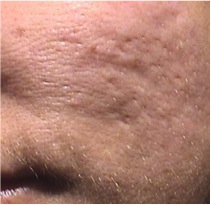
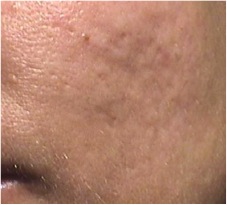
• Acne scars treated with non-ablative fractional laser
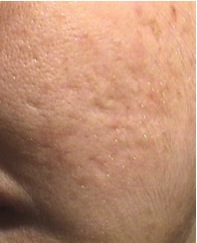
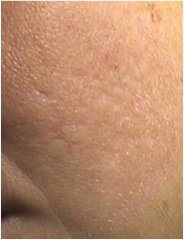
• Keloids by cesarean section treated with non-ablative fractional laser
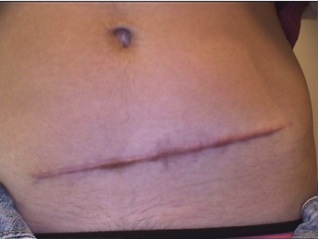
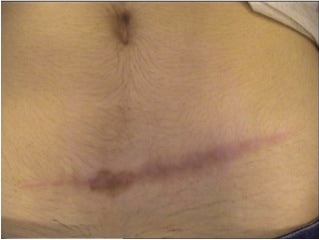
EXPLANATORY VIDEO
FREQUENTLY ASKED QUESTIONS
Is scar treatment with ablative fractional laser effective?
Yes. All published scientific studies regarding the treatment of scars with this method show positive results and high patient satisfaction.
What type of scars improve with the non-ablative fractional laser?
Practically anyone. Because its effect is to reshape the dermis, which is disorganized in all scars, all types of scars benefit from this treatment: surgical scars (cesarean section, mammoplasty, thyroidectomy), burns, acne scars… In any case, the ones on which there is the greatest scientific evidence of response are acne scars and burns.
Do old scars also improve with non-ablative fractional laser?
Yes, although the results are much more positive with recent scars (in the first 6 months of evolution).
Can I lead a normal life if I treat scars with the non-ablative fractional laser?
Yes. It is one of the few methods that allows you to act on the dermis of the skin without any alteration of the most superficial part of the skin (scabs or erosions).
Does the treatment of scars with non-ablative fractional laser require admission, sick leave or general anesthesia?
No. It is an outpatient procedure that lasts a few minutes and does not involve the formation of scabs or wounds, only a slight temporary erythema of the treated area. The sessions are tolerated without anesthesia, although it is optional if the patient wishes, to apply an anesthetic cream a few minutes before therapy.
Is it a painful procedure?
It is a well-tolerated therapy, the discomfort is minimal or moderate, and it is also possible to apply an anaesthetic cream (or local anaesthesia if preferred) before the session. Patients usually report that it is noticeably less painful than laser hair removal.
How many sessions are needed for scars to improve?
It depends on the volume, extension and time of evolution of the scars. It is usually necessary to do between 3 – 6 sessions, although each patient requires a prior evaluation to be able to specify the duration of the treatment.
After doing a non-ablative fractional laser session, do I need to take any special care?
Whenever any procedure is performed on the skin, sun protection with strict SPF 50 is recommended.
What does the skin look like after a non-ablative fractional laser session?
Immediately after the session there is a transient erythema (redness) in the treated area, which usually disappears within a period of 2-4 hours.
Is non-ablative fractional laser better thanCO2 (ablative) laser for treating acne scars?
They are different therapies. However, in the comparative studies between the two options, the results in effectiveness are similar but the non-ablative fractional laser is less painful, more comfortable and tolerated, and does not form scabs that force the patient’s normal rhythm of life to be interrupted.
Which method is best for treating acne scars?
It depends on the type of scars, although the non-ablative fractional laser is the only one that offers a remodeling of the collagen of the dermis with a very high profile of safety, comfort and effectiveness. Superficial peels do not improve deep scars because they do not modify the dermis, and other methods that do reach the dermis are usually poorly tolerated due to pain, crusting and because they usually force the patient’s normal rhythm of life to be interrupted.
I have treated my acne scars with other methods, can I do non-ablative fractional laser?
Yes, this therapy can be combined with any other therapy (even simultaneously if the other does not involve any aggressive procedure such as a deep peel). NON-ABLATIVE FRACTIONAL LASER SCAR TREATMENT
REFERENCES
• Cho SB, Lee SJ, Cho S, Oh SH, Chung WS, Kang JM, Kim YK, Kim DH. Non-ablative 1550-nm erbium-glass and ablative 10 600-nm carbon dioxide fractional lasers for acne scars: a randomized split-face study with blinded response evaluation. J Eur Acad Dermatol Venereol. 2010 Aug; 24(8):921-5.
• Merete Hædersdal, Karen E.R. Moreau, Ditte M. Beyer, Peter Nymann, Bjarne Alsbjørn. Fractional Nonablative 1540 nm Laser Resurfacing for Thermal Burn Scars: A Randomized Controlled Trial. Lasers in Surgery and Medicine 41:189–195 (2009).
• Lene Hedelund, Karen Estell R. Moreau, Ditte M. Beyer, Peter Nymann, Merete Hædersdal. Fractional nonablative 1,540-nm laser resurfacing of atrophic acne scars. A randomized controlled trial with blinded response evaluation. Lasers Med Sci (2010) 25:749–754.