What is it?
Lichen planus is an inflammatory disease of unknown cause that affects the skin and/or mucous membranes. Although the most frequently diagnosed form is cutaneous, it can affect the oral mucosa (very frequently), genital and/or anal mucosa. Very rarely it can be located in the mucosa of the ocular conjunctivae, esophagus or vagina. Sometimes it can also affect the skin adnexa, hair and nails.
Why does it appear?
It is a disease of unknown cause, but with an autoimmune basis. Statistically, it has been observed that patients with lichen planus have 5 times more frequency of underlying infection by the hepatitis C virus, although the relationship between these two entities is unknown. For this reason, it is recommended that, before the diagnosis of lichen planus, a serological study of hepatitis C be performed.
Is it a very common disease?
It is believed that cutaneous lichen planus affects 0.5% of the general population, and that of the oral mucosa approximately 2% of it. The peak of maximum incidence in the cutaneous variant corresponds to 40-45 years, and to 50-60 years in the oral variant.
Is it a serious disorder?
The vast majority of cases do not pose any risk to the patient, beyond the discomfort of the disease. However, oral lesions are considered potentially pre-cancerous. This is especially true in chronic cases, poorly treated and combined with poor oral hygiene, tobacco and/or alcohol. At present, degeneration to cancer is exceptional.
In general, lichen planus usually responds positively to treatment, especially the cutaneous form. Some cases of oral and/or genital involvement are especially resistant to therapy.
What is the course of lichen planus?
It is a chronic disease. Cutaneous lichen planus usually occurs in outbreaks, with disease-free periods that vary greatly between them. It should be understood as a tendency that, on certain occasions, can flare up without there having to be an apparent reason.
As for oral or genital lichen planus, the evolution is usually much more torpid and it is common for the patient to have lesions for months or years.
How does lichen planus manifest itself on the skin?
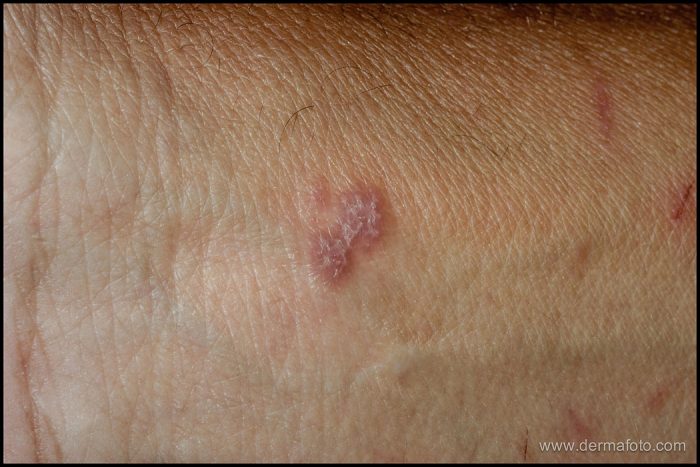
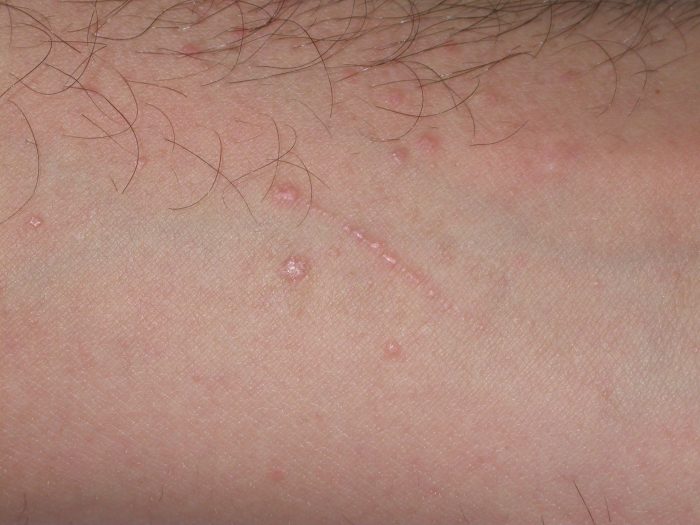
It consists of the appearance of erythematous-purplish papules, polygonal in appearance and flat on the skin, usually on the ventral aspect of the wrists, the pretibial areas and the lumbar area. Observing the lesions closely, it is common to observe, in addition to the purplish coloration, the existence of a whitish reticulation on the roof of the lesion, called Wickham’s striae. Occasionally, lesions in the form of purplish rings and an atrophic center can be observed. This variant is especially common in the penis.
Skin lichen planus is characterized by severe itching and, once the inflammation has resolved, causes residual brown spots (hyperpigmentation) that can last for years after the outbreak.
What does mucous membrane look like?
If it affects the mucous membranes (oral, genital or anal), it most often manifests itself as a whitish reticulation on a violet background, although it is possible to cause white, hyperkeratotic, protruding papules and plaques (appearance of ‘callosity’), and painful erosions if the inflammation is intense or persistent.
How does it manifest on the scalp?
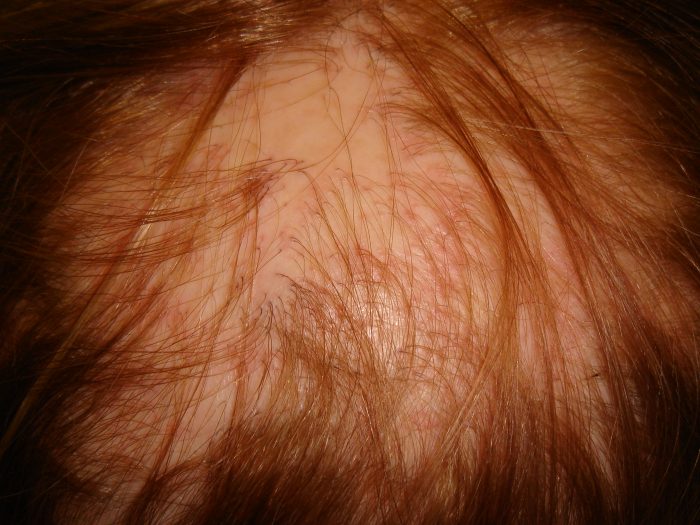
The inflammation produced by lichen planus is located around the hair follicles, with a reddish-violet coloration that surrounds the root of the hair, with or without the formation of a small roughness (hyperkeratosis). In case the inflammation is very intense, the hair sheds and the scarring process can cause irreversible alopecia (lack of hair). To avoid this phenomenon, early diagnosis and treatment are important.
A characteristic type of alopecia has been described that seems to be a special form of lichen planus. This is called frontal fibrosing alopecia, and is expressed as an irreversible loss of hair in the frontal hairline and even of the eyebrows. It is an affectation typical of women. If left untreated, the alopecic area progressively advances backwards, widening the forehead.
How can lichen planus affect nails?
Nail involvement is not frequent, and is usually seen more commonly on the fingernails than on the toenails. Longitudinal striations characteristically occur in the nail, which in the part closest to the skin can form small scarring bridges (pterygium), and/or triangular notches in the most distal part of the lamina. If the inflammatory process is very intense, the entire nail plate can be destroyed.
How is lichen planus diagnosed?
Skin and mucosal lesions are sufficiently revealing for the experienced dermatologist to make the diagnosis by visual examination in the vast majority of cases. In case of doubt, both dermoscopy (epiluminescence, using a magnifying glass with polarized light) and tissue biopsy are of great diagnostic value.
How is lichen planus treated?
The therapeutic approach varies depending on the patient, the type of lichen planus present and its extent. Due to its autoimmune and inflammatory basis, treatment is based on the use of topical and/or oral anti-inflammatory drugs. Due to their safety, corticosteroids are usually used, since other drugs have not been shown to be more effective and are more complex to manage.
The treatment of choice for limited cutaneous lichen planus is the application of topical corticosteroids, with oral corticosteroids being reserved for extensive, stubborn or very symptomatic cases. Other therapeutic options are phototherapy (UVA or UVB rays), retinoids (vitamin A derivatives) and immunomodulatory drugs (methotrexate, cyclosporine or mycophenolate mofetil, among others).
FREQUENTLY ASKED QUESTIONS
Why did I get lichen planus if I had never had anything on my skin?
It is a disease of unknown cause with an auto-immune basis. Like most of these diseases, it usually appears in middle age without any apparent reason.
Can lichen planus be diagnosed without a biopsy?
Yes. Most of the time, the appearance of the lesions is sufficiently characteristic that it is not necessary to biopsy. Biopsy guides the diagnosis in cases of doubt.
Which doctor treats lichen planus?
The professional who is responsible for diagnosing and treating this disease is the dermatologist. Even if lesions occur in the oral or genital mucosa, in general only in particularly stubborn cases is it necessary to visit a dentist, maxillofacial surgeon, gynecologist or urologist for combined management.
Is lichen planus contagious?
No. The origin of lichen planus is not infectious, so there is no transmission to other people in any of its variants.
Can genital lichen planus be transmitted through sexual intercourse?
No. There is no transmission to other people even if there is intimate contact.
Is it possible that I have developed lichen planus on an old scar?
Yes. Lichen planus has a characteristic called Köebner’s isomorphic phenomenon. This means that lesions of the disease can appear in traumatized skin areas, such as a scar.
Have I been diagnosed with lichen planus in my mouth, is it synonymous with cancer?
No. The risk of oral lichen planus degenerating into cancer is minimal, and is classically related in patients with poor oral hygiene, alcohol and/or tobacco use, and especially aggressive variants of the disease.
Does lichen planus heal?
It is considered a chronic disease without a definitive cure. Fortunately, the vast majority of skin cases usually evolve into outbreaks with lesion-free periods that can be very prolonged. On the other hand, oral and/or genital variants are usually very resistant to treatment and generally have a chronic course, with periods of greater and lesser activity.
Do I have lichen planus. Do I need to take any special care?
If you have active skin lesions , it is important to bear in mind that they can appear in traumatized areas (scars): inform your surgeon if you plan to undergo an intervention.
For oral lesions , it is recommended to stop smoking and/or alcohol consumption and to have proper oral hygiene. Likewise, if painful lesions are suffered, soft foods, not very acidic or spicy, and not too hot are recommended to reduce the discomfort that may be caused during ingestion.
In case of genital lichen planus, this does not require the use of a condom due to the risk of transmission, since this disease cannot be transmitted to other people.
REFERENCES
Le Cleach L, Chosidow O. Clinical practice. Lichen planus. N Engl J Med. 2012 Feb 23; 366(8):723-32.
ACKNOWLEDGEMENTS
To Dr. Leo Barco for the clinical images. You can consult his dermatological atlas online at www.dermafoto.com