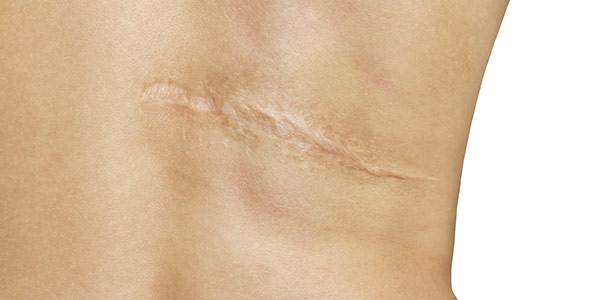
What is a hypertrophic scar? What about a keloid?
A hypertrophic scar is excessively bulky, erythematous (red), and usually pruritic. However, it does not go beyond the boundaries of the wound that caused it. They may regress spontaneously in some areas and partially improve. A keloid has similar characteristics, but its volume clearly extends beyond the boundaries of the wound. Keloids do not improve spontaneously or have a tendency to disappear and, if removed, recur. It is not uncommon for them to cause itching and even pain.
What treatments are available for hypertrophic scars and keloids?
Classically, the therapeutic scheme begins with the application of silicone occlusive dressings and cryotherapy (liquid nitrogen) plus intralesional infiltration of corticosteroids with/without cytostatic drugs (5 fluorouracil, bleomycin…). In the vast majority of cases, only with this treatment favorable results are obtained. However, when the response is insufficient, lasers are usually used. Among the lasers used, two large groups stand out: those that act on collagen, which is disorganized in this type of scar, such as the fractional non-ablative laser or the CO2 laser; and lasers that act on the blood vessels that nourish scars, such as pulsed dye (595 nm), KTP (532 nm) and Nd:YAG (neodymium, 1,064 nm).
How does the 532 nm KTP laser work in the treatment of keloids and hypertrophic scars?
This type of scar very often has a large number of blood vessels, which can be perceived by the reddish coloration and even appear as clear telangiectasias (small capillaries) in and around the scars. In fact, telangiectasias can appear as a result of treatment with intralesional corticosteroids (infiltrations). Although the exact pathophysiology of keloids and hypertrophic scars is unknown, it is believed that the local increase in blood vessels has a role in their origin. Therefore, lasers that impact the hemoglobin inside the vessels to reduce their caliber and number, improve the appearance of this type of scar. KTP’s 532 nm lasers remove the blood supply from keloids, reducing their metabolism and reddish coloration.
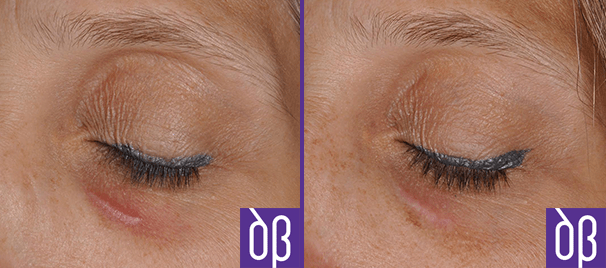
How effective is KTP’s laser for the treatment of hypertrophic scars and keloids?
In the study by Cassuto et al., the efficacy of the 532 nm laser combined with silicone dressing in the treatment of hypertrophic and keloid scars was evaluated. Scars were initially assessed with the Vancouver severity scale based on vascularization (blood vessels), pigment, hardness to touch, and height. The mean obtained on the scale in the 37 participating patients at the beginning of the study was 12.6 points. At the end of treatment with 532nm laser plus silicone dressing, it was 3.3 points (74% reduction). With a single session, there was an average improvement of 1.6 points.
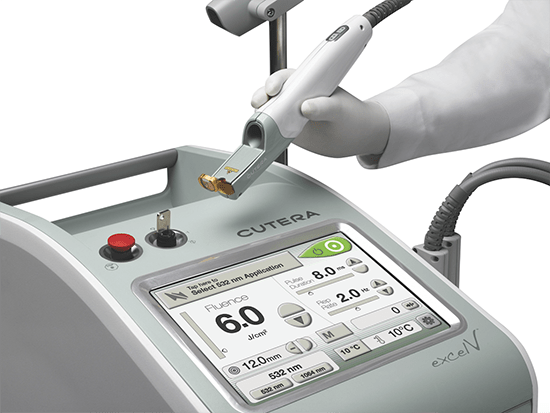
What are the adverse effects of the 532 nm KTP laser in the treatment of hypertrophic scars and keloids?
Redness and swelling of the scar always occur immediately, lasting an average of 2 – 10 hours. According to Cassuto et al., 4% of the scars treated experienced blistering and 7% tiny scabs, which resolved in less than a week in all cases. None of the cases experienced purpura (bruises) or pigmentation disorders (white or brown spots).
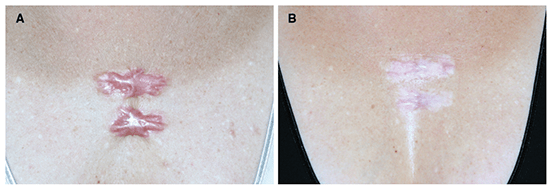
How many treatment sessions are needed?
The mean number of sessions in the aforementioned study was 2.4 for hypertrophic scars and 8.5 for keloids.
REFERENCES
· Cassuto DA, Scrimali L, Siragò P. Treatment of hypertrophic scars and keloids with an LBO laser (532 nm) and silicone gel sheeting. J Cosmet Laser Ther. 2010 Feb; 12(1):32-7.

