What is Pityriasis Rosa?
Pityriasis rosea of Gibert is an inflammatory skin disease, with a self-limiting course, and which is expressed with a very characteristic rash.
What does it consist of?
Firstly, a prodromal picture may appear prior to the eruption. Although this is not constant, you may suffer from catarrhal symptoms (cough, runny nose, sore throat), general malaise, diarrheal syndrome and/or the appearance of palpable lymphadenopathy (swollen lymph nodes).
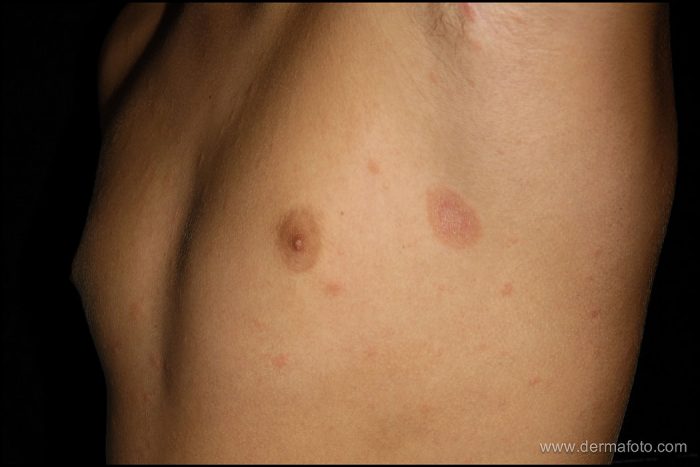
Later, the rash that characterizes pityriasis rosea begins. The typical picture consists of the appearance of an annular erythematous-desquamative plaque, with the center less inflamed, which is located on the trunk or limbs and can remain for weeks. It is called “heraldic plaque”.
Subsequently, similar smaller lesions (papules), salmon and oval emerge, which are distributed mainly on the trunk and root of the limbs, following the tension lines of the skin (“Christmas tree” distribution). Exceptionally, they affect the face and the most distal parts of the limbs. They typically appear suddenly and in waves, which usually alarm the sufferer. Pruritus (itching) is very variable, there are patients who suffer from it very intensely and others who do not perceive any discomfort.
Although this is the classic picture, there are many varieties: solitary heraldic lesion, secondary rash without heraldic plaque, heraldic plaque with vesicles, with purpuric lesions… There are as many pityriases roseas as there are patients consulted, and it is the dermatologist who is the professional who is most accustomed to distinguishing them.
How long does it last?
Pityriasis rosea is a disease with a limited course, which heals spontaneously in a highly variable period of weeks. It is generally accepted that the average duration between the onset and end of the rash is usually one and a half months, although cases of between two weeks and five months have been described.
Why does it appear?
Its cause is unknown, although it seems increasingly evident that it has a viral origin (herpes virus 6 and/or 7). This hypothesis could explain why it usually appears in seasonal outbreaks.
Who suffers from it?
It is most common between ten and thirty years of age, and slightly more prevalent among women. However, it can occur at any time in life.
How is it treated?
It is a disease that cures spontaneously without treatment. The use of corticosteroid preparations can worsen it and even generalize the rash (erythroderma), so they are not recommended. There are also studies that show the worsening of pityriasis versicolor treated with: emollients (moisturising cream), ultraviolet radiation (UVA), heliotherapy (sunbathing), topical antihistamines, oral corticosteroids and antiviral drugs. Erythromycin, an oral antibiotic, may produce a slight improvement but with a high rate of gastrointestinal undesirable effects, which is why it is not currently recommended.
For these reasons, the only therapeutic manoeuvre recommended is the administration of oral antihistamines if the itching is intense.
Can you suffer from it again?
The percentage of recurrences of Gibert’s pityriasis rosea is very low, usually only once in a lifetime, although there are studies that show a recurrence rate of up to 4%.
Is it contagious?
It is a difficult question to answer, since it is not known exactly why it appears. It is accepted that the patient who suffers from it can continue with their normal life without special care.
Can it cause any problems during pregnancy?
It is generally accepted that the rate of miscarriages in pregnant patients with pityriasis rosea is the same as that of the general population, although a slight increase in preterm birth with fetal hypotonia at birth has been described. Acyclovir, an oral antiviral, can be used during the first trimester of pregnancy to reduce a hypothetical risk of miscarriage in cases of very extensive rash, although evidence in favor of this therapy is scarce.
References
Drago F, Broccolo F, Rebora A. Pityriasis rosea: an update with a critical appraisal of its possible herpesviral etiology. J Am Acad Dermatol. 2009 Aug; 61(2):303-18.
Acknowledgements
To Dr. Leo Barco, for allowing the reproduction of the clinical image. See www.dermafoto.com.