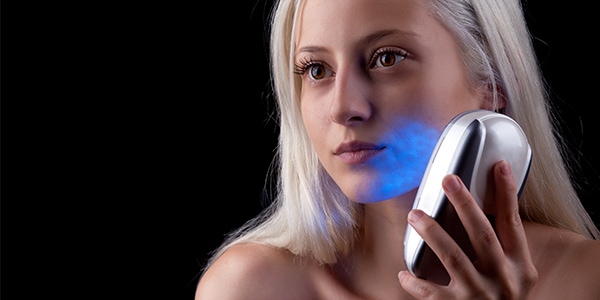
Why are light therapies used as an acne treatment?
Some of the therapies used in dermatology and based on light, such as lasers or photodynamic therapy, have an anti-inflammatory and/or antibacterial action. Because acne is an inflammatory disease with a bacterial superinfection by Propionibacterium acnes, some authors thought that these therapies could be useful to improve it.
What types of light-based treatments are there for acne?
They are classified into three large groups. Those that impact P. acnes (UVA/UVB radiation, blue and/or red light), those that modify the structure of the sebaceous gland (photodynamic therapy with aminolevulinic acid, infrared rays and radiofrequency) and those that act with both mechanisms simultaneously (pulsed dye laser, KTP laser or intense pulsed light).
How are light therapies for acne different?
Different medical devices emit a type of light, which differs from other classes by a parameter called wavelength. Certain substances present in tissues (chromophores) can absorb light with a specific wavelength: this makes it easier for the treatment to be specific to one type of therapeutic target and not another, since the product of the light reaction will only take place in that particular chromophore and will not affect other molecules, respecting the rest of the surrounding tissues.
Are light therapies for all acne patients?
No. They are limited only to patients who do not wish to do any treatment at home; or for those who do not tolerate, desire or respond to retinoids and topical or oral antibiotics. The main drawbacks of this type of therapy are the limited duration of their therapeutic effect, which must be practiced in the dermatologist’s office and the economic cost of the treatment for the patient.
What are the advantages of light therapies for acne treatment?
On the part of the patient, they do not require the application of any topical preparation on a daily basis or the taking of any oral drug, so possible adverse effects related to the drugs are avoided, nor is it necessary to perform blood tests to monitor them (as is required, for example, by the use of oral isotretinoin). Some cases of this skin pathology may also be resistant to standard treatments (antibiotics and retinoids) and may benefit from light therapies. In women of childbearing age, it is a possible option, as they have no implication on conception (oral antibiotics and isotretinoin are contraindicated in case of immediate gestational desire).
How do light therapies act on the existing infection in acne?
There is an overgrowth of a bacterium called Propionibacterium acnes. This microorganism, in its normal metabolism, produces a series of substances called porphyrins, which are capable of absorbing certain types of light (they are photosensitive) generating molecules toxic to the bacterium itself (free radicals) that will lead to its destruction.
Is blue or red light treatment effective?
Blue light has less penetrating power and anti-inflammatory action than red light. Studies to date on the response of mild and moderate acne to blue or red light therapy have yielded very positive results for the duration of therapy (maximum follow-up of 12 weeks). In stopping treatment, the recurrence rate is virtually constant.
Are lasers effective in treating active acne?
KTP’s green laser has shown positive results (reduction of inflammatory lesions of up to 36%) with a high safety profile and virtually no adverse effects.
Pulsed dye laser used in isolation achieves improvements of up to 50% in inflammatory lesions, although it has not been shown to be more effective than a topical preparation of clindamycin and benzoyl peroxide when compared.
The 1450 nm diode laser has shown results as effective as 80% improvements in inflammatory acne lesions with the advantage that the result can be maintained for up to 12 months.
The 1540 nm erbium laser is especially effective for the treatment of acne scars, and for active lesions it also achieves improvements of up to 75% in some studies, also reducing the amount of sebum present on the face.
As for pulsed light, the results are also good (superior to those of blue light) but inferior than other laser systems such as pulsed dye.
Is radiofrequency useful as an acne treatment?
There are only two studies in which radiofrequency has been used to treat this type of pathology, with excellent results but with a follow-up period of no more than a month. For this reason, it is difficult to conclude that it is a useful therapy.
What results are obtained in acne treated with photodynamic therapy?
There are numerous studies that reflect very promising results, but all of them have a very short follow-up of patients, so it cannot be concluded that their efficacy is maintained. We must also remember that photodynamic therapy is a treatment with a high cost for the patient, a factor that must be taken into account before recommending this therapy.
So, are light therapies an excellent acne treatment?
In the opinion of the author of this article, the answer is no. They are just one more alternative in the therapeutic arsenal to combat acne, and would only be used in patients who have not responded to more conventional treatments. The main drawbacks of light systems is that their effectiveness, although in some cases can be high, represent a cost and a waste of time for the patient that is not negligible. It should also be remembered that the therapeutic response to light-based treatments usually lasts weeks, so they do not represent a definitive solution to this type of pathology. More effective and simpler treatments, such as isotretinoin, have a much higher benefit/cost ratio. As for the advantages of light therapies, it should be noted that they have practically no adverse effects and are comfortable for the patient, since they do not involve applying or taking any drug daily.
REFERENCES
· Rai R, Natarajan K. Laser and light based treatments of acne. Indian J Dermatol Venereol Leprol. 2013 May-Jun; 79(3):300-9.