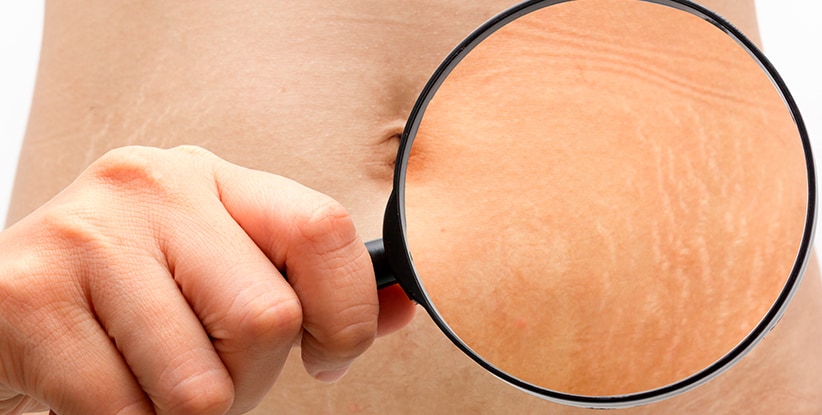
Why do stretch marks form?
Stretch marks appear due to excess tension in skin with weakened connective tissue. This is located in the dermis, the middle layer of the skin, and is mainly composed of collagen and elastin fibers, which provide turgor, elasticity and flexibility.
When there is a variation in volume in the organs located under the skin (such as in pregnancy, growth, weight changes or muscle hypertrophy) the dermis does not have time to react to form new collagen and elastin and fractures. In certain physiological states such as pregnancy, up to 90% of women have stretch marks on the abdomen or breasts throughout the third trimester.
The breakdown and contraction of the dermal fibers externally results in the appearance of stretch marks, which are irregular lines of soft, wrinkled skin tissue of a pearly or pink color. They usually settle in the areas subject to greater tension, such as the buttocks, abdomen, breasts or lower back. In the first phase of formation, stretch marks are pink. Once established, the coloration is pearly or skin tone.
Any of the stretch mark treatments will always be more effective in the phase of formation of the stretch mark, while it is pink.
TREATMENT OF STRETCH MARKS
The treatment of stretch marks is challenging, and there is only clear evidence of the effectiveness of two therapies: the application of tretinoin cream (derived from vitamin A contraindicated during pregnancy) and the use of non-ablative fractional laser. Other therapies have not shown their effectiveness in a proven way or are too aggressive to be practiced routinely.
The non-ablative fractional laser emits pulses of light that impact directly on the dermis, without damaging the surface of the skin, so it does not cause the formation of scabs, erosions or wounds. The impact of the light columns on the dermis causes an increase in the temperature of that area, causing a stimulus for new collagen and elastin fibers to form, and for the old ones to be realigned. Thus, the non-ablative fractional laser only specifically treats the damaged layer of skin, without having any action on the surrounding tissues.
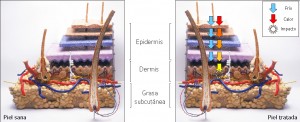
The progressive restructuring of the collagen and elastin fibers of the dermis allows the stretch marks to improve significantly as the treatment progresses. Because this natural process takes time, the effects of the first session are not noticeable until a minimum of six to eight weeks have passed. Also, as the synthesis of collagen and elastin is a progressive dynamic process, clinical improvement continues for a few weeks after the treatment is completed.
The treatment with non-ablative fractional laser is carried out through several sessions, and each of them consists of the application of the refrigerated laser head on the area to be treated so that the light selectively impacts the dermis. The sessions last for minutes, variable depending on the extent of the stretch marks. The sessions are comfortable for the patient, as they do not require local anesthesia and are tolerated with the simple application of an anaesthetic cream (which is not always necessary). Due to the epidermal cooling achieved by the cold head, after the session only a transient redness of the treated area is observed, without crusts or wounds appearing, as is the case with ablative techniques (deep peels, dermabrasions, rollers or ablative lasers). Therefore, non-ablative fractional laser treatment sessions are compatible with the patient’s usual rhythm of life without the need to take leave.
In the studies published to date, clinical improvement of stretch marks in patients treated with non-ablative fractional laser has occurred in all cases, in a range of 50 to 100% in terms of disappearance of stretch marks, with no signs of recurrence of stretch marks up to a year and a half of follow-up after completion of treatment. Efficacy rates are always higher when treatment is started early and ideally while stretch marks are still pink.
→ In conclusion, the non-ablative fractional laser produces a clear improvement of stretch marks, even their disappearance, regardless of their depth, the cause and the area where they sit. The high safety profile, the low rate of adverse effects and the duration of its effects make it a therapy of choice for the treatment of stretch marks. Due to its excellent results and safety, it is the only laser device approved by the FDA (Food and Drug Administration) for the treatment of stretch marks.
TREATMENT OF STRETCH MARKS WITH NON-ABLATIVE FRACTIONAL LASER
→ Non-ablative fractional laser is an effective, safe and comfortable treatment for stretch marks, whatever their cause, and achieves high rates of improvement, especially for recent stretch marks.
→ It is the only laser approved to treat stretch marks by the Food and Drug Administration (EUA) for its results and safety, and there is scientific evidence from studies that support its effectiveness.
→ Compared to other lasers, non-ablative fractionation is more harmless, tolerated and comfortable: it does not damage the surface of the skin and does not form scabs that can force the patient to interrupt their rhythm of life.
→ The sessions are 4 – 6 weeks apart, last a few minutes and cause only a transient redness of the area. It is not necessary to carry out any aftercare of the treated area, beyond sun protection.
→ Scar treatment with non-ablative fractional laser allows this therapy to be combined with other options such as vitamin A cream.
You can also see a summary of the article through this video:
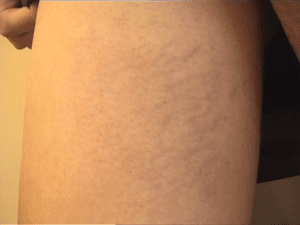
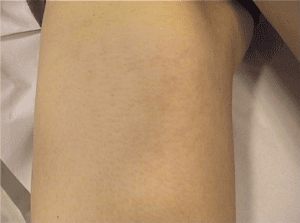
CLINICAL CASES


FREQUENTLY ASKED QUESTIONS
Is treating stretch marks with non-ablative fractional laser effective?
Yes. All studies show results of improvements between 50-100% in the appearance of stretch marks in all treated patients, with high satisfaction . The response is always better when the stretch marks are early (pink).
Is non-ablative fractional laser a safe treatment?
Yes. Because of its effectiveness and safety, it is the only laser system approved by the Food and Drug Administration for the treatment of stretch marks.
What kind of stretch marks improve with non-ablative fractional laser?
All of them, whether they are secondary to pregnancy, weight loss or gain, growth, muscle hypertrophy… And the answer is inversely proportional to the time of evolution of stretch marks.
Do old stretch marks improve with non-ablative fractional laser?
Yes, although the degree of response is better the more recent the stretch marks are. If they are pink (early), the response is much higher.
Does the treatment of scars with non-ablative fractional laser require admission, sick leave or general anaesthesia?
No. It is an outpatient procedure that lasts a few minutes and does not involve the formation of scabs or wounds, only a slight temporary erythema of the treated area. The sessions are tolerated without anesthesia, although it is optional, if the patient wishes, to apply an anesthetic cream 30-45 minutes before therapy.
Is it a very expensive treatment?
The non-ablative fractional laser has an attractive benefit/cost ratio, and is clearly favorable compared to other aesthetic procedures. The cost of the sessions is proportional to the extent of the stretch marks.
How many sessions do you need to improve or make stretch marks disappear?
It depends on the time of evolution of the stretch marks, their extension and their depth. At least 4 sessions are necessary (separated by four weeks from each other), and it is not often that more than 6 sessions are necessary. However, each case deserves a special assessment.
How many days should laser sessions be done to treat stretch marks?
Sessions are usually separated by 4 weeks.
Is non-ablative fractional laser the best laser for treating stretch marks?
Traditionally, the ablative fractional laser was used, which has very similar results to the non-ablative system, but with a higher rate of complications (crusting, pain, need for dressings after sessions). Thus, the effectiveness of the ablative and non-ablative fractional laser is very similar, but the non-ablative has greater safety and comfort.
After doing a non-ablative fractional laser session, do I need to take any special care?
Whenever any procedure is performed on the skin, sun protection with strict SPF 50 is recommended.
What does the skin look like after a non-ablative fractional laser session?
Immediately after the session there is a transient erythema (redness) in the treated area, which usually disappears within a period of 2-4 hours. Occasionally the laser head leaves tiny spots, practically imperceptible, that spontaneously depart in a few days.
Can I lead a normal life if I do non-ablative fractional laser to treat stretch marks?
Yes. This type of laser only impacts the middle part of the skin and therefore no superficial lesions appear as with other aesthetic procedures. It is not necessary to take sick leave and it is perfectly compatible with the normal rhythm of life.
Can I have the non-ablative fractional laser to treat stretch marks preventively or early if I am pregnant?
No. Laser therapies are contraindicated during pregnancy. It is possible to perform it shortly after childbirth and during breastfeeding if desired.
REFERENCES
· de Angelis F, Kolesnikova L, Renato F, Liguori G. Fractional nonablative 1540-nm laser treatment of striae distensae in Fitzpatrick skin types II to IV: clinical and histological results. Aesthet Surg J. 2011 May; 31(4):411-9.
· Yang YJ, Lee GY. Treatment of Striae Distensae with Nonablative Fractional Laser versus Ablative CO(2) Fractional Laser: A Randomized Controlled Trial. Ann Dermatol. 2011 Nov; 23(4):481-9.