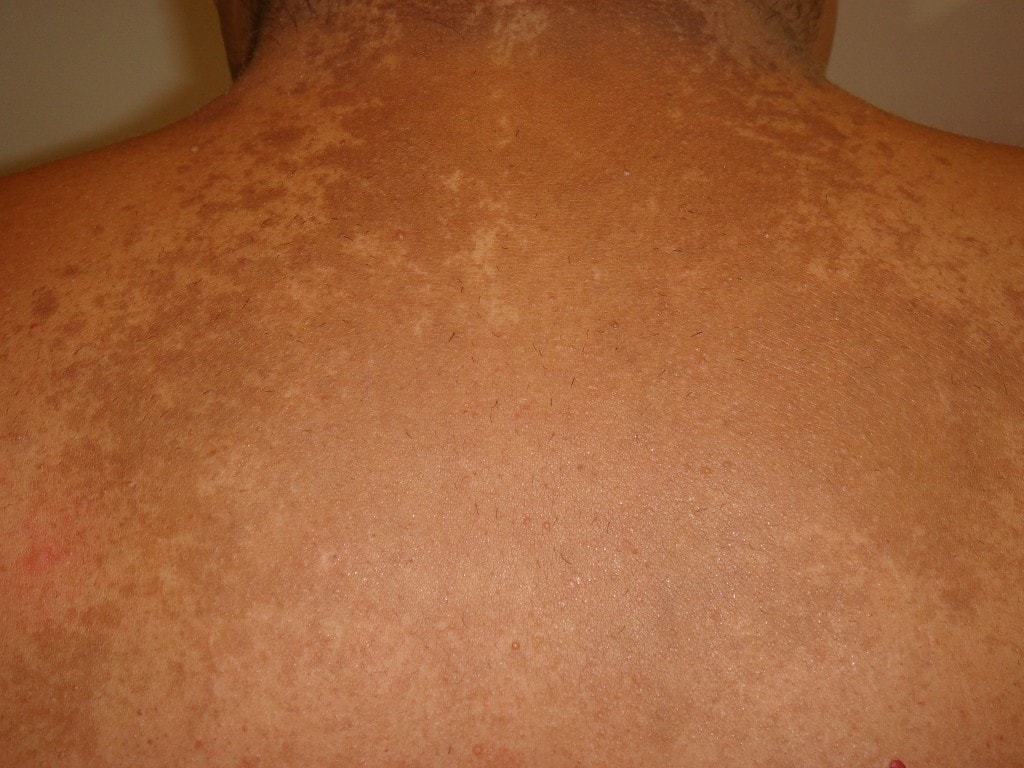
What is pityriasis versicolor?
It is a superficial skin infection caused by fungi of the genus Malasezzia. This type of fungus is part of the normal flora of adult skin, which can be present in up to 100% of the population. When certain optimal conditions for its growth are met (humidity, seborrhea, personal predisposition, use of oils, excessive sweating), the fungus proliferates, changes to its filamentous form and manifests itself clinically. If the conditions of the skin are not optimal for its growth, the fungus is still alive on the skin but does not manifest itself (spore form).
How does pityriasis versicolor manifest itself?
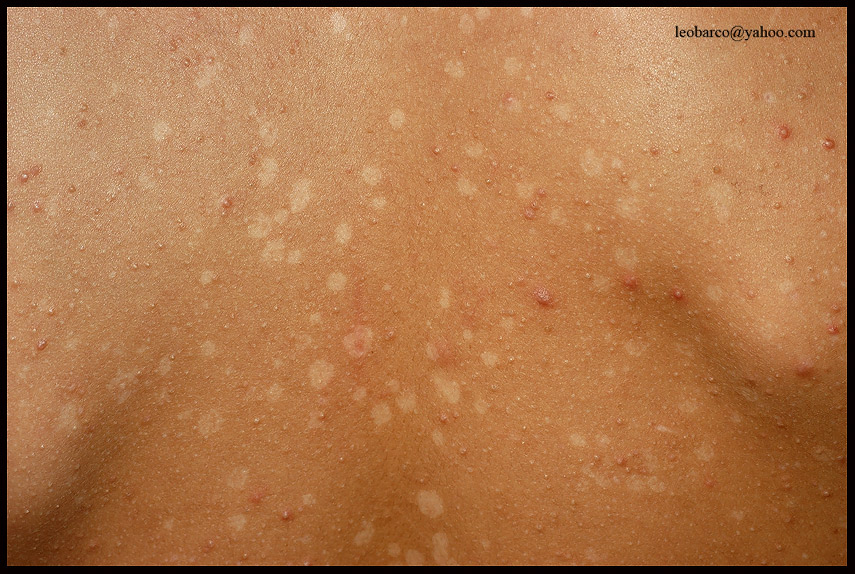
It is usually expressed in the form of rounded macules (spots) of brown, pink and/or white color in seborrheic areas of the body: the back, thorax and the root of the limbs. When the infection is active, the lesions produce epsontanic or scratching scaling (nail sign). When the infection is cured, the residual lesions do not flake. Characteristically, the lesions are usually circular, although more morphologies can be observed. In general, it does not cause discomfort beyond the aesthetic alteration it entails, although some patients report pruritus (itching). Exceptionally, inverted forms are observed, more frequent in immunosuppressed patients, where the folds, the face and some isolated areas of the limbs are affected; or papulo-pustular forms similar to folliculitis, with “pimples” that can be pus, in the dorsal area and chest.
Who suffers from pityriasis versicolor?
The entire population can suffer from pityriasis versicolor, although it most often appears in young people, who have greater activity of the sebaceous glands of the skin. It is an infection especially common in countries where there is heat and humidity in the climate.
Is it very common?
Yes. In tropical climate areas it can affect up to 40-50% of the adult population. In cold and dry areas, such as in the Scandinavian peninsula, its frequency is as low as 1%.
How is pityriasis versicolor diagnosed?
In general, the dermatologist can diagnose this infection visually, as it has a characteristic appearance. On certain occasions, this can be helped by illuminating the suspicious area with Wood’s ultraviolet light, which will reveal a characteristic orange coloration. It is also possible to scratch the lesions and examine the removed cells under an optical microscope with potassium hydroxide solution, a quick examination that will show the classic image of “spaghetti with meatballs” revealing the presence of spores and hyphae of the fungus.
Why does it produce spots of different colors?
The name “versicolor” means that the lesions can acquire different colorations, even in the same individual. The mechanisms by which it modifies the color of the skin are several: the irritation of the skin itself (pink coloration), the inhibition of the enzyme that synthesizes melanin (white coloration) and the increase in the size of melanosomes, which contain melanin (dark coloration). Melanin is the molecule that gives color to the skin. If the protein that manufactures it is inhibited, the skin becomes hypopigmented; and if its size is increased, it becomes darker. The fungus that causes the disease, through different mechanisms, can cause one or another alteration of melanin.
How long do white spots last?
The inhibition of melanin synthesis caused by the fungus can last for weeks or months even if the infection is completely cured. To know if these spots are residual, just scratch them: if flaking appears, the infection is active; if there is no peeling, the infection has been cured.
Is it possible to continue with blemishes after having done the correct treatment?
Yes, it is a frequent occurrence. The white spots last for weeks or months after healing, because melanin synthesis takes time to restart again. It is common for the patient to be alarmed when they see that after doing the treatment they still have spots. It is important to know that this is perfectly normal and frequent, what indicates active infection is the peeling of the lesions, and not the coloration of them.
How is pityriasis versicolor treated?
Since it is a fungal infection, treatment is carried out using antifungal drugs. These can be administered topically (gels, creams, sprays) or orally (tablets or capsules), depending on the extent, intensity of the lesions and previous treatments. In the meta-analyses of treatment studies, all topical or oral drugs, imidazole or non-imidazole, have been shown to be effective, so the choice of one or the other will depend on the factors discussed and the dermatologist’s experience. Among the possible drugs are ketoconazole, bifonazole, miconazole, econazole, clotrimazole, cyclopirox and zinc pyrithione, among others. The higher the dose and duration, the better the results are obtained. Reviews of treatments have not found differences in effectiveness between oral and topical treatments, although the former are much more convenient to do.
In the opinion of the author of this article, it is recommended to use the most effective treatment with the highest safety profile as shock therapy and then a simple topical maintenance option to avoid recurrences.
If I have already had pityriasis versicolor, can I have another one again?
Yes. In fact, recurrences of the condition are very common in hot weather. This is the reason why some specialists recommend using a simple maintenance treatment to limit the growth of the fungal population. The use of an antifungal shower gel for maintenance is usually enough.
REFERENCES
Hu SW, Bigby M. Pityriasis versicolor: a systematic review of interventions. Arch Dermatol. 2010 Oct; 146(10):1132-40.
ACKNOWLEDGEMENTS
To Dr. Leo Barco for the clinical image of the hypopigmented form.