
Treatment of shingles
What is shingles?
It is the manifestation of the reactivation of the chickenpox virus, which has become latent after the first contact with it. The varicella-zoster virus (VZV) causes the so-called “primary infection” in its first contact, which clinically manifests itself as chickenpox. Once this disease has passed, VZV becomes inactive in some nerve root of the body. There it can remain latent without causing any symptoms or signs throughout life, or it can reactivate at some point cause shingles.
How does shingles manifest itself?
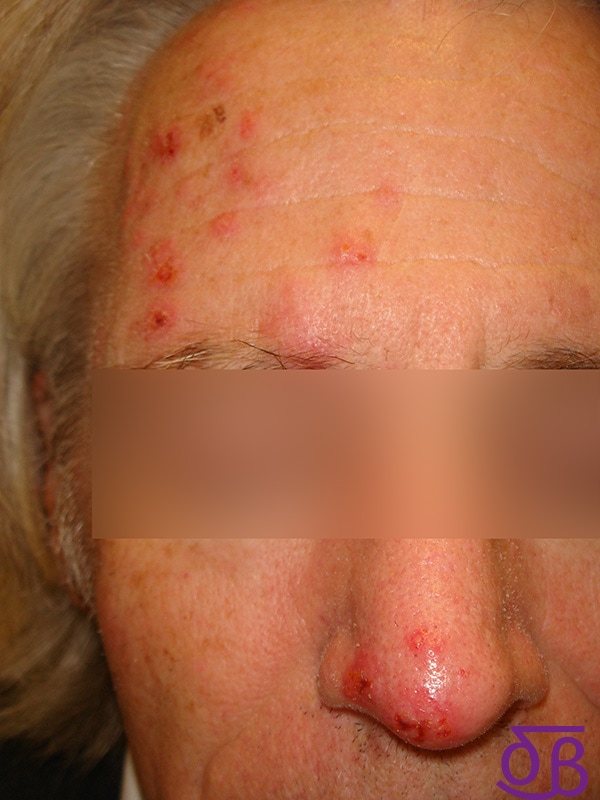
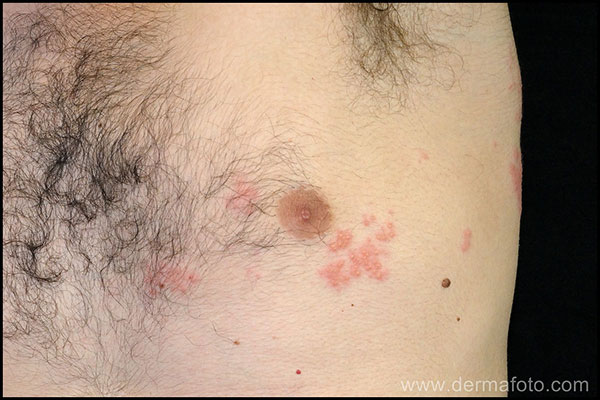
It usually appears as erythematous and edematous papules or plaques to which grouped vesicles are superimposed in hours or days. The rash usually has a linear distribution that follows the path of a nerve root (dermatome), which is why it usually only appears on one side of the body. The rash is often painful. The pain varies greatly in intensity, from non-existent to disabling, and can precede the rash by a few days. It is not uncommon for the patient to have been previously diagnosed with nephritic colic or low back pain and a few days later the rash appears, revealing the real origin of the pain. This may have a different quality depending on the patient: itching, burning, weight, tightness, stabbing, continuous, intermittent… It is not uncommon for some sensory abnormality to be felt in the area affected by shingles: anaesthesia, deficit in thermal sensitivity, vibration, palpation…
When the pain lasts more than a month after the disappearance of shingles, the condition is called post-herpetic neuralgia, which can have a chronic course.
Is shingles very common?
Yes. It is estimated that it appears in up to 20% of healthy adults and in 50% of immunocompromised patients.
Who can get shingles?
Anyone who has been infected with VZV at some point in their life. It is usually more common in patients over 50 years of age, although it is possible that it appears earlier. A person who has suffered from chickenpox has a 30% chance that VZV will reactivate in the future, causing shingles. The incidence and intensity of shingles are proportional to age (it is estimated that up to 50% of patients who reach 85 years of age may suffer from shingles).
Why does shingles appear?
The reasons why the dormant virus is reactivated are unknown, although a relationship has been found between the outbreak and the following stimuli:
- Re-exposure to VZV
- Serious illnesses (infections or neoplasms)
- Emotional stress
- Drug use
Do you have to have had chickenpox to get shingles?
No, but you must have been infected with the VZV virus previously. If infection occurs after the first contact with VZV, the vast majority of cases it manifests itself, a few days or weeks later, in the form of chickenpox (clinical primary infection). However, on some occasions it is possible to have been infected with the VZV virus without having produced a chickenpox rash (subclinical primary infection) or only a flu-like condition. For this reason, although the vast majority of times the patient with shingles remembers having had chickenpox, on some occasions this is not the case, nor is this a mandatory history for its diagnosis.
Is shingles contagious?
Yes. While the skin lesions of shingles are in the acute phase (before the formation of scabs), it is possible to spread the infection by VZV. However, it will only be spread to people who have not previously been infected by this virus. Therefore, a person with shingles can transmit the primary infection to a “virgin” person of this virus which, if it manifests, will do so in the form of chickenpox and not shingles. For this reason, it is especially important that patients with shingles are not in contact with children, since they may not have previously had chickenpox and, when infected, suffer from it. People who have already been infected with VZV at some point in their lives (the majority) are not at risk of being infected with chickenpox. It should be noted that chickenpox has a greater potential for contagion than shingles: it is believed that the latter is a third as contagious as chickenpox. Likewise, the probability that a person infected with VZV will suffer from shingles when contacting a patient who is suffering from it is minimal.
How is the chickenpox virus spread?
By direct contact with skin lesions or by inhalation of fluid from vesicles or respiratory secretions in people with respiratory infection with VZV (a rare condition).
How is shingles diagnosed?
Generally, once the first signs of the rash appear, its appearance is sufficiently characteristic to be diagnosed by mere physical examination of the lesions. In doubtful cases, it is possible to perform a smear of the lesions and perform a test called polymerase chain reaction (PCR), which has a sensitivity of 95% and a specificity of 99%. The virological culture, despite offering a very high specificity, only presents a 20% sensitivity. Likewise, serological tests by means of blood tests are of little use, since only 50% of patients have an increase in IgM and IgA immunoglobulins during the outbreak of the lesions.
How is shingles treated?
In the acute phase, it should be treated with oral antiviral drugs (acyclovir, valacyclovir, famciclovir or brivudine), which inhibit the replication of the virus. The main objectives of treatment are to reduce the severity and duration of the rash as well as the intensity of the pain associated with it. Ideally, treatment should start within 72 hours of the appearance of the rash, or later if new lesions still appear. Even if these conditions are not met, it is advisable to perform oral treatment depending on the intensity or probability of pain-related complications (pain prior to the rash, severe pain, severe skin lesions or neurological complications (e.g., encephalitis). The duration of oral treatment in uncomplicated shingles is one week. If it must be prolonged due to the presence of complications, it will be assessed jointly by the dermatologist and the patient.
What is the best oral antiviral treatment?
There is no study to date that determines greater efficacy among different acyclovir derivatives (famciclovir, valacyclovir). However, the latter have greater bioavailability than acyclovir and are preferable to the former (in addition, the dosage is more comfortable for the patient). Brivudine, another VZV replication inhibitor, has clinical results very similar to famciclovir in terms of efficacy: the main advantage of this drug is that it is a single daily dose. The main drawback of brivudine is its interaction with drugs derived from pyrimidines, which are components present in some chemotherapy regimens (5-fluorouracil), so its use is not recommended in patients undergoing this therapy.
Can shingles be treated with cream?
Treatment with topical antivirals (cream) has no proven efficacy either in relieving symptoms or in modifying the course of the rash, so its use is not recommended.
Only under the prescription of your dermatologist will it be possible to combine oral antiviral treatment with a topical preparation of potent corticosteroids, to reduce the intensity of the inflammatory signs and symptoms of the disease.
Can shingles affect the eye if it appears on the face?
Yes. When shingles runs along the first branch of the trigeminal nerve of the face, it is possible that the ocular cornea and conjunctiva may be affected. It is necessary for an ophthalmologist to assess the condition whenever there is conjunctival erythema or the so-called Hutchinson’s sign (appearance of herpetic lesions on the tip, sides or root of the nose).
Why does shingles cause pain?
The reactivation of VZV occurs along the sensory fibers of a nerve root (dermatome), inflaming it and therefore increasing the transmission of painful sensation originating in the same nerve (neuralgia). Neuralgia usually has an acute course before, during or a few days after the eruption. However, in some cases it can persist for months or years after shingles (post-herpetic neuralgia), which is why it is essential to control the symptoms of shingles from the beginning of the condition. Early action reduces the probability of developing post-herpetic neuralgia.
Can shingles reappear if one has already been suffered?
Yes. In 90% of cases, only a single episode of shingles occurs throughout life, but in a low percentage of patients some other may occur.
Have I heard that when the two “shingles” come together, the patient dies. Is it true?
No. Shingles was traditionally called “shingles” because it has a linear shape that usually runs along a nerve root on only one side of the body. In cases of immunosuppression or when the patient suffers from a serious underlying disease (kidney or lung failure, cancer, immune disorders), shingles can be especially extensive, encompassing more than one nerve path and have a severe course, or aggravate the patient’s underlying disease with a fatal outcome. For these reasons, the popular simile has become that extensive (affecting more than one nerve root) or bilateral shingles can be fatal. Shingles does not cause asphyxiation in the patient, even if it is bilateral, since it does not exert any pressure on the chest (“if shingles come together, they choke you”). However, in this profile of immunosuppressed patients or patients with severe basal disease, it is possible that herpetic infection affects the respiratory system, causing herpetic pneumonia, which is a particularly serious condition.
What is the treatment of choice for shingles?
Shingles has been the object of esoteric therapies or quackery (drawing snakes on the patient’s body, tearing the patient’s skin forming lines…). None of these practices have demonstrated any objective efficacy and may contribute to underestimating or delaying effective antiviral and analgesic therapy.
Herpes zoster in the acute phase should be treated with oral antiviral drugs (acyclovir, valacyclovir, famciclovir or brivudine) with the dose and duration indicated by a dermatologist. If the rash causes pain, it is recommended to administer analgesics according to medical guidelines: sometimes their management may require the attention of a doctor specialized in this field (pain clinic).
How is pain treated during the episode or after shingles?
In addition to the first-choice analgesics (paracetamol, ibuprofen, metamizole, codeine), it is possible to add some topical agents (lidocaine, capsaicin) or specific oral drugs for the treatment of nerve pain (gabapentin, pregabalin, amitriptyline, tramadol). It is not uncommon that, if the patient has post-herpetic neuralgia, a doctor from the pain clinic should be consulted to find the analgesic regimen that best controls the symptoms.
REFERENCES
· Dworkin RH, Johnson RW, Breuer J, Gnann JW, Levin MJ, Backonja M, Betts RF, Gershon AA, Haanpaa ML, McKendrick MW, Nurmikko TJ, Oaklander AL, Oxman MN, Pavan-Langston D, Petersen KL, Rowbotham MC, Schmader KE, Stacey BR, Tyring SK, van Wijck AJ, Wallace MS, Wassilew SW, Whitley RJ. Recommendations for the management of herpes zoster. Clin Infect Dis. 2007 Jan 1; 44 Suppl 1:S1-26.
· Gan EY, Tian EA, Tey HL. Management of herpes zoster and post-herpetic neuralgia. Am J Clin Dermatol. 2013 Apr; 14(2):77-85
Acknowledgements
To Dr. Leo Barco for his excellent clinical photos. Check out www.dermafoto.com to find more dermatological images.