
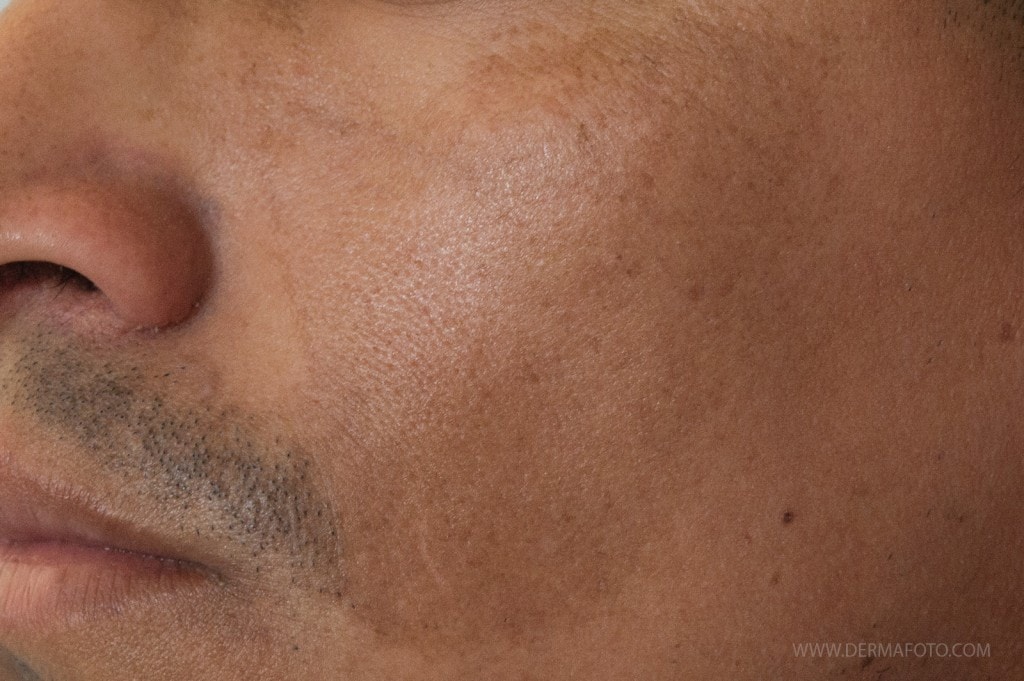
Melasma (or chloasma) is a hyperpigmented brown spot with well-defined borders that appears on the face, typically in young girls. It usually settles in the mustache area, on the cheeks and/or on the forehead.
Although the reason why it appears is unknown, it is known that there is a clear influence of estrogens, since most patients are women of childbearing age with a history of contraceptive use or pregnancy. For this reason, there are professionals who call melasma ‘hormonal spots’.
This alteration should be interpreted as a continuous tendency of certain areas of the skin to hyperpigment. It is very common for it to worsen intensely in summer despite the use of sunscreens and for it to improve spontaneously in winter.
The treatment of melasma is a challenge in dermatology. The application of sunscreen with an SPF greater than 50 should be a constant: the patient should use it as a moisturizer for regular use and should be renewed every two hours when outside. It is essential that the sunscreen is applied during and after the active treatment of melasma.
The initial shock treatment is based on magisterial formulas that contain depigmenting, anti-inflammatory principles and produce a certain peeling. These drugs will be used for a limited time and at increasing concentrations until the optimal response is achieved. It is possible to complement this treatment with glycolic acid peels or laser peels when necessary, although the degree of response is very variable between patients.
As for therapy, it should be noted that melasma is a trend, rather than a punctual and limited alteration in time. In this sense, once sufficient lightening of the spots has been obtained, it is very important that a basic treatment is always maintained: use a topical and oral sunscreen, and use a depigmenting preparation once or twice a week.
Click here for more information on melasma treatment.
Sheth VM, Panya AG. Melasma: a comprehensive update: part I-II. J Am Acad Dermatol. 2011 Oct; 65(4):689-714.