
What are spider veins of the legs?
These are telangiectasias ( superficial blood vessels) with a diameter of 0.1 to 1 mm that are observed in the skin of the lower extremities. They are usually arboriform, forming small red or purplish threads, with a tortuous path. They may or may not have several branches. They may also have a common central trunk from which the ramifications start. It is believed that up to 30-40% of women and 5-15% of men have spider veins on the legs. They do not represent any alteration of health, but an aesthetic alteration.

How are spider veins of the legs treated?
There are two main types of treatments: sclerotherapy (injecting a chemical substance into the vessels that causes them to collapse) and laser therapy (light systems that send very specific heat to eliminate the vessels).
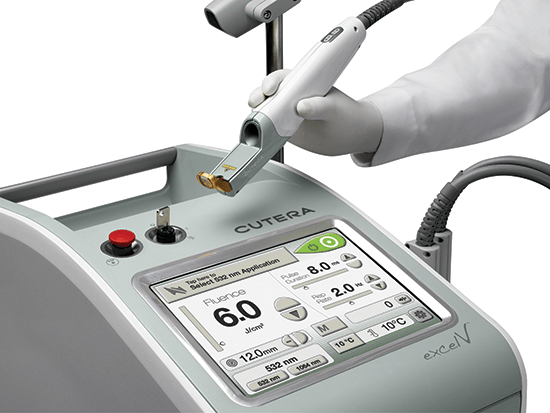
For spider veins less than 1 mm in diameter, sclerotherapy is a difficult technique and not without adverse effects – hyperpigmentation, skin necrosis, thrombosis, allergic reactions – which is why many authors prefer to use vascular lasers. There are different types of vascular lasers, whose target is the hemoglobin that circulates inside the vessels: pulsed dye (585, 595 nm), KTP (532 nm) and Nd:YAG (neodymium, 1,064 nm).
The pulsed dye laser has a very short-acting pulse, which usually causes the blood vessel to burst causing purple (hematoma) lasting days. KTP and Nd:YAG lasers emit longer pulses of energy and drastically reduce the chance of causing purpura. The KTP laser concentrates the energy in the hemoglobin of the blood vessels, causes clumping of red blood cells within the capillaries, and coagulation of the capillaries. The chance of the vessels exploding causing purpura and/or hyperpigmentation is minimal with the KTP laser.
How effective is KTP’s laser for the treatment of fine spider veins of the legs?
There are several studies where the effectiveness of KTP’s laser for the removal of spider veins from the legs has been evaluated.
In the first place, the work of Spendel et al. stands out, where 70 women between 19 and 50 years of age with spider veins in the lower extremities without alteration in deep venos circulation were evaluated. Three KTP laser sessions were performed, separated from each other by 6 weeks, in a selected area of 5 x 5 cm of one leg. The three sessions were practiced in exactly the same marked area.
For spider veins with diameters less than 1 mm , there was a reduction of more than 50% in thickness in 80% of the participants. Treatment with sclerosis in the same study showed that there was no significant change in 88% of the participants whose spider veins had a diameter of less than 0.7 mm.
Therefore, in spider veins with diameters less than 0.7 mm, the effectiveness of the KTP laser is much higher than that of sclerosis. However, for vessels larger than 0.7 mm, its effectiveness is lower. This result is perfectly consistent with the laser wavelength (532 nm), which positions it as an excellent treatment for superficial vascular lesions but not for deep or thick vascular lesions. For thick or deep vascular structures, it is recommended to use lasers with a higher wavelength, such as Nd:YAG (1,064 nm).
In the study by Bernstein et al ., 20 women were treated with two KTP laser sessions. More than 70% of the patients treated had a “significant” or “very significant” response (improvements of between 51% and 100%). All participants were satisfied with the treatment and would recommend it.
What are the most common side effects in treating spider veins of the legs with the KTP laser?
In the aforementioned study by Spendel et al., hyperpigmentation, residual and reversible in 4 – 5 months, was the most frequent adverse effect, occurring in 23% of cases. This complication also occurs with sclerosis and with pulsed dye laser. Hypopigmentation may occasionally appear.
Both redness and oedema in the treated areas are constant after treatment, as they are typical of the heat emitted by the laser, and disappear within the first 24 hours. Scabs may rarely appear in some treated areas, which are removed during the first week after treatment.
In the study by Bernstein et al., the presence of hyperpigmentation was drastically lower (2%), and no cases of purpura, blisters, hypopigmentation, pigment dispersion or scarring were observed. The participants in this study rated the discomfort during the procedure with a mean of 2.9 on a scale out of 10 (minimal pain).
CONCLUSIONS
- KTP’s 532 nm laser is a safe and effective device for the treatment of superficial vascular lesions and less than 1 mm in diameter, such as spider veins of the legs.
- Studies show comparable or superior results to pulsed dye and Nd:YAG for this type of vessel, but with a lower incidence of adverse effects due to the longer duration of their pulse.
- The presence of residual purpura is less frequent and intense than compared to pulsed dye laser.
- For thicker, bluer or deeper vessels, it is advisable to use lasers with a longer wavelength, such as the 1,064 nm Nd:YAG laser.
- In the same session it is possible to treat the most superficial and fine vessels with KTP laser and the thicker and deeper vessels with Nd:YAG laser.
- Regardless of the treatment system for spider veins, telangiectasias and leg varicules, the final clinical result should be evaluated ONE YEAR after the end of treatment, since the improvement is progressive.
REFERENCES
· Spendel S, Prandl EC, Schintler MV, Siegl A, Wittgruber G, Hellbom B, Rappl T, Berghold A, Scharnagl E. Treatment of spider leg veins with the KTP (532 nm) laser–a prospective study. Lasers Surg Med. 2002; 31(3):194-201.
· Bernstein EF, Noyaner-Turley A, Renton B. Treatment of spider veins of the lower extremity with a novel 532 nm KTP laser. Lasers Surg Med. 2014 Feb; 46(2):81-8.