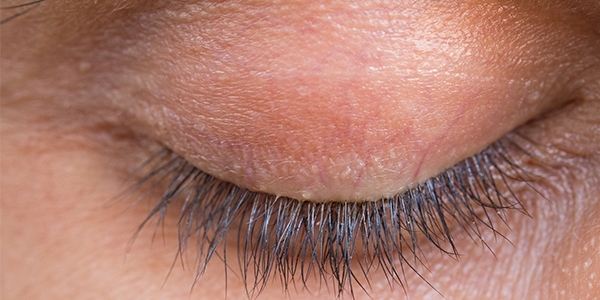
Treatment of Xanthelasmas
What are Xanthelasma?
They are cholesterol deposits located on the eyelids. They appear to be a papule or plaque (raised lesions) of yellowish color, smooth and shiny surface, and well-defined borders. They can appear in a single way or in groups, most commonly being bilaterally located in both inner thirds of the eyelids. They do not cause any discomfort except for aesthetic discomfort.
Why do xanthelasmas appear?
The exact reason why they appear is unknown, although they are more frequent in women, their incidence increases with age and up to 50% of patients suffer from dyslipidemia (alteration of blood lipids (fats) with alteration of apoprotein E or elevation of low-density cholesterol (LDL). A fifth of xanthelasmas are associated with familial hypercholesterolemia.
How important are xanthelasmas for health?
Xanthelasma do not represent any alteration in themselves, nor is there a risk that they will degenerate into a malignant skin lesion. However, in cases that are associated with dyslipidemia, they indicate that the subject suffers a greater cardiovascular risk due to the lipid alteration. For this reason, a necessary study to be performed before the diagnosis of xanthelasma is a blood lipid profile to reduce cholesterol levels if appropriate.
What is the typical course of xanthelasma?
Once they have been established, they usually remain. Very rarely, when lipid levels in patients with hypercholesterolemia are regularized, the xanthelasmas decrease.
Is the removal of xanthelasmas permanent?
Usually not. If xanthelasmas are secondary to dyslipidemia, it is likely that once eliminated, if the lipid profile is controlled, they will not reappear. However, in patients suffering from xanthelasmas without dyslipidemia, the norm is the recurrence of the lesions in a variable period of time (months – years).
It is common for the lesions to be removed every indeterminate period of years to avoid aesthetic discomfort. It is advisable to treat xanthelasmas when they are small: the intervention is simpler.
How are xanthelasmas treated?
In cases associated with dyslipidemia, it is essential to reduce cholesterol levels, either with dietary measures or by adding oral drugs. If these measures do not disappear, the classic treatment is surgical excision. Although this technique usually offers good aesthetic results, in the lower eyelids it can be associated with ectropion (excess retractable opening of the eyelids). Because xanthelasmas tend to recur, the surgical option has more and more limitations, so alternatives are offered: trichloroacetic acid peeling, or CO2 or erbium laser removal.
What are the advantages of CO2 laser treatment compared to surgery?
In the upper eyelids, the aesthetic result is very similar using either technique. However, in the lower eyelid there is a higher risk of abnormal scarring and ectropion (retraction of the eyelid) if surgery is used than if CO2 laser excision is performed. Also, depending on the suture used to repair the area removed by surgery, it is possible that the scar is more prominent and with the unsightly “train track” caused by the stitches. It should be noted that the surgery is usually performed in an operating room and that CO2 laser excision is performed in the outpatient clinic. Finally, the surgical technique necessarily requires the injection of local anesthesia, which is not imperative if the CO2 laser is used. With this technique it is possible to use only one anaesthetic cream most of the time, so the discomfort of anaesthesia punctures and the probability of a secondary haematoma are reduced.
What is the level of satisfaction of patients who remove Xanthelasmas using CO2 lasers?
In the vast majority of cases, patients report a high level of satisfaction and it is common for those who have been treated using both methods to finally show a preference for CO2 laser excision, as it is more comfortable and with fewer risks in general terms.
Are all CO2 lasers useful for treating xanthelasmas?
It has been observed that continuous CO2 laser treatment has a high rate of lesion recurrence, so ultrapulsed CO2 lasers are recommended, which focus thermal damage in small temporary pulses with greater respect for the surrounding healthy tissue and thus reduce the risk of undesirable effects. Continuous CO2 laser has a higher risk of unsightly scarring.
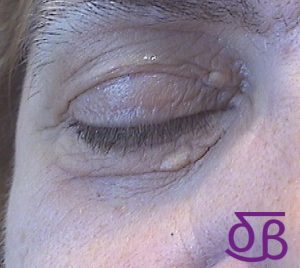
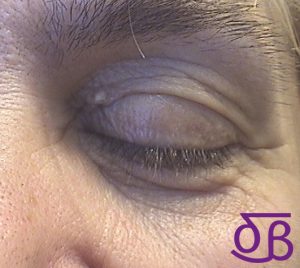
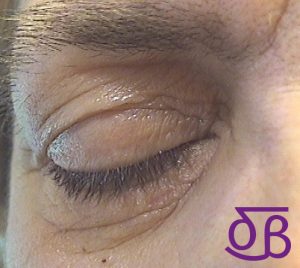
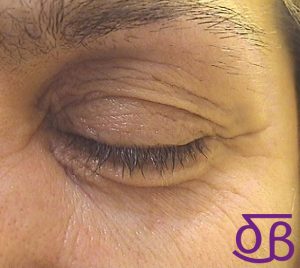
Result of the removal of xanthelasmas in both eyelids of the right eye and in the upper eyelid of the left eye with CO2 laser
REFERENCES
· Delgado Navarro C1, Lanuza García A, Llorca Cardeñosa A, Bañón-Navarro R, Corchero Martin G. Application of laser CO2 for the treatment of xanthelasma palpebrarum. Arch Soc Esp Oftalmol. 2013 Aug; 88(8):320-2.