
What is the use of subcision?
Atrophic acne scars (whether wavy, box-shaped, or icepicked) often have underlying fibrous tracts that, like an anchor, pull the skin’s surface downwards, causing them to adopt this sunken morphology. This fibrosis is also the reason why some acne scar treatments may fail. If acne scars are highly anchored deep by fibrosis, even if collagen is generated, their surface may not rise due to the downward stress exerted by the fibrous tracts. Therefore, it is important to remove or break these fibrous anchors underneath the acne scars when necessary. In this way, subsequent treatments will be more effective.
What is subcision?
It is a simple procedure in which through a minimal puncture an instrument, either blunt, sharp or a laser fiber, is inserted under the acne scars to be treated. If the instrument is manipulated back and forth below the fibrous scars, these fibrous tracts rupture and the surface of the skin rises, either with this maneuver alone or with subsequent procedures to treat the scars. Subcision is performed under local anesthesia, either undiluted or tumescent.
Each of the atrophic scars must be treated at different entry points to ensure that the maximum number of fibrous septa are broken in the same act.
In general, a single subcision session is only required if the scars are not very extensive or deep. If, on the other hand, there is a significant amount of scars or they are very depressed, it is advisable to proceed by monthly sessions dividing the treatment into areas.
What instruments can be used to perform the subcision?
There are numerous techniques to apply this technique.
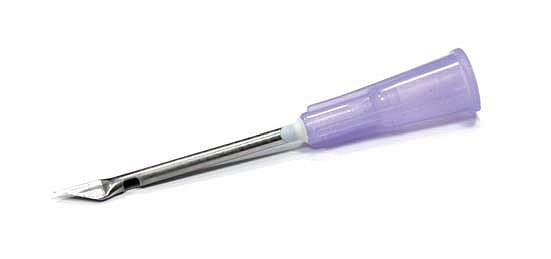
Classically, the Nokor needle, shown in the previous photograph, is used. Its tip is spear-shaped and its edge is sharp. It is 4 cm long. It is usually used for small scars and for small areas. Although very effective, the Nokor needle is associated with a high rate of bleeding at the time of the act and the appearance of subcutaneous hematomas due to its edge.
Blunt cannulas are non-sharp, round-tipped, and blunt instruments. They usually have a long handle and the stem of the cannula itself is rigid to allow the subcutaneous fibrous tracts to rupture. Since it does not cut, it is associated with a lower incidence of bleeding and bruising, but during the procedure considerable force must be exerted to break the fibrosis with this non-cutting instrument. There are short cannulas (4 cm) for small areas and long (15 cm) to treat the entire cheek or other larger areas.
The Taylor releaser is a long, non-cutting instrument with a trident-shaped edge. Its function is to tear the fibrous tissue of the scars. It is the most aggressive tool for performing subcisions (also the most effective) and is therefore reserved for severe and/or very extensive scars. Normally, if the Taylor releaser is used, the subcision is performed with sedation in the operating room. The postoperative period is usually more striking, with swelling and bruising.
The diode endocutaneous laser, on the other hand, is the most conservative instrument to perform subcision, since it is an elastic fiber that emits laser light when it runs inside the skin, accumulating heat and undoing fibrosis. This caloric mechanism also facilitates neocollagenogenesis and the tightening of the surrounding tissues. In this sense, it is indicated when a gentler treatment is desired, in light scars or when tissue retensioning is also desired. The postoperative period is the most discreet of all.
What are the benefits of subcision?
Firstly, the rupture of the fibrous tracts that pull the skin to the depth causes the skin surface to rise immediately and in the following weeks. The procedure causes a new scarring below the skin surface, which will form new collagen to provide the lost volume without the epidermis having been damaged (it does not leave any type of mark or scab). The rupture of the fibrosis and the movement of the needle release blood into the scar gap, so growth factors are immediately provided that will promote new healing, without having to resort to more laborious techniques such as the injection of platelet-rich plasma. Likewise, the accumulation of blood under the atrophic scar provides a volume temporarily that minimizes the tendency for the skin surface to retract to return to its depressed basal state.
It is an extremely quick technique to perform and usually painless, which can be performed under local anaesthesia. In fact, it is not uncommon, if the area to be treated is large, for us to use tumescent local anaesthesia. This contains, in addition to the anaesthetic itself, a large amount of saline solution, with bicarbonate and/or vasoconstrictor. It is used to sleep large areas using a small amount of drugs and, therefore, increasing its safety and comfort for the patient. The injection of this amount of anaesthesia also allows hydrodissection to be performed: separation and rupture of fibrosis by the hydrostatic pressure of the anaesthesia.
What types of acne scars benefit from a subcision?
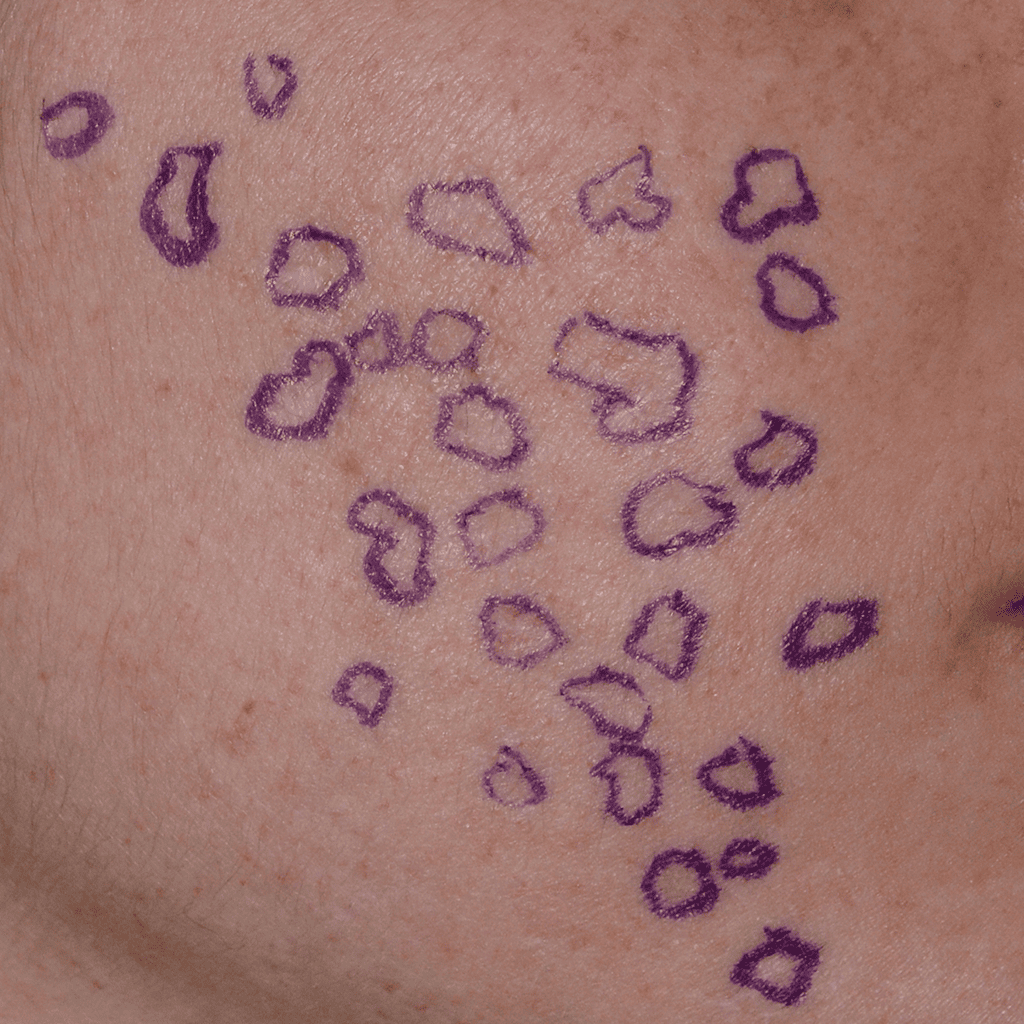
Subcision is especially useful in rolling scars, although they can provide benefits in other types as long as they have underlying fibrosis (its presence can be detected by palpation). It is normal for your dermatólog@ to ask you to smile or make gestures with the facial muscles to assess the presence of fibrosis under the scars. Once the fibrosis has been located, it is advisable to mark the areas to be treated with subcision by making the “map” of the rolling scars.
What are the adverse effects of subcision?
It is generally a simple and extremely safe technique. Occasionally, if there are many fibrous tracts that have ruptured, a mildly painful hematoma may appear under the scars, which will resolve in a few days. It should be remembered that the formation of this hematoma is still positive to promote the recovery of the volume lost with atrophy and due to the contribution of growth factors that it entails. The formation of the hematoma can be reduced if pressure and ice are applied after the subcision has been performed. Also, for 2-3 days it is possible to observe a slight swelling (edema) in the treated area.
Caution must be exercised and avoid using subcision in the mandibular area, the temporal area and the preauricular area, since the needle could inadvertently damage a nerve fiber or a blood vessel. It is recommended that the procedure be performed by dermatólog@s with experience in it.
During the intervention, and up to 48 hours after it, it is normal – especially if tumescent anesthesia has been used – that the muscles innervated by the facial nerve are numb or paralyzed.
Is the benefit obtained by the subdivision temporary or permanent?
In general, it is permanent: the ruptured fibrous tracts do not re-form, nor does the procedure have to be repeated periodically due to loss of improvement, especially if it is combined with other techniques such as fractional CO2 laser or filling.
Is it necessary to combine subcision with other treatments for acne marks?
It will depend on the type of lesions and their extent, but in general terms it is rare for acne scars to be treated with a single technique, even if it is rolling. Subcision is usually combined with fractional CO2 laser, although it is possible to add other techniques such as bipolar fractional radiofrequency of needles or filling with hyaluronic acid or other substances.

Click here to find out what types of acne scars are there.

Click here to learn more about treating acne scars with hyaluronic acid.

Click here to learn more about acne scar treatment with ablative laser.

Click here to learn more about chemical peels on acne.
REFERENCES
- Vempati A et al. Subcision for Atrophic Acne Scarring: A Comprehensive Review of Surgical Instruments and Combinatorial Treatments. Clin Cosmet Investigaig Dermatol. 2023 Jan 18;16:125-134.
- Lobo Y, Lim DS. Surgical Subcision for Acne Scars: A Review of Instrumentation. Dermatol Surg. 2023 Apr 1; 49(4):355-362.
- Ahramiyanpour N, Rastaghi F, Parvar SY, Sisakht AK, Hosseini SA, Amani M. Subcision in acne scarring: A review of clinical trials. J Cosmet Dermatol. 2022 Oct 31.
- Dadkhahfar S, Robati RM, Gheisari M, Moravvej H. Subcision: Indications, adverse reactions, and pearls. J Cosmet Dermatol. 2020 May; 19(5):1029-1038.

