
What is resurfacing?
Resurfacing is the formation of new skin after removing the old one by using a laser. This renewal allows all the signs of skin aging to disappear or improve: brown and red spots (lentigines, telangiectasias), wrinkles, sagging and sagging, replacing them with new skin. The formation of a new layer of skin allows a large amount of new collagen to be manufactured and tighten the skin in a more than noticeable way (lifting effect or skin tightening).
Although the vast majority of the use of resurfacing is aesthetic, it also has a medical indication, since the formation of a new skin also allows the elimination of accumulated sun damage and premalignant skin lesions (actinic keratosis). Therefore, it also has a very effective therapeutic action, especially when there are large affected areas (scalp, face or décolleté).
What effects does resurfacing have on the skin?
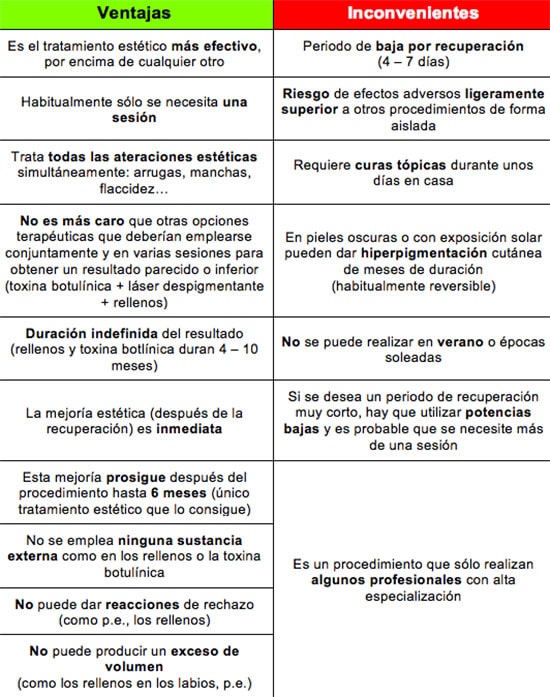
Ablative fractional laser resurfacing is, to date, the anti-aging treatment that achieves the best aesthetic results and with which all the others are compared (it is the “gold standard“). The renewal of the skin obtained with resurfacing causes a very significant decrease in lentigines (sun spots), telangiectasias (capillaries), wrinkles (forehead, between the eyebrows, crow’s feet, eyelids, barcode), sagging (face, neck, double chin), pore size and skin shine . There is no aesthetic treatment as effective or complete as resurfacing, since it treats all the signs of aging and not just some in isolation (as do for example botulinum toxin, which only improves wrinkles; fillers, which only improve furrows and static wrinkles). It is also the most efficient: with a single session you get more results than with any other aesthetic treatment. The aesthetic effects begin to be perceived a week after the treatment (once the scabs of the erosions have come off), increasing the improvement for a period of up to six months. The effects achieved are permanent.
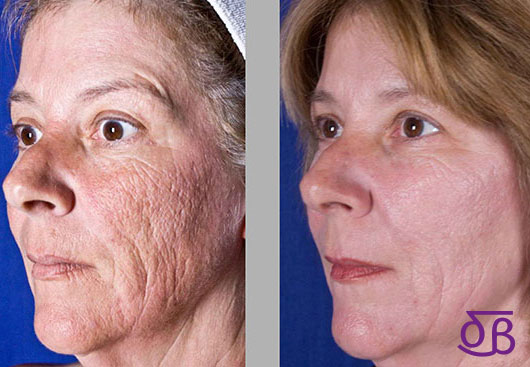
How is ablative fractional resurfacing performed?
It is an outpatient procedure, which does not require admission or performance in an operating room. The two days before the treatment and up to two days after it, it is recommended to take an oral antiviral if there is a history of having suffered from herpes simplex (this is also necessary in the case of using fillers). One hour before proceeding with the resurfacing, an anaesthetic cream is applied in the doctor’s office that will remain on the skin for one hour. The anaesthetic cream is then removed, the skin is cleaned with an antiseptic solution and the laser is applied. The laser head is moved over the skin to be treated and is fired sequentially in areas of a maximum of 2 square cm. As if it were a mosaic of tiles, these areas are treated continuously. The rhythm of the procedure is fully adjustable. If the entire face is treated, the resurfacing lasts about 15 minutes, and is annoying only in some areas (barcode and area closest to the eyelids): on the rest of the face, the discomfort is discreet. Although it is not necessary, if the patient wishes, local anesthesia can be administered in the most sensitive areas, or even sedation can be used for particularly apprehensive people. Immediately at the end of the treatment, a burning/stinging sensation is perceived, similar to that of a sunburn in summer. At this time , cold wet compresses are applied for a few minutes to relieve and then a re-epithelializing cream. In the case of treating limited areas (barcode or crow’s feet), the treatment lasts barely 5 minutes.
What happens after resurfacing?
All the treated skin is replaced. The procedure is exactly the same (but controlled) as when a drop of hot oil falls on us: redness, erosions, exudate, swelling and, later, scabs are observed. This process is necessary to produce an improvement. Usually, on the first day after the procedure, swelling and redness are more noticeable.
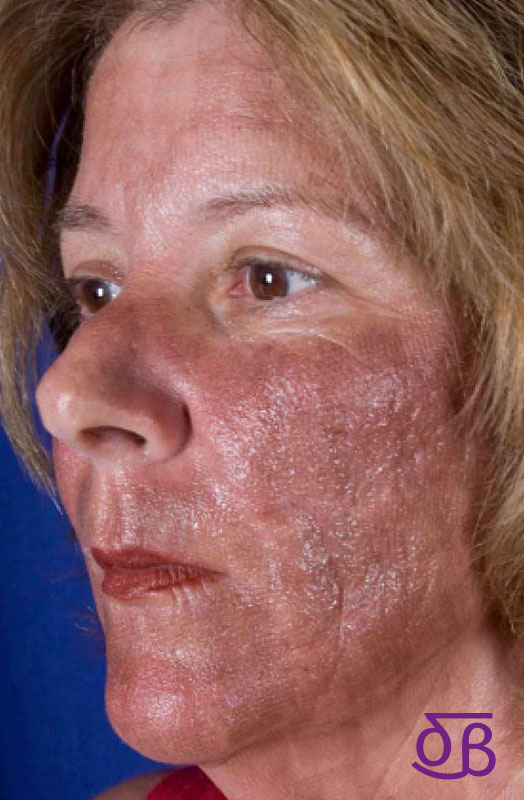
On the second day, scabs begin to form, which will be detached over 5 – 14 days depending on the power used in the treatment and the regenerative capacity of the patient’s skin. During these first days , the face should be cleansed with soap and water three times a day and a specific cream should be used so that healing is faster and safer. It is recommended to take leave for a period of 3 – 4 days so that the most intense epithelialisation phase (which is bulky) can be carried out at home.
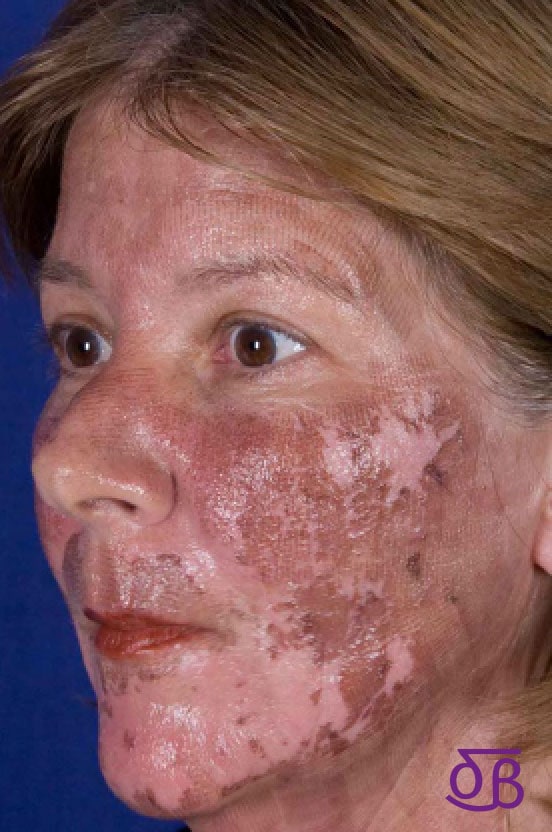
In general, on the fifth or sixth day you can lead a normal life and use makeup. It is absolutely necessary to use SPF 50 sunscreen when going outside.
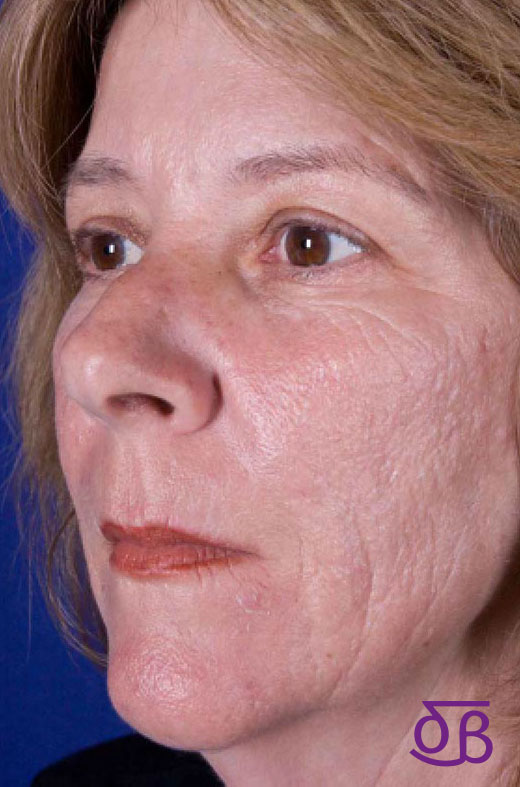
This recovery period can be reduced, if the patient wishes, using low powers. In this way, in 3 – 4 days you can lead a normal life but the effect achieved is less and it is likely that in the coming months you will want to do a new session.
How many fractional resurfacing sessions are necessary?
In general, with a single session at intermediate power, excellent results are achieved. However, it will depend on the intensity of the laser parameters we use. The more energy used, the more positive effect is obtained, although the duration of the epithelialization phase (crusts and exudate) also increases.
What are the adverse effects that can occur after ablative fractional resurfacing ?
Although ablative fractional resurfacing is a safe procedure, some unwanted effects may occur in some cases: prolonged redness for weeks (transient), hyperpigmentation (less than 1% in fair skin), hypopigmentation (exceptional), and secondary scarring (exceptional at moderate strength and on the face).
Adverse effects are more frequent when treating the neck and décolleté area and in patients with dark skin (phototypes IV or higher), so caution is recommended in these cases.
What are the advantages and disadvantages of ablative fractional laser resurfacing ?
What is the best indication for performing ablative fractional resurfacing ?
The best answers are obtained the “worse” the skin is. Aged skin of women who have brown and red spots and extensive wrinkles (deep or not) are the optimal indication for resurfacing. If the defects are minimal, or limited to one area, another therapeutic option is usually recommended, even if it is temporary. Another application of resurfacing with excellent results is “barcoding” (longitudinal wrinkles in the mustache area and around the mouth) and “crow’s feet” (transverse wrinkles on the outer corner of the eye).
In conclusion, ablative fractional resurfacing is the aesthetic treatment with the best results, with an optimal benefit/cost ratio, high performance (response obtained per session) and with an immediate effect after the epithelialization phase. However, the patient must be willing to spend a few days off work (3 – 7, depending on the power used and the healing) in which he will have to perform topical treatment three times a day.
REFERENCES
· Tierney EP, Hanke CW, Petersen J. Ablative fractionated CO2 laser treatment of photoaging: a clinical and histologic study. Dermatol Surg. 2012 Nov; 38(11):1777-89.
· Tierney EP, Hanke CW. Fractionated carbon dioxide laser treatment of photoaging: prospective study in 45 patients and review of the literature. Dermatol Surg. 2011 Sep; 37(9):1279-90.

