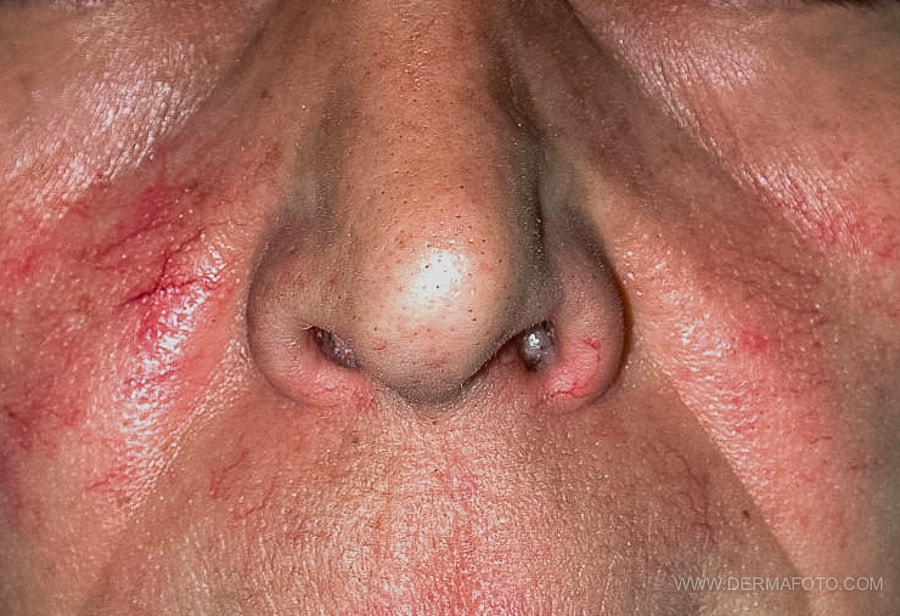
What are they?
Telangiectasias, spider veins, and varicose veins are dilations of the superficial vessels of the skin, which manifest externally as small capillaries of red/purplish coloration, with a fine linear arrangement (telangiectasias), thick and tortuous (varicules), and arboriform or arachniform (spider veins). Spider veins are also called spider veins or spider angiomas.
Why do they appear?
This type of vascular lesions appear as a normal sign of skin aging , as a result of sun damage accumulated since childhood or as a manifestation of circulatory disorders (the latter is more common in the case of varicules of the lower limbs).
Rarely, very numerous spider veins can be the result of liver disease, thyroid disease or high estrogen levels (e.g., pregnancy or taking contraceptives).
Likewise, both telangiectasias and spider veins can exceptionally be part of complex syndromes whose manifestations include these lesions (familial hemorrhagic telangiectasia, vascular malformations, unilateral nevoid telangiectasia…).
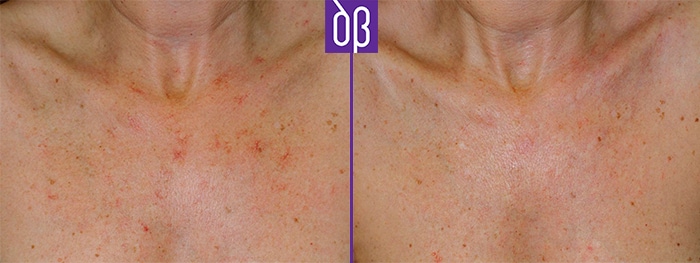
Where do they appear?
Spider veins are typical of areas exposed to the sun in adults (mainly face and chest); in children they are not rare on the hands, fingers and around the nose and eyes.
Telangiectasias are common on the cheeks (couperose), chin and décolleté, and often accompany other signs of skin ageing (e.g. solar lentigines) or the presence of pustules – pimples of pus – (in rosacea).
Varicules are typical of the lower limbs and are more common in women.
How are they deleted?
It should be said that it is not strictly necessary to treat them, since they only pose an aesthetic problem in the vast majority of cases. If you want to remove them, there are different options:
· Electrocoagulation. After the application of local anesthesia, small vascular lesions can be charred by the electrocoagulator. The results are usually good, although as it is a device that cauterizes what its tip comes into contact with, there is a greater risk of scarring than with other methods. Without local anesthesia it is very painful.
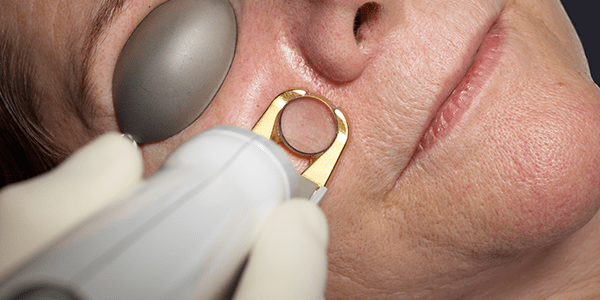
· Light sources. Vascular lesions can be treated with different light sources, such as lasers or intense pulsed light. Among the lasers that are most commonly used for this purpose are pulsed dye, 1064nm neodymium:YAG (both for flat and slightly raised lesions) and CO2 (protruding lesions). Intense pulsed light is also an excellent option for most cases, and has the advantage that it allows pigmented lesions and skin aging to be treated simultaneously.
Both laser and pulsed light have advantages over electrocoagulation such as a lower probability of scarring, crusting and that they do not require local anesthesia.
CLINICAL BEFORE-AFTER SAMPLES
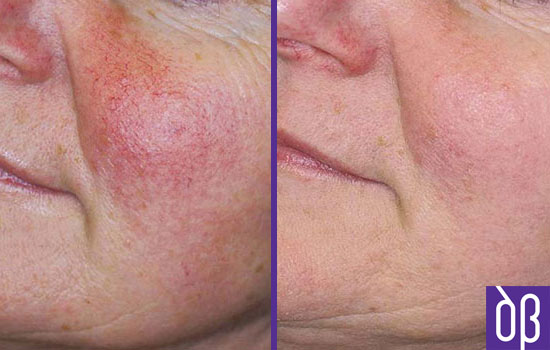
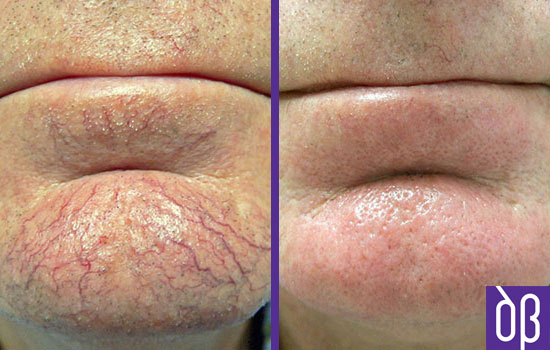
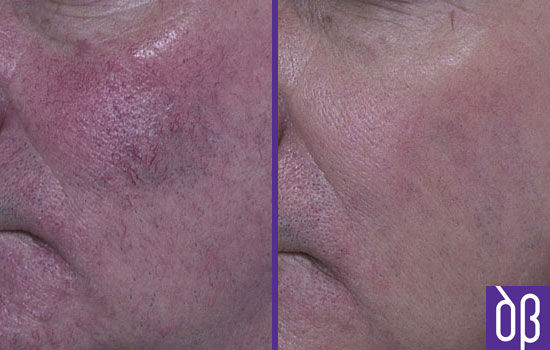
LASER TREATMENT OF TELANGIECTASIAS, VARICULE VEINS AND SPIDER VEINS
→ They are benign lesions typical of the passage of time reflected in the skin.
→ They are nothing more than an aesthetic problem in the vast majority of cases.
→ Although there are other methods of removal, both laser and intense pulsed light offer advantages: they do not require local anesthesia, and the risk of scarring or scab formation is minimal.
→ Intense pulsed light, in addition to treating vascular lesions, allows other signs of skin aging , such as sun spots and atrophy, to be improved simultaneously.
REFERENCES
· Tanghetti, EA. Split-face, randomized treatment of facial, telangiectasia, comparing pulsed dye, laser and an intense pulsed light handpiece. Lasers, Surg Med., 2012, Feb; 44(2):97-102.
· Srinivas CR, Kumaresan M. Lasers for vascular lesions: standard guidelines of care. Indian J Dermatol Venereol Leprol. 2011 May-Jun; 77(3):349-68.
Click here for more information on couperose and facial capillaries.