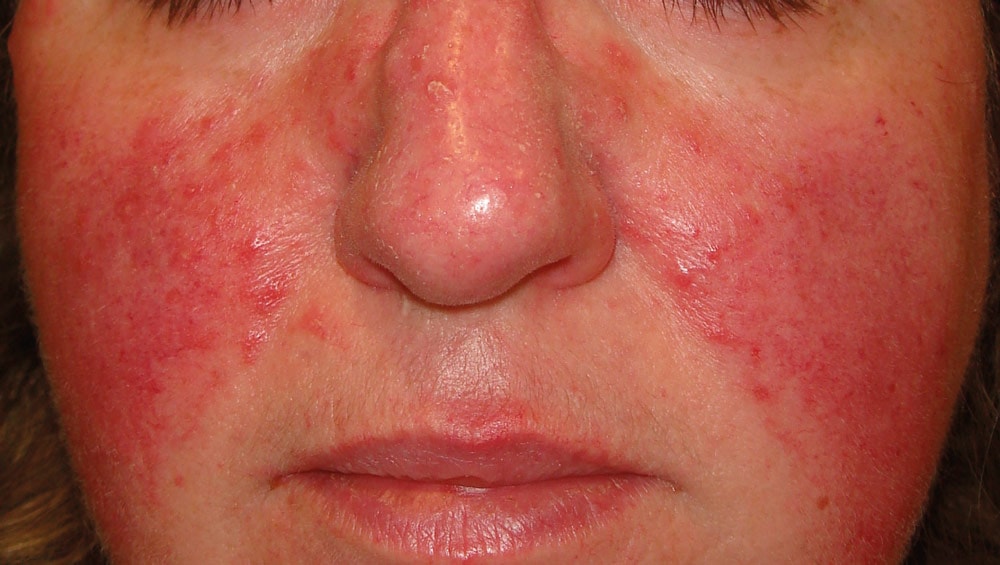
What is rosacea?
It is a chronic skin disorder that is manifested by a tendency to constant flushing or flushing, the appearance of telangiectasias (capillaries) and later the formation of pustules and papules (“pimples”). It usually settles in the central area of the face (cheeks, nose forehead and chin), although it is possible to find lesions on the décolleté and upper back. It is a disorder of unknown origin.
Why does it appear?
The exact cause of its appearance is unknown, although several etiological factors have been implicated, the combination of which probably explains its origin: chronic sun exposure, genetic predisposition, skin superinfection by a commensal bacterium -Demodex folliculorum-, alteration of the contractile response mechanisms of the skin capillaries…
Who can get this skin disorder?
This pathology is a very common disorder in the general population (it is estimated that in Europe it affects up to 10% of people), although it is characteristic of women of 30-50 years of age and with fair skin. On the other hand, in men there are usually more intense forms.
Is it a serious disorder?
It usually involves only an aesthetic alteration and occasionally causes local discomfort. Although it does not endanger the person’s health, up to 70% of people who suffer from it report a decrease in their self-esteem and greater difficulty in their professional relationships.
How does it manifest itself?
The most characteristic sign is erythema or redness that persists for more than 3 months. It is usually located on the cheeks, is constant and can be temporarily aggravated with episodes of flushing and a feeling of suffocation. This erythema usually coexists with telangiectasias (dilated capillaries), papules and pustules (“pimples”). These lesions are usually located in the central area of the face: nose, chin, cheeks and forehead. Characteristically, comedones or pimples do not appear in rosacea, as these are characteristic of acne. It is not uncommon for signs of eczema, such as flaking and pruritus, to coexist with an excess of sensitivity to the application of topical preparations (moisturizers, sunscreens, toners). It is also possible that it affects the conjunctiva of the eyes and associated blepharitis and/or conjunctivitis occurs. Other rarer signs are persistent oedema (Morbihan’s disease) or the appearance of rhinophyma (indurated thickening of the skin of the nose with accentuation of its follicles), which are currently rare and usually affect men.
What is its relationship with food?
No study has been able to link the intake of any food with the appearance of this skin disorder. However, all dietary stimuli that cause vasodilation (heat, alcohol, spicy foods) can momentarily worsen the symptoms, especially flushing.
What is the relationship between this skin disorder and the stomach or digestive diseases?
In some studies, its presence has been related to a higher prevalence of chronic gastric infection by Helicobacter Pylori, gastritis, achlorhydria and improvement of the skin condition after the eradication of Helicobacter from the digestive tract; although other publications do not find any relationship. At present, it is not common to determine whether the patient with this cutaneous pathology has gastrointestinal colonization by Helicobacter Pylori, since this causal relationship has not been reliably confirmed and its treatment does not guarantee the improvement of rosacea.
How is it treated?
The simplest measure is skin care: use mild topical preparations, SPF 50 photoprotection and avoid peels and aggressive cleaning products. It should be remembered that all vasodilatory stimuli can worsen the condition: heat, hot baths and consumption of alcohol or spicy foods.
The medical treatment of rosacea involves the use of antibiotics and topical anti-inflammatories (metronidazole, azelaic acid, clindamycin, calcineurin inhibitors) and the avoidance of corticosteroids: although these have an excellent anti-inflammatory effect, they cause a rebound effect when suspended, with a sudden worsening. They also promote skin atrophy and the appearance of telangiectasias, which increase the clinical symptoms of the disease. Antibiotics such as tetracyclines can be administered orally, which are very effective in the most inflammatory rosacea with eye involvement. In particularly stubborn cases of skin efactation, oral isotretinoin, a derivative of vitamin A with high efficacy, can be administered.
Laser treatment reduces the vascular component of the disease, reducing or eliminating telangiectasias and preventing the condition from evolving more rapidly. The aesthetic improvement after the removal of the vascular component of rosacea is very remarkable. Among the most commonly used devices are intense pulsed light and pulsed dye laser.
How can you prevent a worsening?
The most important and simple measure is sun protection, since ultraviolet radiation damages the dermis, where the skin capillaries are located. The loss of support of the capillaries is one of the main causes for it to appear. The elimination of telangiectasias with laser allows the rate of progression of rosacea to be slowed down and its aesthetic appearance to be improved significantly.

For more information on laser capillary removal, click here.
REFERENCES
Barco D, Alomar A. Rosacea. Actas Dermosifiliogr. 2008 May; 99(4):244-56.