
Why use lasers instead of punctures (sclerosis) in the treatment of fine varicose veins and telangiectasias of the legs?
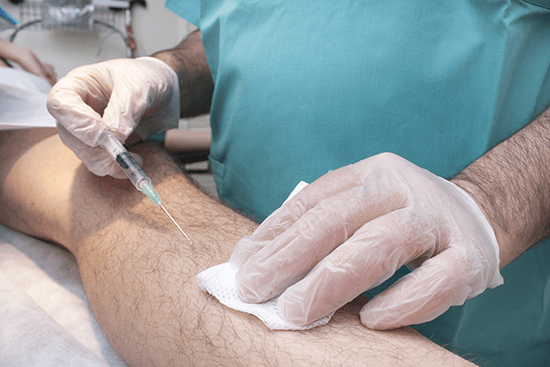
Sclerosis consists of the puncture and injection of an occlusive substance into the blood vessels to be treated, a surgical technique approved for the treatment of spider veins of the legs and which usually offers excellent results in selected patients. However, some patients do not tolerate the procedure as they have a phobia of needle treatments. Sclerotherapy has also been associated with a relatively common complication: matting. Matting consists of the appearance of a network of very fine capillaries in the treated area. This complication is more common with sclerotherapy than with laser treatment.
How does the Nd:YAG laser work in the treatment of spider veins and fine varicose veins?
The neodymium laser emits light energy with a wavelength of 1,064 nm, which is selectively absorbed by the hemoglobin that circulates in the blood inside the blood vessels. Once the hemoglobin absorbs this heat, the wall of that vessel closes due to thermal effect.
The Nd:YAG laser is useful for treating varicules up to 4 mm in diameter in the lower extremities. These vessels are usually deeper and bluish in colour.
KTP’s laser, which has a similar technical basis but with a wavelength of 532 nm, is more useful for treating superficial spider veins less than 1 millimeter in diameter – more information here. These vessels are usually more reddish.
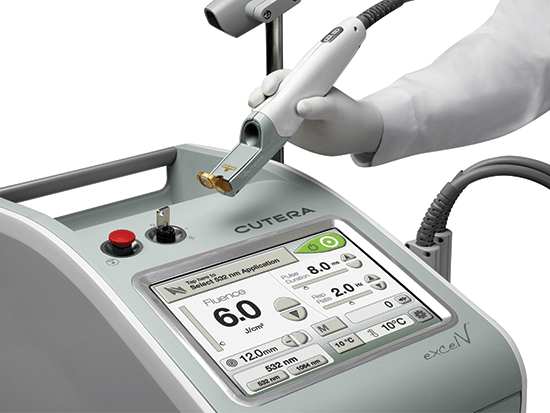
Certain laser devices also have an additional advantage. Both the KTP and Nd:YAG lasers on the platform have a 5ºC cooled head that contacts the skin, so the discomfort caused by the treatment is limited. Using TruPulse™ technology, the Excel V™ device is the only neodymium laser capable of emitting a single pulse with constant energy release along the pulse.
How effective is the neodymium laser for treating leg veins?
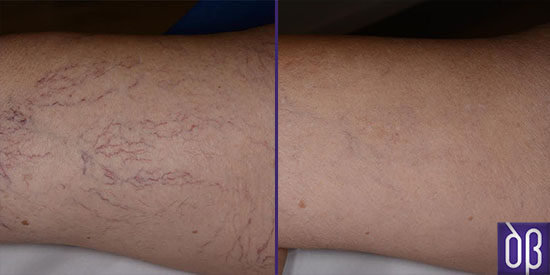
According to the study by Trelles et al., performed on women between 24 and 58 years of age with varicules in the legs up to 4 mm in diameter and through a total of between one and three laser sessions separated from each other by 6 weeks, the result was an attenuation of the vessels of between 50-100% in 82.5% of the patients one year after treatment. The patients had not previously undergone any treatment and both the saphenous veins and the collateral vessels were competent, without having perforating or reticular vessels confirmed by Doppler ultrasound.
What side effects can occur in the treatment of fine varicose veins and spider veins of the legs with neodymium laser?
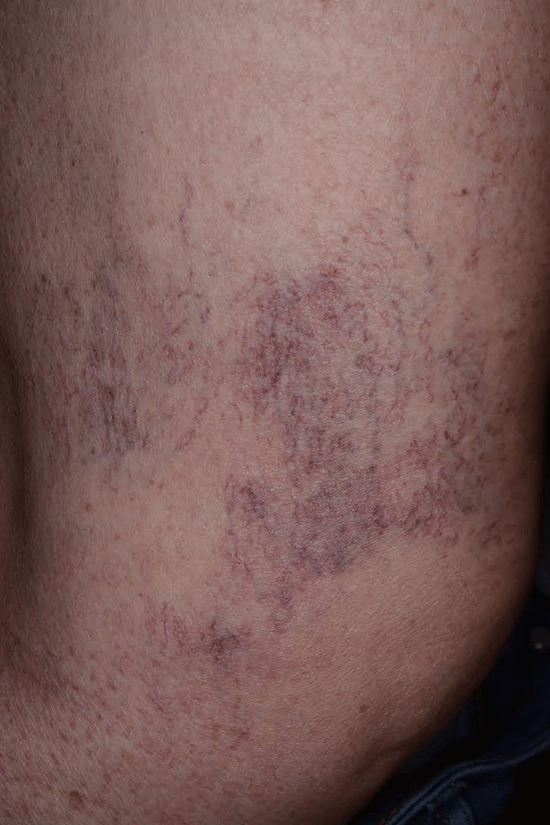
According to the data from the Trelles study, the percentage of matting was only 10%, and of residual hyperpigmentation 12.5%. Practically all adverse effects occurred in patients with Fitzpatrick’s phototype IV (brown skin coloration, always tanning easily and with minimal solar erythema). After one year of treatment, all cases of hyperpigmentation had resolved.
Are there any comparative studies between sclerosis and neodymium laser treatment for fine varicose veins and spider veins of the legs? What are the results?
In the study by Munia et al., the clinical efficacy between the two treatment systems is similar. Treatment with sclerotherapy appears to be slightly less painful but is more likely to cause matting and is less useful for small diameter spider veins. Neodymium laser treatment also seems more appropriate forpatients with a phobia of needles and allergic to compounds of the sclerosing substance.
Are there any comparative studies between KTP laser and neodymium laser for the treatment of spider veins of the legs?
Özden and colleagues compared the clinical outcome of treating telangiectasias in the legs using KTP and neodymium lasers. They concluded that, for bluish, deep, or larger vessels than 1 mm in diameter, the neodymium laser is more effective than the KTP laser. Conversely, for redder spider veins (more oxygenated blood), smaller than 1 mm in diameter, and more superficial, the KTP laser is more appropriate than the Nd:YAG laser.
CONCLUSIONS
- The 1,064 nm Nd:YAG laser is a safe and effective method for the treatment of fine varicose veins and varicose veins of the legs, especially for those with a diameter of between 1 and 4 mm, deep and bluish.
- Comparative studies with sclerosis (puncture) show similar results between the two systems, although sclerosis is less appropriate for patients with needle phobia and is associated with a higher probability of matting (appearance of small capillaries in the treated area).
- Residual purple is less frequent and intense than with pulsed dye laser.
- For blood vessels that are more superficial, reddish, or with a diameter of less than 1 mm, it is more appropriate to use the KTP laser. More information here.
- In the same session it is possible to treat the most superficial and fine vessels with KTP laser and the thicker and deeper vessels with Nd:YAG laser.
- Regardless of the treatment system for spider veins, telangiectasias and leg varicules, the final clinical result should be evaluated ONE YEAR after the end of treatment, since the improvement is progressive.
REFERENCES
· Trelles MA, Allones I, Martín-Vázquez MJ, Trelles O, Vélez M, Mordon S. Long pulse Nd:YAG laser for treatment of leg veins in 40 patients with assessments at 6 and 12 months. Lasers Surg Med. 2004; 35(1):68-76.
· Munia MA, Wolosker N, Munia CG, Chao WS, Puech-Leão P. Comparison of laser versus sclerotherapy in the treatment of lower extremity telangiectases: a prospective study. Dermatol Surg. 2012 Apr; 38(4):635-9.
· Ozden MG, Bahçivan M, Aydin F, Şentürk N, Bek Y, Cantürk T, Turanli AY. Clinical comparison of potassium-titanyl-phosphate (KTP) versus neodymium:YAG (Nd:YAG) laser treatment for lower extremity telangiectases. J Dermatolog Treat. 2011 Jun; 22(3):162-6.