Treatment of perioral dermatitis
What is perioral dermatitis?
Perioral dermatitis is an inflammatory and chronic skin disorder characterized by the appearance of erythematous papules (red elevations), pustules and vesicles in the areas near the mouth. In 90% of cases it appears in women between 20 and 45 years of age and its cause is unknown.
Why does perioral dermatitis appear?
Although the disorder is of unknown origin, it is known that there are different factors involved in its appearance. It can often be associated with the occasional use of corticosteroid, cosmetic and/or toothpaste creams or inhalers. There is also a certain relationship with external factors such as ultraviolet radiation, heat, wind, emotional stress, taking contraceptives or superinfection by a microorganism (spindle bacteria, Demodex folliculorum, Candida sp.). None of these factors is usually the only cause, but it is the sum of some of them that produces the appearance of perioral dermatitis.
What does it consist of?
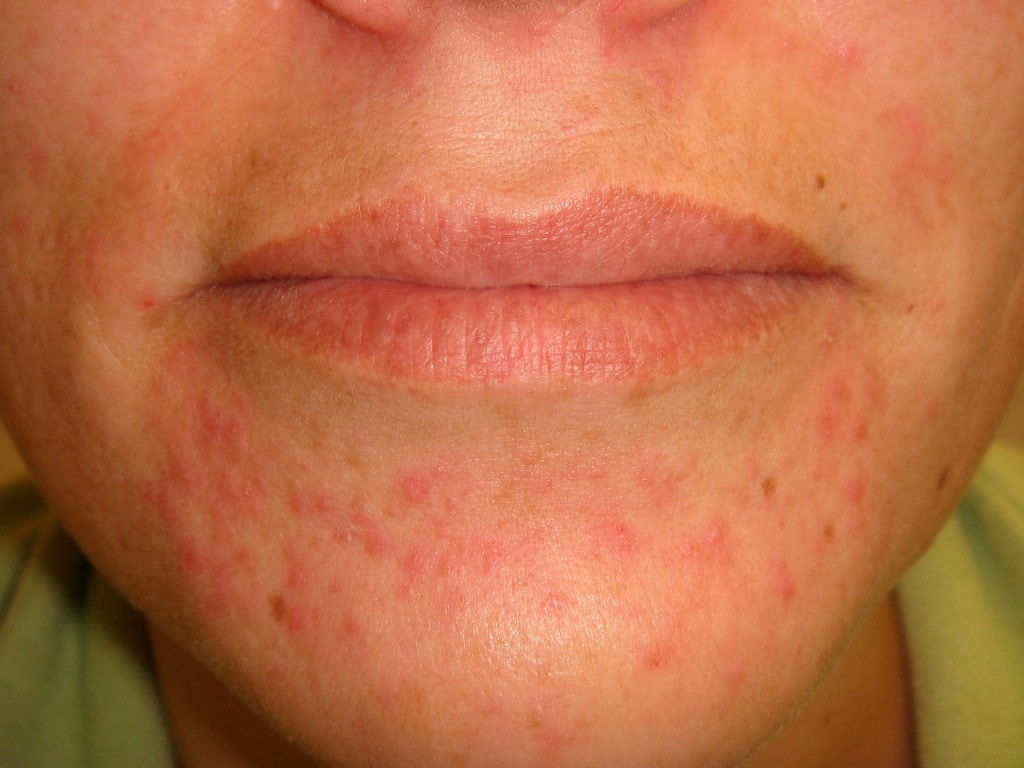
The characteristic lesions are located around the mouth, and may reach the nasolabial folds and lower eyelids. Papules appear on an erythematous base (“small red pimples”), pustules and vesicles that usually converge in small groups. There are some cases (granulomatous variant) characterized by yellowish papules. Its course is usually chronic, with periods of inflammatory flare-ups and others of less clinical activity.
A proper clinical feature is the appearance of a border of healthy skin between the lips and the lesions.
How is perioral dermatitis diagnosed?
In the vast majority of cases, the diagnosis is visual through the examination of an experienced dermatologist. It should be borne in mind that in perioral dermatitis there are no comedones, a clinical sign of great diagnostic value. Only rarely will a diagnostic test be performed to support the clinical hypothesis, such as a culture of the pustules or a skin biopsy. A blood test is of no interest, as there is no haematological alteration in perioral dermatitis.
What complications can perioral dermatitis have?
It is an exclusively cutaneous disease with no systemic repercussions and can only exceptionally cause scarring. However, it can have a significant psychological impact on the patient, especially if it is resistant to treatment.
How is perioral dermatitis treated?
First of all, external causal factors must be ruled out, which should be avoided (mainly the use of corticosteroids and cosmetics). It is recommended that all patients eliminate all cosmetics and use only water for facial hygiene, without the application of any additional product (moisturising creams, toners, soaps, gels, etc.). The lesions take weeks to disappear even if the treatment is adequate. Rebound phenomena can be treated with corticosteroids of very low potency and always under the prescription and control of a dermatologist.
Occasionally, oral antibiotics (macrolides or tetracyclines) or topical antibiotics (metronidazole, macrolides or tetracyclines) are used; topical anti-inflammatories (calcineurin inhibitors) or even oral isotretinoin in stubborn cases. Very exceptionally, light-based therapeutic systems (photodynamic therapy and/or laser) can be used, although they will never be a first option.
Is perioral dermatitis a type of acne?
No. Acne is an inflammatory disorder of the pilosebaceous unit in which there is a blockage of its opening to the outside (comedo or pimple) as the main cause. In perioral dermatitis there are no comedones, so they are two clearly differentiated diseases that usually respond to different treatments. The diagnosis will be provided by an experienced dermatologist through clinical observation of the skin lesions. Interestingly, both disorders may respond to common treatments (tetracyclines, isotretinoin).
What is the relationship between perioral dermatitis and rosacea?
Clinically, they are similar disorders, although rosacea usually has a more marked vascular component (telangiectasias and flushing) and tends to settle in the malar region. However, it has been observed that both disorders can coexist and that their origin and treatment are sometimes the same. Clinically, the distinction is of interest in patients in whom one of the two diseases can be related to a specific origin (e.g., use of fluoride toothpastes in the case of perioral dermatitis) in order to avoid the triggering factor.
REFERENCES
Lipozenčić J, Hadžavdić SL. Perioral dermatitis. Clin Dermatol. 2014 Jan Feb; 32(1):125-30.