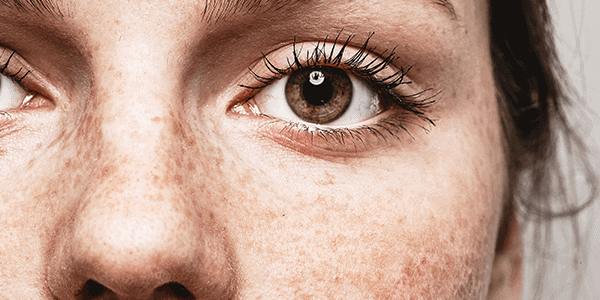
Treatment of sun spots and redness
What is photoaging of the skin?
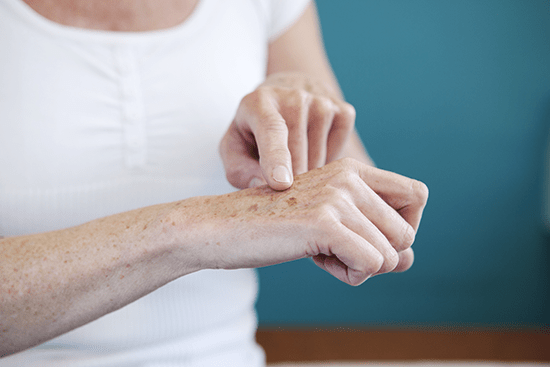
It is characterised by the appearance of changes in texture (wrinkles, sagging, increase in pore size) and colour (brown spots (lentigines), red spots (telangiectasias). Changes in colour are usually early and aesthetically poorly tolerated signs (‘age spots’).
How are age spots treated?
Lentigines contain melanin – a pigment that gives skin its colour – and telangiectasias, being blood vessels, contain haemoglobin. Both melanin and haemoglobin are targets where some medical lighting devices have an impact: pulsed light, alexandrite laser, pulsed dye laser, KTP laser, etc. Lasers are more specific systems and, in general, either treat brown spots (e.g., alexandrite laser) or red spots (e.g., pulsed dye laser). Until now, only pulsed light (which is not actually a laser) was the only light system capable of simultaneously treating brown and red spots while respecting the epidermis, as its wavelength is wide and allows it to impact different targets at the same time. However, the KTP laser also allows, with its wavelength of 532nm, to affect both melanin and hemoglobin.
Which system is more effective for treating age spots, pulsed light or KTP laser?
There are different comparative studies between the two devices, although the most remarkable is that of Butler et al., in which the treatment was performed in 17 patients. Pulsed light was applied to one half of the face and, to the other half, KTP laser. The response to a single session one month after the treatment was evaluated.
For vascular lesions (telangiectasias, spider veins, couperose), the improvement one month after a session was 38% with IPL and 42% with KTP laser. For pigmented lesions (solar lentigines), the degree of improvement with IPL was 35% and with KTP 30%. The differences obtained were not statistically significant.
The mean duration of treatment was 10 minutes for IPL and 8.7 minutes for KTP laser. The discomfort was similar with both devices. The formation of scabs or black stippling (lasting up to one month) was clearly higher in the area treated with IPL compared to the area treated with KTP.
As for the adverse effects, the authors of the aforementioned study comment on several advantages of the KTP laser. Firstly, the KTP laser head is transparent (sapphire crystal) and allows you to see the immediate response of the pigment and the vessels to the light shot, so it is easier to see if it is effective and how safe it is. The size of the trigger field (“spot”) can be graduated during the procedure with the KTP laser, while the IPL head is fixed: the variation in size allows greater precision to treat delicate structures and increase the degree of safety of the act. Finally, the KTP laser has less risk of causing accidental hair removal than pulsed light. However, Butler says that the KTP laser is slightly more painful during the procedure and that, because it is more effective on the capillaries, it causes a slight swelling that is higher than IPL.
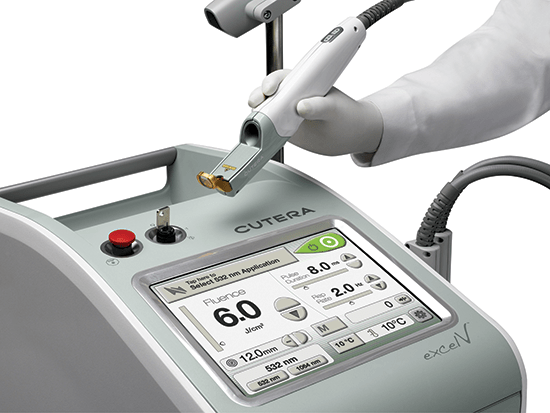
In conclusion, it seems that both KTP and IPL lasers are excellent options for treating skin aging in the form of blemishes. Both systems can be combined simultaneously in expert hands and benefit from the positive effects of both in the same session.
REFERENCES
· Butler EG 2nd, McClellan SD, Ross EV. Split treatment of photodamaged skin with KTP 532 nm laser with 10 mm handpiece versus IPL: a cheek-to-cheek comparison. Lasers Surg Med. 2006 Feb; 38(2):124-8.