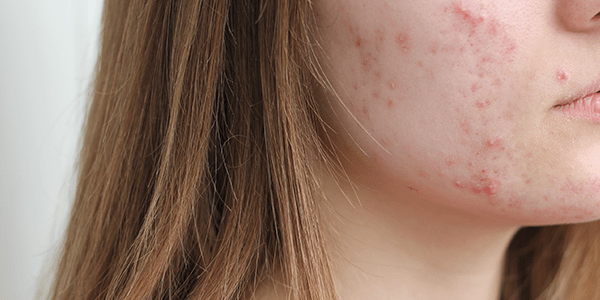
Treatment of Hormonal Acne in Women: When to Suspect It
When acne appears in adult women, it is often associated with a possible hormonal cause. Although, in principle, male hormones (androgens) are usually involved in one way or another in acne in young women, it is essential to rule out an abnormality in their levels when acne is accompanied by other signs characteristic of hyperandrogenism: the appearance of coarse, dark hair in certain areas (sideburns, chin, jawline, chest, around the navel, and/or back); severe facial seborrhea; diffuse hair loss in the central part of the scalp (androgenetic alopecia); or abnormalities of the external genitalia.
Although this principle is the standard one, based on experience, it is worth considering the possibility of hyperandrogenism when acne occurs in conjunction with certain circumstances:
1. Acne in adults. Acne that appears in children between the ages of 5 and 10 may be a sign of hyperandrogenism (e.g., congenital adrenal hyperplasia). Similarly, persistent acne or the onset of acne after age 20–25 in women may be a sign of hyperandrogenism (SAHA syndrome, polycystic ovary syndrome).
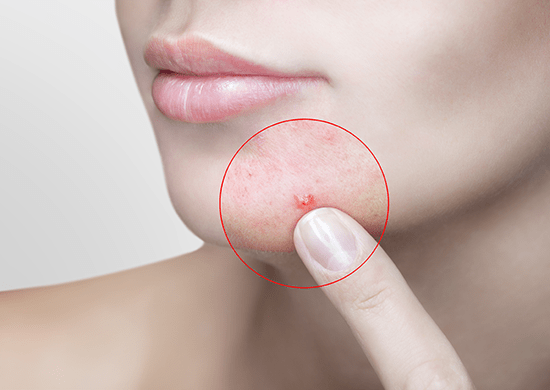
2. Primarily located in the lower third of the face. In this area, androgens have a particular effect on the pilosebaceous unit, which is why it is a common site for hirsutism and acne.
3. Irregularities in the menstrual cycle. It is not uncommon for certain hyperandrogenic syndromes to cause the menstrual cycle to lengthen to more than 30 days (e.g., in congenital adrenal hyperplasia); for the cycle to be irregular, or for menstruation to even fail to occur during certain cycles (anovulation associated with polycystic ovary syndrome).
4. Acne recurrence or the onset of acne when stopping or switching oral contraceptives. Certain contraceptives have an intrinsic antiandrogenic effect that can keep underlying hyperandrogenism asymptomatic. When a woman stops taking or switches contraceptives, both androgen levels and sensitivity to androgens may return to the pathological levels seen prior to anovulatory treatment, leading to the onset of symptoms of hyperandrogenism.
5. Acne relapse after completing a full course of isotretinoin. Isotretinoin is the most effective treatment for acne vulgaris. It can also prevent hormone-related acne from appearing while treatment is underway; however, once treatment is completed, because the underlying hormonal imbalance has not been addressed, the acne recurs. A recurrence of acne within months of finishing isotretinoin should lead the dermatologist to suspect that there may be underlying hyperandrogenism. Undoubtedly, if more than one course of isotretinoin has been completed and a relapse has occurred after each one, the likelihood of this diagnosis is even greater.
6. Insulin resistance. Hyperandrogenism tends to increase insulin resistance and contribute to overweight. Clinically, insulin resistance may manifest on the skin with the appearance of acanthosis nigricans and multiple skin tags in skin folds. Laboratory tests may reveal hyperinsulinemia, hyperglycemia, and elevated glycated hemoglobin levels.
When acne accompanies the symptoms described, it is recommended that the dermatologist consider whether to perform additional tests, such as a blood test during the follicular phase of the menstrual cycle and an ovarian ultrasound. With these two simple tests, it is possible to confirm whether there is an excess of androgens and whether the structure of the ovaries accounts for these findings. The hormonal panel should include all the androgens implicated in the cause of acne.
In rarer cases, an abdominal ultrasound or CT scan may be needed to evaluate the ovaries and adrenal glands.
It is worth noting that “hormonal” acne does not necessarily mean that androgen levels are elevated. In fact, in SAHA syndrome—a type of functional hyperandrogenism—levels of these hormones are normal. In this case, it is a matter of qualitative hyperandrogenism (sensitivity to androgens) rather than quantitative hyperandrogenism (excess androgens). Therefore, a normal ovarian ultrasound and blood test results showing normal androgen levels do not rule out the possibility that androgens are involved in the cause of acne.
KEY POINTS
- In acne affecting young women (over the age of 20), androgens typically play a key role in its development.
- It is advisable to consider hyperandrogenism whenever a woman’s acne is accompanied by:
- Hirsutism, seborrhea, or androgenic alopecia.
- Mainly located in the lower third of the face and/or neck.
- Irregular menstrual cycles or anovulation.
- Relationship to stopping or switching oral contraceptives.
- Relapses after discontinuing isotretinoin.
- Signs of insulin resistance.
- A normal ovarian ultrasound and/or normal hormone test results do not rule out hyperandrogenism or polycystic ovary syndrome.
- It is possible to have functional or qualitative hyperandrogenism, to suffer from acne as a result, and to show no abnormalities in androgen levels during the follicular phase or on an ovarian ultrasound.
- Hormone-related acne usually responds to isotretinoin only while the patient is undergoing treatment; it commonly recurs within a few months of discontinuing the medication.