What is a picosecond laser and what is it for?
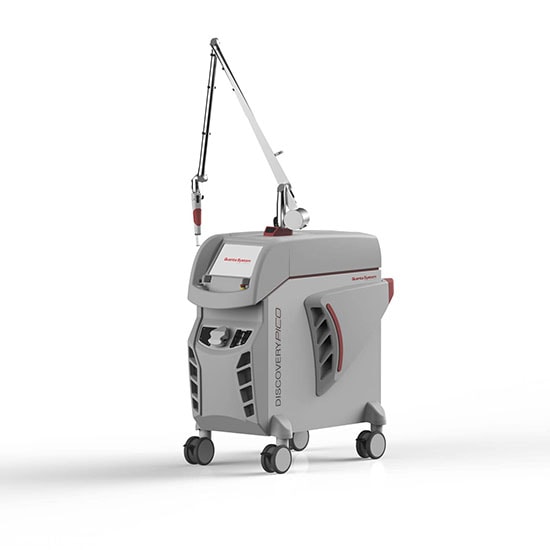
It is a laser device that emits pulses of light energy with a duration of 10-12 seconds. The main use of the picosecond laser is the treatment of pigmented lesions (lentigines, ephelides, melasma) and tattoos. However, by using picosecond lasers with a diffractive lens, it is possible to separate the energy into different beams and stimulate the manufacture and rearrangement of collagen in the dermis. It is precisely this effect that can be beneficial in improving collagen disorders such as hypertrophic scars and keloids.
What is the advantage of using a fractional picosecond laser to treat scars?
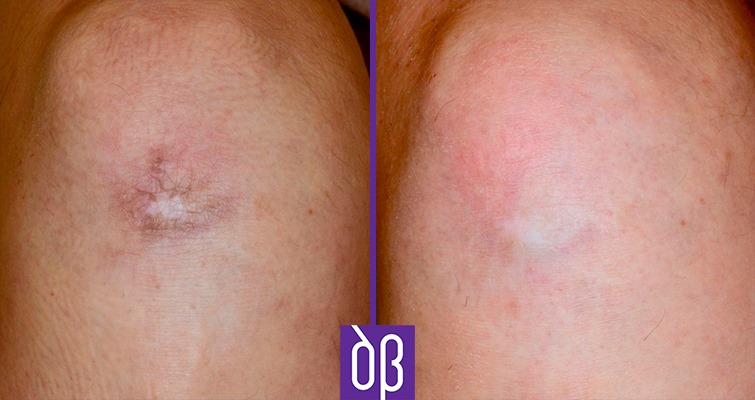
The main advantage of the fractional picosecond laser is that it allows the pigmentation (brown color) and the texture of the scar to be treated simultaneously. This characteristic makes it an ideal device for treating scars and/or dark skin. The particularities of the picolaser light beam allow the treatment to be carried out without anesthesia or only using anesthetic cream. It does not cause scabs in the treated area but produces the appearance of a red-violet pixelation lasting 1 – 4 days, not palpable and perfectly made up or camouflaged with the use of a tinted sunscreen. In this way, it is not necessary to take any leave of absence from work or social leave after the treatment of the scar with a fractional picosecond laser. This device can be combined in the same session with other techniques to improve scars, such as cryotherapy, intralesional infiltration of drugs, vascular laser, ablative and non-ablative fractionation.
In some scars with accidental tattoos (for example tar, sand or rubber residues), the picosecond laser is the treatment of choice, as it allows the presence of these external pigments in the skin to be removed or reduced.
What aspects of a scar does the picosecond laser enhance?
The picosecond laser improves most items on the Vancouver scale in a hypertrophic scar, which assesses the severity of a scar: hyperpigmentation, vascularization, elasticity and thickness of the scar. Interestingly, it is also capable of improving atrophic scars (loss of volume), which are usually the ones after acne.
So, is the best treatment for scars picosecond laser?
No. The best treatment for scars is personalized and must take into account the appearance of the scar (redness, pigmentation, volume) and its evolutionary stage (time since its appearance). All the published therapeutic proposals advocate combining different treatments simultaneously in the same session, so that each of them impacts the signs of that specific scar. For example, redness is treated with vascular lasers; excess volume can be mitigated with cryotherapy and/or intralesional infiltration of 5FU/corticosteroids… The picosecond fractional laser allows pigmentation and fine texture to be treated to a greater degree than other therapeutic options. For this reason, it can be another tool in the therapeutic arsenal for scars, especially those that settle on dark skin.
Is the fractional picosecond laser only useful in hypertrophic scars and keloids?
No. It is also capable of stimulating collagen synthesis in atrophic acne scars and improving their appearance. Its effectiveness has been published in different studies, especially in dark skin phototypes. It seems that the main advantage of this device over the fractionalCO2 laser is its high safety profile and that it does not cause crusting where it is applied. For this reason, it is a very valid option for aquell@s patients who wish to treat atrophic acne scars and cannot afford a social/work leave of approximately one week, as is the case with the fractionalCO2 laser. As we have mentioned, the picosecond laser causes pixelated redness lasting 2-4 days, which can be made up. The efficiency of the fractional picosecond laser is clearly lower than that ofCO2, so it requires a greater number of sessions than the latter.
Is the treatment of scars with fractional picosecond laser very painful?
It is annoying, but perfectly tolerable. The treatment can be performed without topical anesthesia or it can be applied in cream 20-30 minutes before the session if it is to treat, for example, an entire face.
What does the scar or face look like after fractional picosecond laser treatment?
It does not form crusts. It leaves a pixelated redness of 1-4 days duration, which has no volume. It can be managed very well with tinted sunscreen or makeup and does not impede social or work life.
References:
- Choi YJ, Kim JY, Nam JH, Lee GY, Kim WS. Clinical Outcome of 1064-nm Picosecond Neodymium-Doped Yttrium Aluminium Garnet Laser for the Treatment of Hypertrophic Scars. J Cosmet Laser Ther. 2019; 21(2):91-98.
- Kwon HH, Yang SH, Cho YJ, et al. Comparison of a 1064-nm neodymium-doped yttrium aluminum garnet picosecond laser using a diffractive optical element vs. a nonablative 1550-nm erbium-glass laser for the treatment of facial acne scarring in Asian patients: a 17-week prospective, randomized, split-face, controlled trial. J Eur Acad Dermatol Venereol. 2020; 10.1111/JDV.16643.